What Language Do Amish Speak? (3 Languages)
Amish speak a version of German known as Pennsylvania German, or Pennsylvania Dutch. It has some similarities with dialects of German spoken in Europe today. This is their first language.
Pennsylvania Dutch, as spoken by the Amish today, includes some English words. Accents, and manners of speaking Pennsylvania Dutch, can vary between Amish communities. Besides PA Dutch, most Amish people speak two other languages – English and High German.
- PA Dutch – the “Amish Language”
- Amish speak English too
- Amish learn 3 languages
- High German – Language of church
- Amish language FAQ
The “Amish Language”
Pennsylvania Dutch is generally not a written language. However, some attempts have been made to transcribe the language to a written form. Dictionaries have been compiled and some books written in the dialect. The language is a variety of German which also incorporates some English words – particularly for modern terms and innovations.

Additionally, the so-called “Swiss Amish”, primarily found in Indiana, speak a Swiss dialect which differs from that spoken by the majority of Amish. This can even cause difficulties in understanding between a Swiss-speaking Amishman and one from a PA Dutch language background.
Amish may refer to the Pennsylvania Dutch language in different ways. They may say that they speak “Dutch”, “Deitsch”, or even “speak Amish”. And though Pennsylvania Dutch is often referred to as the “Amish language”, in truth the Amish share it with others.

They include the Old Order Mennonites, and some non-Plain people (though that number has declined greatly). At one point in history, many non-Plain citizens of southeastern Pennsylvania spoke Pennsylvania Dutch. Over time the use of Pennsylvania Dutch dwindled among non-Plain population in favor of English.
Amish also speak English
When Amish write letters, they do so largely in English, with some occasional use of German possible. Amish use English when conversing with non-Amish individuals, and when doing business with outsiders.
It’s common that when a non-Amish person enters a conversation with Amish people, the Amish speakers will switch from Pennsylvania Dutch to English as a courtesy. As one observer noted:
My Amish friends always speak English when I’m in their presence. Some people in the community seem to have mastered the language while others obviously struggle. It seems to be directly related to how much contact they have with outsiders.
Whenever a visitor stops by and I’m there, they will always speak in English, even when they have very poor command of the language. I’ve always thought that was very kind and considerate. However, even the ones who seem to speak English perfectly will say that speaking PA Dutch is easier.
Old Order Mennonites speak Pennsylvania Dutch as well, and Amish and Old Order Mennonites will converse in the language. Amish tend to switch to English when non-Amish enter within earshot, out of respect and to involve the others.
English proficiency varies among Amish
As hinted at in the comment quoted above, just because Amish people speak English, it doesn’t mean they have the same command or comfort level with the language as non-Amish people do.
Besides distinctive accents when speaking English (in some communities in particular), this is evident in mispronunciations of common words (e.g. “favoright” for the word “favorite”) or by calques (aka loan translations) such as “it wondered me” for “I wondered”.
Though many Amish speak English without difficulty, for most Amish people it is still a second language. I once asked someone from a much “higher” Amish group whether dealing in English still “felt” like using a foreign language. She replied that it did, saying that she thinks in Pennsylvania Dutch – even though she does much work in English.
The level of English proficiency can also vary across Amish groups – sometimes greatly. Karen Johnson-Weiner, who has done extensive work on both Pennsylvania Dutch language and Old Order education, explores this topic in Train Up a Child: Old Order Amish and Mennonite Schools.
Johnson-Weiner notes that Swartzentruber Amish (the most traditional of Amish groups) learn “an English no longer spoken by their non-Amish neighbors” (p 59). Vocabulary taught in Swartzentruber schools, typically based in outdated school texts like McGuffey’s Readers or the circa-1919 Essentials of Spelling, is archaic (p 58).

Much of it, she notes, is “of little use” in practical matters. For example, sixth graders “memorize for spelling tests such words as “luncheon”, “telegraph”, “madam”, “trolley”, and “piano””.
Eighth graders must tackle “words no longer used by their English-speaking neighbors, including household terms such as “emetic,” “gimp,” “chiffonier,” and “poultice,”; industrial terms such as “magneto” and “adz”; urban terms such as “jitney” and “linotype”; and rural words such as “Bordeaux,” “sulky,” and “whiffle tree”” (p 58).
There are a number of reasons these texts are used, including “reinforc[ing] a sense of continuity in the community” (p 60). The net result, though, is that graduates of these schools are likely to have a weaker grasp on the English language.
On the other hand, Amish in more progressive churches often have a much more fluid command of the English language. This is in part because of their different Old Order education – and in part due to greater exposure to non-Amish people. Outsiders should not be surprised to hear some Amish people comfortably using current American slang and expressions.
Amish learn three languages
Pennsylvania Dutch is the language of the home. It is the first language an Amish child learns. Most Amish children have limited exposure to English before entering first grade.
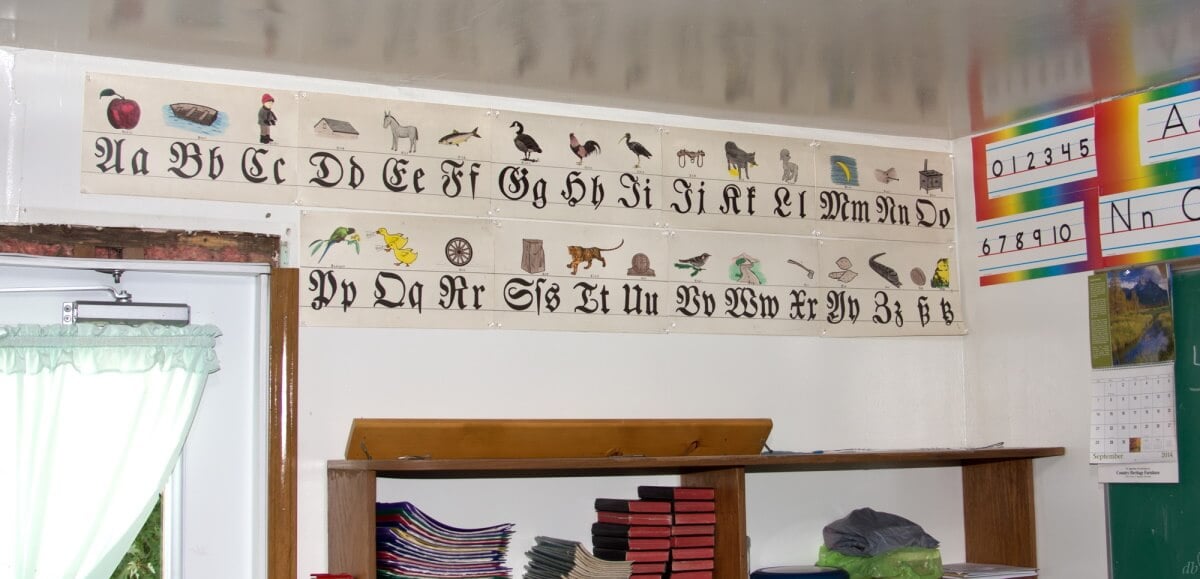
In Amish schools, instruction is in English, along with some classes in High German. Some Amish children become quite proficient at English at a young age. This phenomenon has become more common with the rise of Amish business and greater exposure to the non-Amish world.
In many cases, however, Amish children will have little command of the language before entering grade school. Parents or siblings will translate from English to Pennsylvania Dutch for the youngest ones. Since nearly all books are in English, Amish parents will translate to “Dutch” while reading.
High German
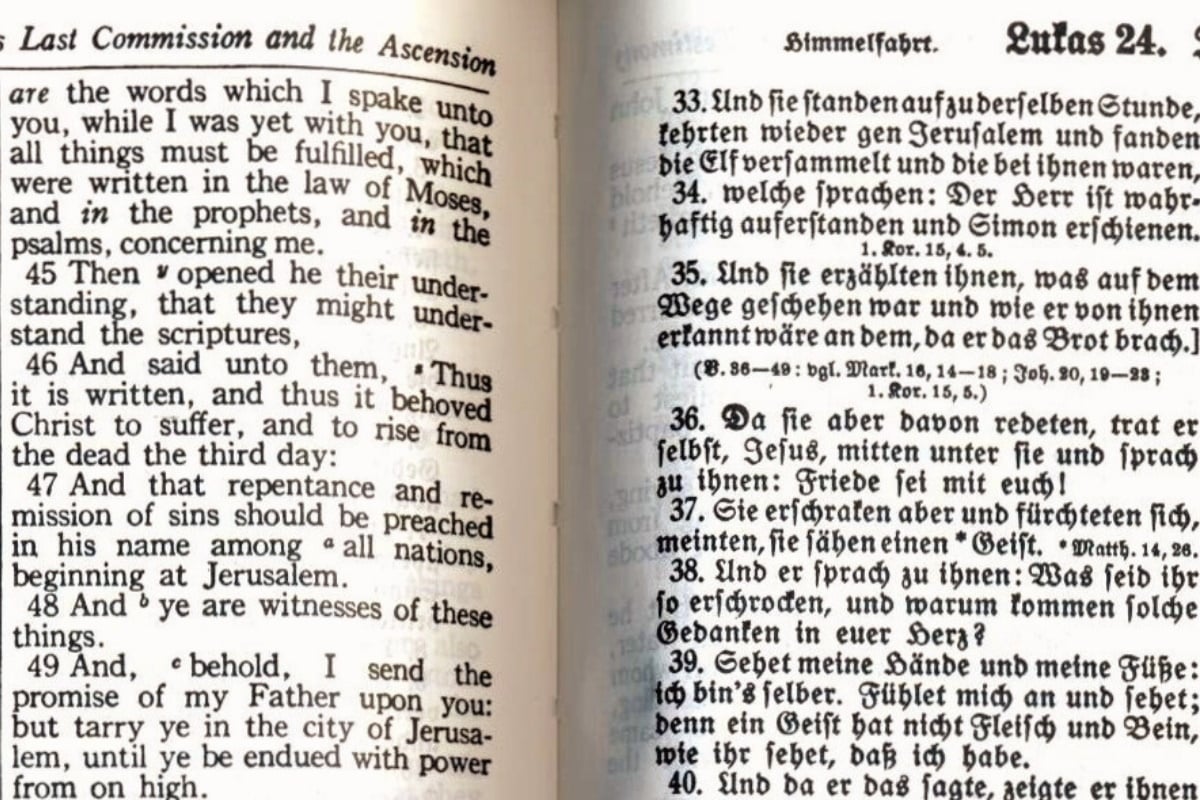
Bibles used by Amish are written in High German, and verses read in church are also in High German, as is the Amish songbook, the Ausbund. Proficiency in High German can vary among Amish.
It is safe to say that Amish are at least a bilingual people, with individuals having a varying degree of ability in High German. Some Amish people will have a better command of High German than others. High German is not the same as Pennsylvania Dutch/Pennsylvania German.
An anecdote of Amish language use
An Amish “taxi” driver observed the following on the use of English and Pennsylvania Dutch by her Amish customers. This anecdote nicely captures much of the dynamic of language use by the Amish:
I “taxi” for the Amish in our area and find that there is a variety of language use in my car. Some passengers chat almost exclusively in the Amish dialect except when they speak to me while others use English for the most part. One regular customer has apologized for speaking Amish in my car because she feels that it is “rude”. I have told her that I don’t consider it rude when she speaks to other Amish in front of me as long as I don’t hear my name (LOL)! Some, especially the younger women, switch back and forth, throwing in English words for which there may be no Amish (products, etc.)
I had a local bishop explain to me that the Amish word for ‘six’ sounds like ‘sex’ and he didn’t want me to think they were talking about sex. That kind of tickled me as I really don’t listen that closely to conversations. I find that children under the age of 5 don’t understand a lot of English and when I talk to them their mothers will often translate my comment to them and then translate their comments back to me. Some school age children speak English very well, and others do not.
I think one determining factor is how much contact their family has with the English, those that have shops or stores often speak better English, using idioms and slang more frequently. One teen uses “whatever” and “no way” quite a bit. I am learning a word here or there but no way can I follow conversation.
Amish language & identity
The Pennsylvania Dutch dialect is not only a means of communication but also seen as important in a symbolic sense. Along with Plain clothing and the horse-and-buggy, it is seen as a marker of the Amish and other Plain people, marking them in contrast with the outside world.
Thus the preservation of the Pennsylvania Dutch language is important to the Amish. In some communities there is concern that Pennsylvania Dutch may be falling out of use in favor of English.
Amish Language FAQ
- What language do the Amish speak?
- Why to Amish people call their dialect “Dutch”?
- Is the dialect Amish speak the same everywhere?
- When do Amish children learn English?
- Do Amish speak High German?
- Do Amish speak English with an accent?
- How can an outsider learn PA Dutch?
What language do the Amish speak?
Amish speak a dialect called Pennsylvania Dutch or Pennsylvania German. It is a German dialect which in its everyday usage often incorporates English words. The dialect is generally not written. It’s spoken in everyday conversation as the primary language of the home, business, and social interaction.
Why do Amish people call their language “Dutch?
It’s not what they speak in Holland.
True. Pennsylvania Dutch is not the Dutch spoken in the Netherlands, though you may have heard Amish people describing what they speak as “Dutch”.

The name of the dialect comes from the name given to the Pennsylvania Dutch people, a larger group of immigrants which included Amish and Mennonites but also many others of other religious persuasions. There are different theories as to why this group of people came to be known as “Dutch”.
Is the language Amish speak the same in all communities?
No. There are differences, for example, between the Pennsylvania Dutch spoken in Lancaster County and in Midwestern settlements like Holmes County, Ohio. Also, the Swiss Amish speak a different dialect which can be difficult for Pennsylvania Dutch speakers to understand.
When do Amish children learn English?
Typically when they enter the first grade, Amish children will get their first formal training in English. However, some Amish children may get exposure to the English language due to their parents’ occupations (eg, jobs involving contact with English clientele) or via non-Amish neighbors and visitors.
Do Amish speak High German?
High German is considered the language of the church. It is not spoken in everyday usage, but Bibles and other religious books are printed and read in High German. Amish children have German lessons in school.
Do Amish speak English with an accent?
Usually. But it’s not an “Old English” or heavily German accent as it may be portrayed in fictional works, television programs or movies. The Amish accent can vary across settlements.

In some communities it involves a softening of syllables, such as the word “just” being pronounced more like “chust”. Amish may pronounce certain common words in an unusual manner, such as the word “favorite” being enunciated as “favo-right”. They may also use some unusual phrasings, such as “it wondered me”, instead of “I wondered”.
Some Amish accents are stronger than others, and Amish in different communities and situations will be more and less comfortable communicating in English. Generally, businesspeople who have a lot of exposure to non-Amish people tend to have higher language skills while Amish in plainer, more isolated settlements have weaker English abilities.
Can non-Amish people learn Pennsylvania Dutch?
Yes. There are a number of resources available to help non-natives learn the language, including books, dictionaries, and at least one course. If you’re curious about the language, you can view some PA Dutch kitchen terms and similar-sounding words.
You can also hear PA Dutch being spoken by a variety of speakers at the University of Wisconsin’s Center for the Study of Upper Midwestern Cultures American Languages project.
References:
- Stoltzfus, Lillian. Speaking Amish. Bird-in-Hand, PA: Eckshank Publishing, 2013.
- Kraybill, Donald B., Karen Johnson-Weiner, and Steven M. Nolt. The Amish. Baltimore: Johns Hopkins University Press, 2013.
- “Group Identity and Language Maintenance: The Survival of Pennsylvania German in Old Order Communities”, Karen Johnson-Weiner, Diachronic Studies on the Languages of the Anabaptists, 1992
- “Community Identity and Language Change in North American Anabaptist Communities”, Karen Johnson-Weiner, Journal of Sociolinguistics 1998 2/3: 375-394
- “Kannst Du Deitsch Schwetza?”, David Luthy, Family Life, July 1975
An Matthew
Ich schreibe auf Deutsch da du diese Sprache lernst.
Wenn ich englisch schreibe, zuerst auf norwegisch und lass dieses überstzen auf englisch (geht über Google Translate) gut aber ja! aber nicht gut genug.
So meine Muttersprache nimm ich an, gleicht sehr im der Sprache der Amish. Meine Muttersprache ist elsassisch. Alsatian! Elsasser-ditsch (Alemannisch)
Es ist ein deutscher Dialekt wie viele Dialekten in Deutschland \ Ôsterreich \ Schweiz. Die Dialektene sind viele, viel älter das das Hoch-Deutsche oder Amts-Deutsch. Ich kan Dir gerne die alle nennen, aber es sind viele. Un da hat der Schrifsteller Goethe er nötig gefunden das die Bayern mit den Leute aus Schleswig-Holstein sprechen können, eine Schrift-und sprachen “erfundet” da sie miteinander kommuniseren können.
I grew up in Augsburg…. a city in Bavaria… Provice Schwaben.
I spoke this dialect as a child. It is very unique from any other part of Germany. “Schwitzer deutsch” a swiss dialect is very different from the “schwabischen ” dialect.
My children and I have so much fun listening to them speak in german. Today the dialect is not so strong anymore due to TV, etc.
Augsburg
How nice to see something from someone from the town near and dear to my heart: Augsburg! I bin vor viele Johr’ Student do gwä un ka’ au Schwobisch schwätze! The Amish would do well to train up their children in German and English–not an impossibility: my grandmother remembered school in German and English in Pittsburgh (Lutheran Church schools) and even though many had an Americanized accent, they were completely fluent in German. Mr. Zadoch, our oldest member @ St. Matthew’s German services, NOrthside, Pittsburgh, PA where I was the last organist to serve the German services (they stopped in the early 1990s believe it or not) was one of those who learned High German in school along with English and spoke with an American accent–yet could read and understand every word in the hymnal and sermons! It’s not impossible–someone needs to take the upper hand and PRESERVE WHAT IS WORTH PRESERVING!!!
Ja, richtige antwort
Das gefällt mir und i wois des gwiess. Kinder müssen alle Deutsche wisse. Müssen schauen auf die Zukunft.
Augsburg
My first assignment in 1982 as an American military dependent teacher in Germany was to Augsburg. Unfortunately, I was transferred to Munich two weeks later. Two years later, my family was transferred to Nurnberg. We came back to the states in 1986. I really loved living in Bavaria. My spoken German has a Bavarian accent. I have recently become acquainted with Amish farmers nearby and can converse a bit with them. It is lots of fun and it brings back many fond memories of a special place and wonderful people.
Deutsch Täglich
Zu Hause haben wir nur englisch gesprochen. Ich möchte aber deutsch lernen. Jezt bin ich alt (73) und muß jeden Tag was auf deutsch lesen, singen, oder denken. Vielleicht gibt es eines Tages auch die Grlegenheit den Ausbund zu lesen!
ich muss lachen
The program Amish Mafia is too funny. Almost to the point of embarrassing especially when my friends ask me if the translation is correct according to the captions. I have to laugh when they seem to mix English (which of course the Amish always complain about) with what I consider an offshoot of a Bavarian dialect. I tend to leave the room when this program comes on. I have nothing against the Amish. I really dont. But I have to wonder if the Italians are a little pissed off. Signed, formerly von Haunstetten.
ich muss lachen
Amish Mafia is a “reality TV show” and is mostly scripted. Maybe some of the people in the program were former Amish, but for sure, none of them are currently Amish.
Don’t take what you see presented on TV as representative of the Amish, because it’s not. Go visit the real Amish communities and you’ll see just how different the Amish are to anything you see on Amish Mafia or similar programs like Breaking Amish.
Also, stay away from tourist corridors in some of the Amish communities. While they are good areas to try food and learn about the community, those areas are largely commercialized and not exactly the best place to experience the Amish lifestyle.
Amish Mafia
I can respect not liking Amish Mafia. I know how it really is in Lancaster/Lebanon ctys. So I see it as just another entertainment show. There are far worse tv shows out there. Like the Kardashians. And movies that claim to be reality. Like Paranormal Activity. TV is full of acting. Even the Amish aren’t immune, unfortunately. But I don’t get mad. I get a little laugh. A few of my personal friends were acting on Amish Mafia & even the “Dr Phil special” that really was poorly done and unfortunately portrayed the Amish in a bad manner to an audience of people who do not know the Amish.
However, with Pennsylvania Dutch they often throw in English words when speaking. Many even have variations on the same words. I almost see it as a verbal artform.
What language do the Amish speak?
I agree that PA Deitsch (some say Dutch, which is a misnomer) is practically an art form! You should have heard the way my friend Rhoda once spoke to a Mennonite woman in Somerset County, PA: it absolutely flowed, and sounded so nice to my ears. I speak High German and a mix of Schwaebisch-Badisch (the way it’s spoken not far from Pforzheim they tell me). It was almost like hearing my dear Tante Rosi (she passed away in 1990) again! People make fun of Deitsch sometimes, and unfairly so. Of course, the same can be said of many people’s attitude toward Yiddish, which is about 80% Middle German from the Rhein region (not far again from the area my people were from), with lots of Hebrew expressions and even some Slavic words thrown into the mix. Yes, on TV, Seinfeld and other shows used a sort of “Amer-Yiddish” with a kind of New York accent, and that does the language a great disservice! You should have heard my friend Abe and his wife speak it: it was positively elegant! Also my friend Ike (Yitzchak) and his wife, Miriam. They made it sound so nice that I was sort of sad that I never learned it. (Long story from my strange life: in 1993 I had converted to Judaism, and thanks to German had no problem understanding most Yiddish! I returned to Jesus in 2003, and still have a soft spot for my Jewish friends, of course!). At any rate, when one language is retained in a country where another is dominant, it is not uncommon for the two to be mixed occasionally and even often, as in the case with Yiddish and PA Deitsch. You should have heard what I did on Pittsburgh’s famous Monongahela Incline just the other day: a young lady was speaking to an older lady in Spanish. It was beautiful. The older lady answered partly in good Spanish (which I only partly understood, and didn’t hear any Anglicisms), some in “Spanglish”, and then in absolutely elegant English–she didn’t miss a beat or an idiom in her English, and I wanted to applaud!! The Amish are actually trilingual, at least my friends were (Henry passed away last year): he could read perfect High German, he spoke Deitsch, and English without any trace of accent. He even read some of my dialect poetry books, which are out of print, from the region of Pforzheim (“Mei Pforze”, by Fritz Hoehn). I love languages as you can tell, and to make fun of any is really quite sad. In closing this long answer: I love what the late Elias Canetti (Nobel Prize winner, he grew up speaking Ladino, which is largely the Spanish from the time of Cervantes, and learned German later and became a prolific writer of his life and experiences in German)had to say: the death of a language is as if an entire universe ceased to exist. Learn languages, use them, enjoy them, and learn of them! 🙂
Language
You clearly are very knowledgeable and enjoy languages. Well done!
Eric: would you please asked otters to respond in English. Please! If one must respond in eg: German. Respond Equally in English. Furthermore, Amish won’t buy I phones. Fat Change, they’ll even read the response, Majority read English. Far chance in eg: German. The full Cooperation to obviously equally is Appreciated.
Janice Hill
Janice if you can copy from the book you mention here, the Bible. Whether it is written in Gothic or not, I can read both written language, it could be of great interest to many. So I wait one or another time to get over there and put up with the quiet, listening and hearing Amish people spoke. See how they greet each other, how they work and consume. But most is the language that occupy me.
Have a fantastik Christmas Janice!
I certainly will try,.I will see what this forum can let me load..I tried pics before and was not successful – however perhaps I can do a try at another way to link it. So yes I will get it out and think on this.
I have a family Bible printed in Cassel dated 1781. It’s exact identification is this: Biblia,das ist die ganze Helilige Schrift Alten und Neuen Testament Author Martin Luther(1483-1546) Publication Cassel: J.R. Seibert 1781. A forward is by Lutheran Minister Johann Arnds.
I would love to confirm the language – THANKS!!!
Hello Janice and greetings from Berlin, Germany.
Your old German bible was printed in the City of Kassel (Cassel), Germany. The translation was made by Martin Luther, and the name of the printer was J.R. Seibert. Your edition is to be found in several libraries in Germany: http://www.worldcat.org/title/biblia-das-ist-die-ganze-heilige-schrift-alten-und-neuen-testaments/oclc/50449707
Bible from Cassel
Gisa, I thank you for your interest in posting to me. I first,.did find this in World Cat. a few years back as you have listed for me. I however came across something new in looking again,.that there is a vol.2 (of the 3 listed) and it is pretty neat! So thank-you for prompting me to look at this URL World Cat. listing again! Something I just learned, this Bible having dates for the family “Gilbert” listed dod.dob’s it says are in this one. This is interesting as my Bible ALSO is from the Gilbert Family! Yes I am a descendant -Wow! But I have no dates in this one. The inked signature is from a Gilbert (can’t say exactly what the first name is,.(another relative thought it was Conrad) But it was given by him to my GGG John May (his mother was the Gilbert surname)So must figure out how to get those dates out of the other Bible!!! What a find!
* I have to re study all the info ..
Gisa..as my prev message stated..(this on just a few hours later) I am really excited to find this vol 2 – you say these are in Germany,.I am not sure how I would e-mail as there is no link or library name listed where this is; can you help me? I want to get the family names and dates out of the Bible of course,,I don’t know if this will be possible?…Any hints..as all I have as an identifier on this listing is an OCLC number..(6928835)and no name of a library?
R.E. I am just getting back to the forum today and wanted to copy you or let you know I am responding to Gisa,..but one part of it I thought might be helpful? I hadn’t thought to include previously that I did already research as Gisa has given the URL to the World Cat library,.. I had done this but to my knowledge and limited German (like zero) I did not think it held answers to the language the Bible is printed in. But perhaps it does? The link is in her post..But Something I just learned, and my interest is piqued is that one of the volumes (vol.2)of the three listed in libraries in the world says “Gilbert Family” as a schematic search term with the explanation of this Bible having dates for the family “Gilbert” listed dod.dob’s I assume. This is interesting as my Bible ALSO is from the Gilbert Family! Yes I am a descendant -Wow! But I have no dates in this one. The inked signature is from a Gilbert (can’t say exactly what the first name is,.(another relative thought it was Conrad) But it was given by him to my GGG John May (his mother was the Gilbert surname)So must figure out how to get those dates out of the other Bible!!!
GILBERT BIBLE
Could you please explain a little about the German Bible from Gilbert. I am a direct descendant of Johann Conrad Gilbert
Grrrrr
I grew up in Karlsruhe, Germany and therefore my first language is German or Deutsch i studied in Holland and learned Dutch then later moved to Pennsylvania not far from Lancaster. I cannot understand how the Amish can have a German bible written in Hoch Deutch which is actually proper German without a dialect and claim they speak “Dutch” (which they don’t!) And then say well its actually “Deutsch” (which it isn’t!). The so called Pennsylvania Dutch is not German nor Dutch! Not even “old German” and definatel not Hoch Deutsch! I will say there are some German words in the Pennsylavnaia Dutch language that have an extremely heavy south German sound to them. There are also a few Dutch words and a lot of jumbled English words. Most of the words are made up and while they sound like one of these languages they are not! I guess you cant expect much from a culture that wont go to school past the 8th grade.
Dear Ahaich, you have given a good description of how unique the Pennsylvania German dialect is. It’s one of a kind, wouldn’t you say? Sorry if it’s frustrating to you. It’s up to you if you want to learn it. The High German in the Bible is used by the Plain People for reading in church services, but the Pennsylvania German is used for conversations at home. Generally, it’s a plus to be able to know more than one language.
Pennshylvania Deutsch
While I find your comment extremely rude and arrogant in critisizing the Amish people I will still respond to it in a civilized manner. My son, who joined the Amish, was recently visiting friends in Germany. While there he had the opportunity to speak to a gathering at a local church in the village and later met some of the folks at a reception. One older gentleman introduced himself and explained that he was a retired professor of Classic Languages. He went on to explain that he had been raised most of his life in a village in the Pfaltz area. His home had been bombed out during the war. His father was killed when the Russians came. So, he and his mother went back to the Pfaltz to live with his maternal grandparents in their rural farming village. He was so thrilled to hear Mark and the boys with him speak their Pennsylvania Dutch. He said that it just sounded like his grandparents speaking. He said that when he closed his eyes he could almost believe his grandfather and his grandfather’s old Pfaltz farmer friends were talking. He said that so many of the idioms, phrases, expressions, and accent were like the Pfaltz dialect of 300 years ago. He said that it just had touched his heart and was like a gateway to his past. So, Ahaich, whoever you are and wherever it is in Germany you are from, I guess that there are some German people that would disagree with you.
Plattdeutsch
My father speaks a form of Plattdeutch which is similar, but not quite the same as the Deitsch spoken by the Amish. (We have roots in the Germans-from-Russia ethnic groups.) In my area, we have several Hutterite colonies, and Dad has spoken to the people who live there–again, not quite the same, but intelligible. (They speak Hutterish.)
There were so many small, enclosed areas in Germany, many many many areas spoke some form or another Plattdeutch became the common tongue. But, not all the forms were mutually intelligible. Some infused a bit of French, some Dutch; it just depended on locale, and sometimes exposure to outsiders. Hoch Deutch (High German) was supposed to “standardize” the German language, which it basically has, being as it’s the main form of communication on TV, in the media, movies, etc, etc…. However, it’s kind of like here in parts of the USA, a speaker might say in school, “I’m planning to do _____ after supper,” but once the speaker goes home, the comment becomes “I’m fixing to _____….”
There is a linguistic phenomenon called “register” which is used in society–there are different levels of familiarity that are allowed in certain situations. That’s why one would not say, “Dude, how’s it going?” when meeting an interviewer for a job. However, if one asked a friend, “I would like to inquire as to your health and general well-being…” the friend would (rightly so) think the first friend was acting like a pompous jerk.
What all of this comes down to is, the Amish (and several other groups) speak their “language” and call it good. The Amish never really intended to communicate with the outside “world”, thus really had no need to learn High German (except as it pertains to the Bible.) As they found their connections with outsiders required more and more English, the English strayed into their language (much as foreign words like “yacht,” “patio,” and “butte” strayed into English.)
The Amish are a neat people. As I have German-from-Russia roots (as do many Mennonite sects) I consider the Amish “relatives.” Anyone who wants to blast the Amish are going to hear it from me, first. If they’re lucky, it’ll be in English.
Our Plattdeutsch Dialect's Name
The dialect of Plattdeutch my father speaks is Mecklenburgisch-Vorpommersch.
Maybe you should look on a map where in Germany the Pfalz region is, then “maybe” you can figure out why that region has it’s own dialect. Germany is just like America when it comes to dialects. Northern Germany speaks “Hochdeutsch” while in the south they have their own specific dialect. It’d be like comparing the English spoken in San Francisco for example to the Amish version of that, which would be the English spoken by some redneck Tennessee hillbilly. You catchin’ on now, y’all?
Rednecks
There is nothing the matter with being a “Hillbilly”. My Dad’s father’s family came from England in the 1600s and settled in western Virginia; this was the frontier or a little beyond it at the time. They have thrived there ever since. That is pretty good for a bunch of “Hillbillies” whose ancestors from a civilized country managed to adapt to the wilderness.
I would not consider myself ignorant nor rude. Quite the opposite actually. I am simply frustrated with the lack of education on the matter. That may not pertain to you, but it does to many. I speak 5 languages two of those being German and Dutch. The languages are extremely different. The Amish folks that I have come into contact with claim they speak German and then refer to it is Dutch. I’m simply stating that they speak neither. The PA Dutch may be based on these languages but is not one or the other. I highly respect these people and how hard they work. They make a life for themselves that only very few people could and it’s admirable. I do apologize for what your friends family has gone through. It must have been terrible. My family went through a lot at that time as well. Granddaddy was in the SS his brother in a camp. My grandmother and her mother hid people in their home and saved many people while her father was forced to kill them. They were dark times and any of us Germans have a history. It’s not wheather or not Germans agree it’s simply a matter of what language they speak. I do agree that it is a language but it should be classified as it’s own language and not another. For example; I am a paramedic but I don’t go around telling people I’m a doctor. So they do speak a language but they should not call it german or Dutch because that’s simply not what it is.
The comment “I guess you cant expect much from a culture that wont go to school past the 8th grade,” could be considered rude or ignorant. I speak the dialect and when I’m asked what I’m speaking, I answer it is a Germanic dialect often called Pennsylvania Dutch or Deitch. I might add that particular label was put on by others and has become a common name for it. My apologies if the inaccurate label put on this dialect by Ameericans offends you. You are correct — it is not Dutch and though it is not High German, getting into all the particulars with a casual visitor is only going to confuse things. I might add people from Southwest Germany seem to have little difficulty understanding our dialect and often say, “Ah! So diah kenne Schwabisch schwetze!” True, our accent is very different (Americanized?) and there is a lot of English mixed in — but with no ties to modern German language or dialects, we use the English for many things that have come along since the Amish landed here over a century ago — tax returns, buffets, taxi-drivers, highways, chiropractors, pizza, and on and on… those are just a small sampling of English words that have found their way into our dialect.
And at the end of the day it doesn’t matter what we call it, what you call it, or what anyone else labels it: it’s the language that calls the family to supper, the language that discusses the day, and the language that tucks the children into bed at night and it is our way of communicating.
I aee how that comment could be taken as rude. I apologize if that was offensive. It was not my intention. I do have a lot of respect for the Amish people and some are actually close friends of mine. A few of them have told me how they wish they could continue their education and are not given the opportunity. That’s where my frustration comes from. One of these friends (I’ll call her Anne for the purpose of her privacy) has had to privately further her education because it is frowned upon by her family. “Anne” also agrees with my viewpoint on the language. She calls Pennsylvania Dutch Pendee. She now speaks fluent HochDeutch and is in the process of learning Dutch. She is doing so to pass the language onto her peers. Another thing Anne has told me is that since she didn’t know how to read she relied on her elders to interpret the bible to her and when she realized it wasn’t written in “Pendee” she was upset and stated, “how can we live life through the word of God when we can’t read what he wrote?” Makes sense to me. Again, this is where my frustration stems from and I apologize if it offended anyone.
I’m not sure where your friend Anne lives, but she apparently lives in a community much different from what I am used to. I feel for her if she feels she is missing out by not getting a higher education. I love learning and probably would have enjoyed getting a higher education, but not enrolling in college or whatever has not stopped me from learning. A person chooses whether or not to join the church — and the stance on going after a higher education is one of the things to be considered.
I’m a little confused at what you wrote about Anne not knowing how to read. She’s learning Hoch Deutsch? That’s what the German Bible is written in. She didn’t know how to read it? Sad. Hopefully now that she is fluent in it she can now read it. In communities I am familiar with it is taught in school and should be taught at home also. Maybe Anne’s parents neglected this? We read the Bible in 3 languages: English (usually KJV but we do have a few study Bibles in other translations, the High German Bible, and the PA Deitch Bible. (Which was just the New Testament until recently.) Despite what Anne told you, the NT is available in the dialect. our children have heard it their entire lives and it is written just as we speak it at home in our daily lives.
I completely agree with Anne on one point: How could we live the lives God wants us to if we could not read what He has written? How true! And this is why I am thankful for the ability to read AND the availability of the Bible in the traditional High German, the mother-tongue dialect, and English.
Mark's Ability in Express Himself in Writing
For several days I have been feeling that Mark speaks English so well, and expresses himself in writing so effectively, that he should write about the Amish and his own life for publication.
One way to get started would be to keep a diary. I would also keep a notebook and record my observations and reflections on life.
I suggested something similar to another participant on Amish America. I don’t know if he ever followed up on the idea.
How about it, Mark? Have you considered writing as an avocation?
Thank you, Bill, but no — I’m not interested in writing a book. This is something interesting & worthwhile to follow when I have time, but I am not looking to do anything else or taking it further. I keep a journal but it’s more what our family has been up to, what is going on at work and in the community.
Greetings, Ahaich:
Firstly, you are right insofar as the Amish do not speak Dutch (as in ‘niederländisch’), nor do they speak Modern High German (or ‘hoch-deutsch’).
Secondly, as you will no doubt have ascertained from this particular thread, the Amish use a language that in many ways defies a strict, academic approach (believe me, I’ve tried).
Based on what orginally appears to be a South German/Swiss dialect (‘alemannisch’ is one theory), it has over the centuries absorbed lexicological as well as syntactical traits from Standard English to produce what is commonly referred to as Pennsylvania Dutch. Despite the lack of linguistic codification, PA/Dutch seems to be perfectly adequate for communication amongst the Amish, and so qualifies as a genuine language.
Thirdly, most of the prevalent assumptions and claims concerning the Amish are made by ‘the English’, i.e. Americans or ‘outsiders’, such as myself. The Amish themselves seem to have other things on their minds.
Finally, I shall assume that the invective tone of your comments reflects academic purism, which I might understand, and nothing else.
Languages
The Amish Pa German is a language, however, not because it is simply adequate for communication. There is a substantial literature and written forms abound! If they could agree on a lithography (there is a New Testament in a form of lithography based on English which is hard for someone who grew up with German to wade through–I’m living proof of that!) and I would suggest since the majority of the words came from German, a German lithography would be needed, not an English one–the language could be preserved, maintained and allowed to bloom as a language, not merely a dialect. In Pittsburgh we have a dialect–the difference being: no one writes Pittsburghese, but we speak it informally: gumbands, in’e road ‘n at etc. are common expressions every Pittsburgher understands, but no one ever really uses in writing. “I’ll be dahn in a minit I’m reddin’ out the cuppboard” is another–dialect, not standard. Make PA German a standard language–GIVE IT A COHERENT LITHOGRAPHY and continue the literary tradition. Anyone who’s ever studied language knows that in order to retain it if living in a place where anotherlanguage is more commonly used knows you need to muster all of your resources–that would include reading and writing.
Wow that’s really interesting. Information. Ive never heard of some of these. Thank you!
Deutsch, not Dutch - misunderstanding
the Pennsylvania Dutch having nothing to do with the Netherland Dutch. The reason that they are called “Dutch” is that when the first Germans arrived here from Germany, they were asked what they were and they said “Deutsch”, but the Americans thought that they said “Dutch”, thus the Pennsylvania “Dutch” – absolutely nothing to do with the Netherland Dutch.
Not a mishearing
It’s not that English-speakers took “Deitsch” to mean Dutch. Rather, the word “Dutch” was commonly used in early modern English (17th cent. and for quite a while thereafter) to refer to any or all of the Dutch and German dialects or languages (including the more-or-less standard, written forms of both Dutch and German taught in schools). “Dutch” also refered, of course, to the speakers of those languages.
The usage “Pennsylvania Dutch” is a holdover from that early usage, and it means exactly the same thing as “Pennsylvania German.” The language itself uses the word “Deitsch”, or, if it is necessary to be painfully explicit, “Pennsifaanisch Deitsch”; the usual word for the (Standard) German language in PA German is “Hochdeitsch”–which is itself arguably a tiny bit of a misnomer, but that’s a discussion for another time.
http://pdc.wikipedia.org/wiki/Modern_Hochdeitsch
Ahhhh- I see
Thank you for clarifying the “Dutch” (Deuch) (deuchland) meaning German & not Dutch/swiss/netherlands.
Dutch or Deutsch ?
I’m from the coal mining area NE of Köln in Nordrhein/Westfalen, Germany. I’ve lived in English speaking countries since 1953, and our family has always spoken Hochdeutsch at home. What I’ve noticed over the years, is that we’ve formulated our own “German” which now consists of a combination of the “easiest” words from both languages. By doing so, we can speak “more and quicker” than if we chose soley one or the other. When it comes to the Amish, this has become quite more pronounced, since they’ve had many more generations under their belt here in the US, thus much more time to intermingle languages. I think it’s entirely possible for the Amish of today not to be able to understand those 200 years from now for the same reason. So what in my opinion is the modern Amish language of today? A bastardized form of German if you will, most of which I can understand when watching the Amish show on TV, because it certainly isn’t Dutch. When new immigrants to America arrived here years ago, they were frequently asked, “where are you from” or “what are you?” If that person came from Germany he would respond, “Ich bin Deutsch”. (I am German). Most Americans back then, as is the case today, don’t know the difference between Deutsch and Dutch. To them it sounds the same, so they picked the one easiest to pronounce and spell, which is Dutch, and that mixup has remained to this day. Had they asked that question of a person from Holland/Netherlands, he would have answered, “Ich bin Holländer”, or “I am Dutch”. Both of course are 2 totally different languages. I also have an old German bible written in Hochdeutsch but printed in “die alte deutsche Schrift”, or the old German script, which most German speaking Americans wouldn’t be able to read. It’s only about 3″x5″ and titled, Testament und Psalmen. The first page states: Das Neue Testament unseres Herrn und Heilandes Jesu Christi followed by that it was printed in New York by the Amerikanische Bibel-Gesellschaft, gegründet im Jahre 1816. The date of print is 1910 with the signature of the original owner, Arthur Stragis, born December 27, 1884, who was in fact a German immigrant and most likely bought this bible when he entered the US through Ellis Island in New York, like most immigrants from Europe did.
Amish language
I was born and raised in Rheinland Pfalz, I speak Hoch Deutsch and Paelzisch. Ich muss sagen can’t understand the Amish, they use a few High German words and some dialect but the sentence structure is completely off, almost backward. By the time I try to make sense of it I can’t remember the rest off the words that didn’t fit. So it’s definitely not german
Severe case of NPD 100,% proven
Stay home, please.
Pennsylvanian Dutch
Relax mate. I am an English speaking South African. In South Africa, we have a language called Afrikaans which comes from Dutch in The Netherlands. In turn, Dutch from The Netherlands came from German. The language the Amish use is just another branch of the Germanic family tree. Even English is from the Germanic tree although it incorporates French and Latin as well. The English word for “cheese” comes from Friesan, a language spoken in the North of the Netherlands. Languages have no rules. My South African English is littered with Afrikaans and Zulu lol!
inactivity lately?
HI all, I am wondering if I forgot to check the box of “being notified” for others when I made some recent posts. Just saying hello and hadn’t seen anyone on of late; either to new posts or responses to mine. Just a mid Feb. check in,.and this time I was sure to check the box! 😉
Hi, Janice! In case you didn’t see it, there were some other recent posts about Pennsylvania Dutch.
https://amishamerica.com/pa-dutch-interview-amishman-and-sons/ This post has a 19-minute video in Pennsylvania Dutch, plus the readers give excellent resources in the comments.
https://amishamerica.com/do-you-know-these-10-amish-terms-part-2/ Erik had 3 quizzes so far. Some words are in English, some are in Pennsylvania Dutch.
I was near Intercourse recently and had a conversation with an Amish lady in Pennsylvania Dutch. Well, I was using Hochdeutsch and she was using Penn. Dutch. We didn’t seem to have too much trouble communicating, except for the odd word here and there. I’m not sure whether everything quite got across, though… She may now think that the primary language of Australia is German.
I attend the German Language School, and have for a couple of years now. That’s Saturday mornings, and I’m the only one there who isn’t actually German (this is what happens when homeschoolers want to learn a language). There’s quite a mix there, people from all over Germany, Austria, and Switzerland. Although the teachers always use Hochdeutsch with the children, it’s not uncommon to hear them slipping into dialect with each other or with parents, or even for children to use dialect amongst each other. I use Austrian with my father – my teacher has told me off a couple of times for using mountain words. Most of my friends speak a Rheinland dialect, but my teacher and one of my closest friends both speak Swaebisch. I’ve heard it enough that I was surprised to recognise Pennsylvania Dutch as being Swaebisch. Which it isn’t.
German
How interesting that you can speak German and that you are from Australia. A language learnt is never a waste. I disagree with the teacher though on the “mountain words” lol! I am from South Africa but there are English “mountain words” in Appalachia in the United States – go mountain folk! They have such a cute little American accent there.
Pennsylvania German hour, Lob Lied, Pa. Dutch singing
-The Berks Community Television, http://www.bctv.org, hosts a Pennsylvania German hour, usually once a month on the first Friday of the month. This is the recording of the one-hour June 7, 2013 program:
http://www.bctv.org/special_reports/community/pennsylvania-german/vmix_02e0b376-cfa8-11e2-967b-001a4bcf887a.html
(Among other songs, the Dolpehock Sanger Chor sang, “Bring Sie Rei/Bring Them In”. An interview is in Pennsylvania Dutch.)
-http://www.bctv.org/special_reports/community/pennsylvania-german/vmix_ed1109e6-b419-11e2-a494-001a4bcf887a.html
(Pennsylvania German hour/Die Pennsilvaanisch Deitsch Schtunn. Mother’s Day program of song and poems. 5-3-2013.)
About halfway through, the Chor sang, “Des is em Gott sei Welt”/This is my Father’s World. Then another song, “Meedli, Witt du Heiere?/Daughter Will you Marry?”
-http://www.youtube.com/watch?v=4eIBH4XemOQ
Die Miller Brieder: En Finger, en Daume. Song. 2:27. Miller Brothers. It’s kind of like singing a round, with motions.
http://www.kididdles.com/lyrics/o113.html
words to the song in English, One Finger, One Thumb
-John Schmid singing in Pennsylvania Dutch, with Amish photos. 1:49. Mei Vadder un Mudder sinn Deitch, with English translation. 2010.
http://www.youtube.com/watch?v=0dA2icD6Zbw&feature=share
-John Schmid has 3 CDs in Pennsylvania Dutch, IN DUTCH, IN DUTCH AGAIN, DUTCH BLITZ. IN DUTCH has the Lob Lied. http://www.johnschmid.org/music.html
I think the CDs are $15 each. (In Dutch has a double meaning! Am I in dutch if I’m late?)
-http://www.lmhs.org/Home/Shop/PA_German_CDs
Lancaster Mennonite Historical Society has John Schmid’s CDs, too, plus the CD of Enos Stutzman’s BOHNE SUPP.
-From 2005, http://dorcassmucker.blogspot.com/2005/12/pa-dutch.html (Dorcas Smucker wrote about Pa. Dutch.)
“And then what should sound but a long, chanted, OO-ooo—ooo-oo—ohh, the opening notes of the Loblied, and I was instantly transported back to being four years old, sleepily putting my head on my mom’s lap on the backless bench in church while the old slow tunes billowed around me in soft, high waves of sound. It was incredible.”
-http://www.youtube.com/watch?v=8t1wrB9A7hQ
(Das Loblied 4:45. 2010. The information says it could be downloaded without the pictures.)
-http://www.loblied.com/ (You can download the song file, or listen to the YouTube with pictures.)
-http://www.mennolink.org/cgi-bin/search.cgi?bk.amv.01.txt&track=10
(sample of “O God Father” in German, in a faster tune. Acappella.)
re: ahaich's comments
I think ahaichs first sentence says it all ” I grew up in karlsrhure” …. In 1966 I was in this area of Germany and as a young English girl was subjected to a torrid and insulting verbal attack by a group of local residents . This was unprovoked and was because we were English. Bigoted remarks about other cultures from such people do not suprise me
Germans in Australia
Well Halliday, I on the other hand was a young German boy growing up in the suburbs of Sydney, Australia between 1953 and ’63. Bigoted remarks towards me wouldn’t even begin to describe the verbal abuse I had to endure from those Aussies simply for the fact that I was German. And what do they really hail from ? England’s white trash and convicts, so I suppose I shouldn’t have expected any better. It’s the reason we moved to America in ’63, where we could rid ourselves of that predominately prejudiced “English” society and into one more integrated with peoples from all over the world. Best move my dad ever made. Maybe you should read, “The long, slow death of White Australia” by Gwenda Tavan and it’ll give you a good idea how welcoming you English are.
Easy now, I have nothing against the Amish! I respect them land all humans alike! I feel sorry for the way you were treated. It is not right and I do it condone it. When the Americans moved into our area they were treated very poorly! It was horrible. I was 5 when my mom met my step father and he was stationed there. We were treated terribly for befriending the Americans! I am pleased to announce that it is no longer that way. When I go back to visit my family and friends and we go out to eat or go dancing they ask for ID. When they see a military ID now or an American drivers license you are treated like royalty now. The people shake your hand and thank you. A lot has changed since then. Please do not judge my hometown on mistakes they made in the past that would be like me judging Americans for the history of racism. “Your great-grandfather was mean, so I hate you all now!” That’s just silly ignorance. The Amish are great people and so are the Americans, the Germans and every other people. If you read my comment without judging me from where My history lies you would see that it has nothing to so with the people only the language.
As a native speaker of Pennsylvania German who learned to speak English in grade school, I can probably answer a few questions concerning the dialect. Clearly P.G is a German dialect rather than a Dutch one. Some of the shifts that occurred in the development High German are present in P.G. while others are missing.
The differences between P.G. and H.G. are fairly uniform, such as the following vowel changes: English home, bone, one, alone, stone, etc. are German heim, bein, ein, allein, stein. P.G. heem, bee, een, alleen,schtee. Usually H.G final “n” is dropped in P.G. The frequency of English content varies greatly from speaker to speaker. Older speakers may use very little English, usually only for terms introduced to the dialect since immigration to the Americas.
The plural form of P.G. nouns will easily distinguish between words of German origin vs. English origin. In most cases nouns of English origin will form the plural forms with an “s” just as in English.
The German dialects closest to P.G. are: Hesse, Elsass, Saar, Pfaltz, and Mannheim.
Grüss Gott, herr Zimmermann:
Thanks for your much appreciated comments. I hope that you will be able to provide some views on the following:
a) My first theory is that back in the mid-18th century the first Amish, being Swiss, used a dialect from North-Switzerland or one closely related to it, e.g. ‘alemannisch’.
b) My second theory is that present-day PA/Dutch must be different from the original dialect, even when allowing for near-perfect isolation and some ‘contamination’ from Standard-English. *
c) You suggest that present-day PA/Dutch resembles dialects found in e.g. Hessen, Pfalz and Saarland.
d) This would mean that the Amish, linguistically, have moved north from Switzerland and well into south/south-western Germany without any significant external influence.
That is a very intriguing proposition – if I’ve understood you correctly.
* I know ‘PA/Dutch’ a misnomer, but it’s the term used by everyone on this site, so let’s go with it.
Hello Grey/Catz, the Amish as well as many Mennonites had their origins in Switzerland, but fled to the Palatinate due to persecution from the established Swiss churches. Once in the Palatinate the number of adherents grew by proselytization of the local populace. Within a few generations the language had largely shifted from Swiss German to Palatinate German. Some groups emigrated to the Americas directly from Switzerland and if isolated, retained more Swiss features in their dialect.
So, the Amish have ancestral roots in both Switzerland and the Palatinate, but have liguistic roots primarily in the Palatinate.
As I listen to varios German dialects, I find the Mannheim dialect rather close to mine including the pronunciation of Mannheim as “Mannem”. (We have a local town named Manheim).
My dialect is not an exact match for any specific German dialect, but rather, an amalgam of several dialects, just as the immigrants themselves.
Cases in point, Mir for Wir, genung for genug, glee for klein, etc. These changes are found in the various German dialects.
Adding another piece to the puzzle.
Hello, Martin:
If the Amish, prior to emigration, were linguistically rooted in and around Pfalz, it would explain why present-day PA/Dutch seems more akin to dialects found in Germany rather than in Switzerland.
Maybe it’s time to adjust our view of the Amish as being Swiss: geographically and historically, they still are of course, but in terms of language (and most likely culture) it would probably be more accurate to view them as descended from Palatinate Germans.
Whether you agree or not, I thank you again for your useful comments.
Your analysis is correct. My own ancestry is about 75% Swiss and 25% Palatinate German. My Palatinate ancestors were from Eich and Sinzenich, Germany. My Swiss ancestors were from Zurich and Bern.
The Amish surname Zook (Zug) is from Switzerland. Stolzfus is from the Palatinate. Some of the Amish surnames are from Alsace, France, the surname Blank (Blanc in French) for example.
Blank
Blank is also used in the Canton of Berne without having any connection to Blanc from France!
The name Blank is also used in the Kanton of Berne without having any connection to the French Name Blanc!
Interesting post
I thought this post would be interesting to my son, Mark. He joined the Amish about eleven years ago and speaks fluent Pennsylvania Dutch. He says that the Amish don’t refer to the dialect as Dutch but as Deitsch. Mark related that when the Anabaptists were persecuted and expelled from Switzerland most of them went by boat and followed the Rhine River. The Rhine flows north. Some of them them landed on the east of the Rhine and settled in the Alsace region of what is now France. Others went on and settled on the west side of the Rhine in what is called the Pfaltz Region. They were there for quite a long time. Probably over a hundred and fify years. They picked up Pfaltz speaking converts and probably gradually over time lost a lot of the Swiss German dialect. A year and a half ago Mark was in Germany in the Baden – Wurtemburg area. He met an older gentleman who was just fascinated by Mark’s and the others who were with him when they spoke. He was raised in the Pfaltz and after WWII he and his mother went to live with his grandparents in a little rural village in the Pfaltz. He said that when he heard Mark and the others speak it took him back to his childhood. Their accent, vocabulary, etc. were so much like what the older farmeres and villagers spoke there in the Pfaltz. Certain words that Mark and the others used he said that he hadn’t heard since his grandparents passed away. He said that it really took him back to his childhood. One word that Mark said he just exclaimed over was when Mark used the word “allegebot.” It means “every once in a while.” He was so excited. “Allegebot! Allegebot!. That is Old Pfaltzich!”
Hello Don, yes allegebot is a commonly used word in the dialect. Some other differences are that German “pf” becomes “p”, or even “b” Pflantzen becomes Blantze. Likewise “p” in front of another consonant becomes a “b” Prediger becomes Brediger . “k” in front of another consonant becomes a “g” Kreutz becomes Greitz. Nearly all final “n”s are dropped although they are often retained if there is a suffix. “Schee” (Schoen) becomes “Schenner” in the superlative.
Great account Don, thanks for sharing. Allegebot! 🙂
Yes it is spoken of as “Deitsch” but it is also referred to as “Dutch”, at least when speaking about it with English folk.
I have always found it fascinating that some German speakers in Germany have this reaction to what Amish speak.
What language do the.......
After having to take a week off work r&r from surgery, I am reading lots of catch up here and enjoying it very much.
I do have question on “learning” to speak Pa. Dutch. Toward the top of this thread there is a pop up type ad, orange backgrounds asking if you want to learn Pa Durch to please submit your name and email address. Is this something sponsored, approved or otherwise involved with you and the AA forum? Or is it an ad out of nowhere that got lucky enough to appear in the middle of your thread?
Curious Cat
That’s actually from this site Catherine. It’s not a pop up but just a subscription form for those who want to hear more about the program when it’s closer to ready. We have been developing a basic PA Dutch audio learning program with the help of some Amish friends. We have completed recordings but the production side is taking a lot of work (I’m not involved in that part of the process), but hopefully will start to move along here. If you want us to let you know about it when it’s ready, you can sign up in that form.
Hope your surgery recovery goes well!
Alsac; west of the Rhain
Don!
You mean wast of the Rhain, yes?
Regards from Sweden
George
"Allegebot"
It may not have a relevance.
In some Swiss dialects, “allpott” means “quite often”, such as “busses run quite often on this route, there is one every 10 minutes”. Not exactly matching “every once in a while”, could be a co-inky-dink.
I’d be interested to know which expression is used in Amish German for the English ‘about’, such as in “It would take me about 30 mins to finish this work”.
Thanks,
—
Carlo
5-five languages that can be compared with Amish language ... which of them is closest?
https://de.wikipedia.org/wiki/Deutsche_Sprache
https://en.wikipedia.org/wiki/German_language
https://als.wikipedia.org/wiki/Deutsche_Sprache
https://nl.wikipedia.org/wiki/Duits
https://no.wikipedia.org/wiki/Tysk
Here you have Wikipedia on 5- five languages:
German
English
Alemannian
Dutch
Norwegian
So you can find out what a language similar to that of our Amish friends talking.
Which Language do the Amish Speak?
Pennsylvanisch Deitsch! Oh, and incidentally, there are not only books to learn it, there is a blog: “Nau loss mich yuscht eppes saage” by a teacher of German who grew up speaking it. Mr. Douglas Madenford is a master of this language, and his blog is worth looking up! Also, he and a colleague of his wrote a course book on it, and there is another which I ordered with a CD by another author. It is certainly possible to gain the rudiments of this language, if one is willing to make the effort. There are also several websites you can find on Mr. Madenford’s blog page. There is also one called “Hiwwe wie Driwwe” which he is co-editor of, and which is in conjunction with scholars both here in the USA and in the Pfalz region of Germany! Viel Spass, liewwe Leit!
Ah but Pennsylvania German/Dutch IS a written language!
Ah but there are many things written in Pennsylvania Dutch/German.
The Bible:
https://www.bible.com/bible/1455/JHN.1.pdcb
and many other publications on this website:
https://www.jw.org/pdc/
as well as videos:
https://www.jw.org/pdc/publications/videos/#pdc/categories/AllVideos
Help finding/understanding some words?
Hi, a dear friend of mine grew up Pennsylvania Dutch in Ohio and has a couple of words we can’t seem to find anywhere on the Net. Hopefully someone here, or the owner of this website, can provide some insight:
1) “Budeschnest” (written by ear) is their word for making a little bedroll or nest on the floor with blankets.
2) “Laadvet” is a type of bread, they have a memory of a relative singing a song called “Boana Sup Und Laadvet Brot” at a reunion (and that it was rather disgusting!)
As we can’t find anything online, it would be some nice closure to our search if anyone knew the words, or could point us to someone I can e-mail who might have more information.
Pa German is more than an Amish language
I have been reading these posts with interest and wonder. I am a Pa Dutch speaker coming from a family line that was never Amish. There is so much history that is being left out of this conversation to understand the development of this language.
Also, Calling it a “dialect” diminishes its value and scope of its use.
The Pa Dutch are a people group that came from the Schwaben part of what is now Germany prior to the establishment of the county. My ancestors left that region in the late 1600’s making their way up the Rhine and finally to the US seeking religious freedom. The more conservative Amish came later, both in the formation of the religion and to the US.
Many of the non Amish that spoke Pa Dutch stopped speaking it when WW 2 started out of fear of being interned in camps like the Japanese were.
Recently I spoke Pa Dutch to a Plain Mennonite child here in Kentucky where I now live and she had no idea what I was saying. The dad apparently understood me and told me the mom did not grow up speaking and so the children do not.
I am a proud “Pa Dutch woman”, a fraktur designer, and hexmeister. Like many languages Pa Dutch has developed and changed over the years and been influenced by history and the regions it has been used in.
Need PA Dutch Interrpeter Nov 15 2022 at 9:00am
Need an interpreter for 2 children the ages 3 and 5. It will over video conference. Any help would be greatly appreciated.
Please call us at 314-989-9112 and ask for Michael or Sarah.
Thank you!
Sarah Disney
reply
all of this reading per norsk is great since im of norse background