
New York Amish Community Guide
New York has one of the fastest-growing Amish populations, and 5th-largest overall
New York is a state which most people do not immediately connect with the Amish. But today over 25,000 Amish live in New York, in around 60 distinct locations.
The Empire State first saw Amish settlers in 1831, and has had a significant Amish presence since the 1970s. In recent years New York’s Amish population has grown by leaps and bounds. Over 40 new settlements have been founded in the state since 2000.

Amish settlements in New York include:
- Conewango Valley – The oldest settlement in New York. Founded by “Troyer Amish” in 1949; roughly 2,700 Amish live here today
- Heuvelton – A highly conservative Swartzentruber Amish community near the Canadian border. The largest in New York, with 12 church districts and over 2,900 Amish as of 2024
- Clymer – Settled by Amish from Geauga County, Ohio in the 1970s, this is one of the most significant Amish communities in Western New York
- Mohawk Valley – The Mohawk Valley in central NY is home to five distinct Amish settlements
- Mayville and Lowville – These two settlements were founded by Amish from Pennsylvania
- Other New York Amish Communities – New York state is home to nearly five dozen Amish communities. Many are smaller settlements, founded in the past two decades
- Visiting Amish in New York – Which are the best Amish communities to visit in New York?
New York Amish origins
As described in David Luthy’s The Amish in America: Settlements that Failed, 1840-1960, the first Amish settlers to New York arrived in 1831. These pioneer Amish settled in Lewis County near the town of Croghan in upstate New York.
This settlement grew during the 1830s and 1840s, attracting settlers from Alsace-Lorraine in Europe. Eventually the settlers in this original group assimilated with more progressive churches, and by the 1950s the descendants identified themselves as Mennonite.
The next New York Amish community was not founded until 1949, in the Conewango Valley of Cattaraugus and Chautauqua Counties. The Conewango Valley settlement is currently one of the two largest in New York, with 18 church districts as of 2021.
Amish in the Conewango Valley
The Conewango Valley is home to the oldest, and one of the two largest, Amish settlements in New York today. In New York Amish: Life in the Plain Communities of the Empire State, Karen Johnson-Weiner outlines the founding of this settlement. The first group to arrive, coming from Pennsylvania and Ohio, consisted of members of the highly conservative Troyer Amish group.
Members of this group were motivated to come to the Empire State in order to acquire farmland and maintain an agricultural tradition.
Additionally, Johnson-Weiner notes that the move to New York allowed the new settlers to avoid ongoing church dissension in the Holmes County Ohio settlement, which had earlier resulted in the formation of the Swartzentruber Amish affiliation.
The Troyer group itself formed in Holmes County in 1932 over conflict concerning excommunication. Moving to New York allowed these Ohio Amish to preserve homogeneity and start anew, away from threats in other communities.
Today the Conewango settlement is one of the most conservative in New York. Johnson-Weiner describes Troyer Amish homes as lacking “linoleum floors, carpeting, sofas, and other upholstered furniture. There are no indoor toilets, and homes are lit with oil lamps instead of gas or battery powered lamps.” (New York Amish, Johnson-Weiner, p35).

Amish in this settlement have maintained a strong agricultural lifestyle, producing milk for a local cheese factory. Amish in the area are also involved in small industry, with businesses including basket-making, furniture production, harness, and sawmills. Amish here are conservative in outlook, but practically oriented to the public in many of the enterprises they run, selling products to local New Yorkers and tourist visitors alike.
Heuvelton Amish
The area of Heuvelton, in St. Lawrence County in upstate New York, is also home to a highly conservative group of Amish.
This Swartzentruber Amish community was founded in 1974. Johnson-Weiner explains that the motivation for the move, like that of many Amish migrants, was affordable farmland. Similarly to the Troyer Amish migrants to Conewango Valley, New York also offered these Amish settlers refuge from conflict and threats from more progressive Amish groups in their home settlement of Holmes and Wayne Counties in Ohio.
Like other Amish, Swartzentruber life is dictated by the Ordnung, which can be thought of as church rules or a set of guidelines for daily living. The Ordnungs of Swartzentruber Amish groups are particularly strict. The hair of Swartzentruber men is longer than that of other Amish, and women’s clothing is heavier. Homes are typically sparsely decorated, and follow a standard design plan. Swartzentruber buggies lack a slow-moving vehicle triangle, electric lighting, windshields, and mirrors.
When it comes to technology, battery-powered flashlights are permitted in Swartzentruber districts, but most other forms of power, including hydraulic and air power, are not.
Swartzentruber shops are typically operated using a diesel engine which turns a crankshaft running underneath the floor. Belts emerge from the floor in various places along the shaft to power saws and other equipment. This method of generating power is common among the most conservative Amish groups, for example being seen amongt the tradition-minded Amish of Big Valley in Pennsylvania.
Despite the restrictions of the Ordnung, the Swartzentruber Amish of New York participate in local economies. In addition to agriculture, the Amish of Heuvelton are active in cottage industry.
Johnson-Weiner notes that “in New York’s North Country, the women quilt much more, and the majority of the quilts they make are for sale outside the community” (New York Amish, Johnson-Weiner, p 71). Adolescent girls are involved in quilting, and quilts are purchased by tourists and vacationers. Some quilts are also assembled by Swartzentruber locals for eventual sale by Lancaster County Amish. Johnson-Weiner notes that Amish women in the area produce a variety of goods for sale that they themselves would not use, including Christmas tree skirts and toaster covers.
Other businesses in the area include those that cater to Amish, including harness makers and buggy shops, as well as bulk food stores. Men operate businesses commonly found in Amish communities with restrictive Ordnungs, such as sawmills.
At one point, Swartzentruber churches decided to allow the use of bulk tank milk dumping stations, following the closing of a local cheese house which had previously supplied product for stores across New York, providing a market for Swartzentruber Amish dairy farmers.
This allowance has permitted Swartzentruber Amish continued access to a market for their milk, as unrefrigerated Swartzentruber milk could previously only be sold for cheese making. This decision to change testifies to the fact that the rules and guidelines of an Amish community are not static, with change happening even among the most conservative groups.
Johnson-Weiner observes that as the Heuvelton community continues to grow, an influx of outsiders, many from outside New York, has added pressure to the Heuvelton settlement. Land prices have risen and competition among local Amish has increased. Today, the Heuvelton Amish community is the largest in New York, with around 2,900 Amish in 13 church districts (congregations).
The Clymer Amish settlement
The Amish of Clymer originate from Geauga County, Ohio. Like other Amish immigrants to the state, land pressures motivated Amish in Geauga County to seek land in New York in 1976.
Clymer Amish are relatively progressive compared to other Amish in the state, including the nearby settlements at Mayville and the Conewango Valley. Amish businesses in Clymer create harnesses, sell housewares, and do carpentry work. They also operate a number of tourist-oriented businesses.
Clymer Amish have fewer technological restrictions than many nearby New York settlements, evidenced in the style of buggies they drive, the allowance of telephones in phone shanties, as well as the types of businesses they run. Clymer Amish also follow a more moderate approach to social shunning. Today the Amish population is over 1,600 strong.
Amish of Mohawk Valley
In the valley of the Mohawk River in central New York, a number of Amish groups have established settlements since the 1980s. Karen Johnson-Weiner outlines the diversity of settlement in this area, which includes Old Order, Swartzentruber, Byler, and Andy Weaver Amish.
The Byler Amish settlement, at Fort Plain, was the first established (1986) and today numbers over 600 Amish residents in four church districts. A Swartzentruber settlement at Poland in Herkimer County, was founded in a location previously occupied by an unrelated Amish settlement. A third Mohawk Valley settlement, founded in 2006, has grown to be the largest in the area with over 800 Amish in eight congregations.
The two Old Order group, both found in Otsego County, originate from Delaware and Geauga County, Ohio. Though they are both considered Old Order affiliations, they live by different church standards and so are considered different settlements.
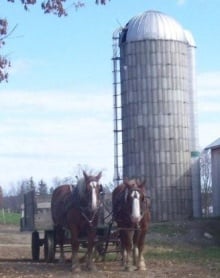
Andy Weaver Amish settled in Montgomery County near the towns of Glen and Fultonville. The Andy Weaver affiliation originates in Ohio. Settlers to this part of New York left their home community at Ashland, Ohio largely due to long-standing concerns over behavioral standards among youth in the settlement.
Andy Weaver Amish are more conservative than mainstream Old Order affiliations, but less so than Swartzentruber Amish. Andy Weaver churches typically permit more limited technology than Old Order congregations, and adhere to strict shunning.
Amish in the Mohawk Valley of New York exhibit the wide range of diversity found in Amish society. Ranging from more progressive Old Orders to conservative Swartzentruber Amish, a variety of cultural practices and technological allowances are seen among local Amish.
The different approaches of the Amish groups in this part of New York have led to differing interactions with non-Amish residents. They have also led to different ways of making a living, ranging from traditional dairies to tourist-oriented enterprises.
Pennsylvania Amish settlers to New York
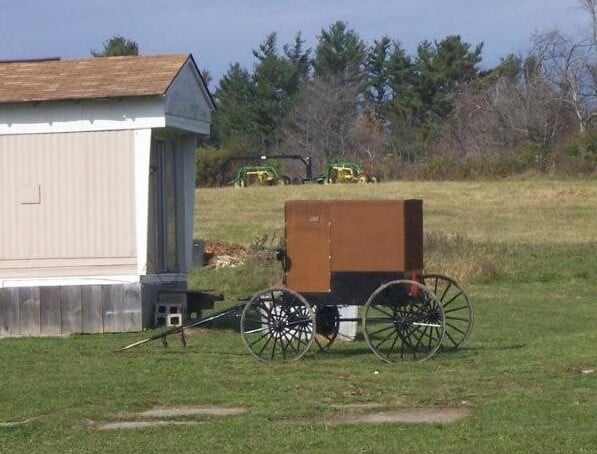
Perhaps unsurprisingly (due to its proximity), a number of New York Amish communities have been started by settlers from Pennsylvania. The settlement at Mayville (1976, two church districts) was started by Amish from New Wilmington, Pennsylvania. Like the Amish in the parent settlement at New Wilmington, these settlers to New York (known as Byler Amish) are easily distinguished by their brown-topped buggies.

This group of Amish also follows a restrictive Ordnung in comparison to most Amish. Amish here follow a strict interpretation of shunning (Meidung). Though they do use the SMV triangle and lighting, buggies lack a front windshield. Clothing is plainer in this community, and wagons are equipped with steel-rimmed wheels.
Homes of Byler Amish lack indoor plumbing and gas lamps. At the same time, Johnson-Weiner notes that visitors to this region of New York are guided to local Amish-run businesses by a helpful map, indicating that some Amish make ends meet operating businesses patronized by non-Amish clientele.
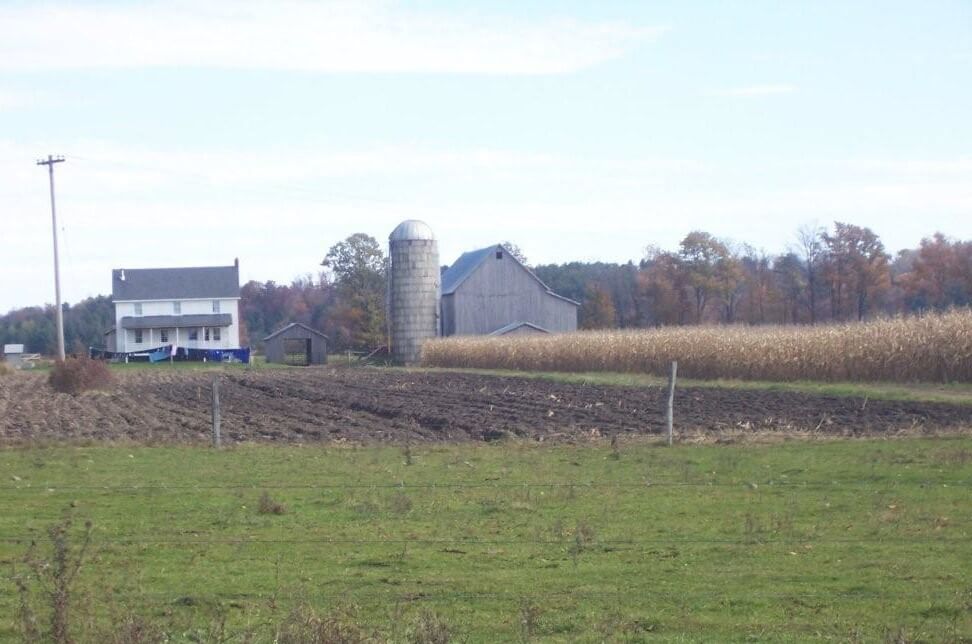
Another New York Amish community founded by settlers from the Keystone State is found at Lowville (three districts), in Lewis County, home of the original Amish immigrants to New York. Settlers from Path Valley (Franklin County, PA) arrived in this region of upstate New York in 1999, and were joined by Amish settlers from the Lancaster County daughter settlement in St. Mary’s County, Maryland.
As with many other Amish migrants to New York, relatively inexpensive farmland was a big draw for the Lowville newcomers. Settlers left behind high prices for acreage in both Pennsylvania and Maryland and set up dairies in this less-populated region of New York. Farming is common here, and local Amish are able to provide higher-grade milk thanks to bulk dumping stations, reminiscent of the arrangement found in the Swartzentruber Amish community at Heuvelton, (NY).
Lowville Amish maintain a stricter Ordnung than that common in Lancaster County, with its entrepreneurial orientation. Johnson-Weiner reports that “The Lowville settlement has yet to permit telephones in shops or even to put up a phone booth for use by community members” (New York Amish, Johnson-Weiner, p89). This stands in stark contrast to the Pennsylvania and Maryland communities, where cell phones and phone shanties are common.
Other New York Amish Communities
New York is home to nearly five dozen Amish settlements. The Amish of these varying communities, spread across the state, come from a variety of different backgrounds and follow widely differing Ordnungs. Diversity has implications for life within Amish society. The closeness of one community’s Ordnung to that of another may determine to what degree two Amish groups interact.
In addition to the Swartzentruber, Byler, Old Order, and Andy Weaver groups detailed here, New York is also home to Swiss Amish settlements, in the upper north part of the state (Norfolk, 1974, one district), as well as at Clyde (1997, three districts) and Prattsburgh (1979, one district) to the west. Diverse approaches to Amish life impact everything from the way one makes a living, which other Amish groups one interacts with, as well as relations with the non-Amish public.
Controversy and conflict in the Empire State
Some Amish have been well-received by local New Yorkers. Karen Johnson-Weiner points out that Amish arrivals to Lowville in Lewis County were greeted with open arms. Locals saw in the Amish immigrants the arrival of positive values and economic revitalization. More progressive Amish in other areas of New York also may host benefit suppers open to the public, which fosters ties and promotes cooperation.
In other areas, however, the relationship between Amish and non-Amish New Yorkers has not been so sunny. Conflicts have occurred over horse manure and building codes. Some of these conflicts have been elevated to legal battles in which Amish religious rights have been pitted against local regulations.
A factor in such disagreements is the conflict between Amish ways and local expectations. Due to previous experience with Amish, or pre-existing perceptions, non-Amish New York residents may expect Amish to behave and operate in a specific way. In reality, the practices and orientation of Amish can differ widely among different affiliations.
Some Amish groups in New York also adhere to more restrictive standards, which leaves less room for compromise over an issue such as building codes, and subsequently greater chance for conflict. As the Amish population continues to grow in New York, diverse practice among Amish will factor into relations with non-Amish communities.
Tourism in New York Amish communities
Tourism exists in New York Amish settlements, but to nowhere near the degree it does in better-known Amish communities such as Shipshewana in Indiana or Lancaster County, PA.
In an interview on the Amish America blog, Amish scholar Karen Johnson-Weiner noted that “Some counties have created maps showing the location of Old Order businesses. This is the case in western NY, home to the oldest Amish settlement. Other counties have mentioned Amish settlement in tourist brochures, and there are a number of local shops in areas of Amish settlement that offer Amish-made items for sale.”
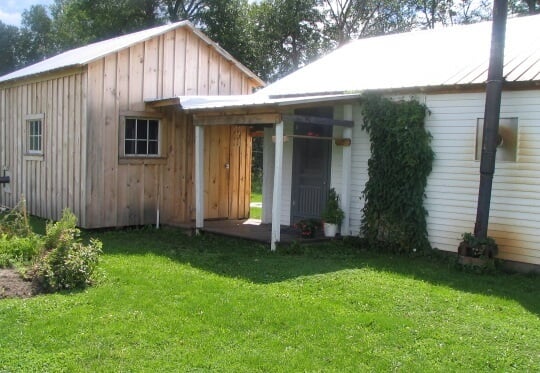
Tourist industries in New York may focus on quilt making, producing products for sale to visitors such as baskets and furniture, and even offering services such as buggy rides and homestyle meals (read more on Amish furniture in New York). Though there is no hard and fast rule, the level of tourist development often depends on how conservative a community is, how large and well-established it is, and its proximity to population centers.
Where can you visit Amish in New York?
The answer to that question is really just about any community, but it depends on what you want and expect. In even some of the smaller communities, Amish run shops and other businesses. But they may be few in number. Larger settlements naturally provide more options to find Amish products and interact with Amish people (the best way, as an outsider, is to visit their stores).
Keep in mind there is no “Lancaster County” in New York – ie, there is no heavily-tourist-oriented Amish community in New York state. However, good choices of Amish communities to visit in the state include:
- Conewango Valley – many Amish businesses in a relatively traditional, and sizeable, community. Has solid promotion of the local Amish tourist “attractions” (Amish businesses), marketed as New York’s “Amish Trail”
- Heuvelton – the state’s largest settlement, this plain Swartzentruber community is home to many small businesses. Far-flung however, lying near the Canadian border
- Clymer – a good-sized and relatively progressive Amish settlement in western New York
- Mohawk Valley – this region provides the opportunity to visit multiple Amish settlements within a relatively short drive, and observe the differences between them
Failed Amish settlements in New York
On the whole, Amish have found success in settling in New York. While different Amish settlements grow at a different pace depending on a number of factors, most settlements founded by Amish in New York are still in existence today.
There have been at least three that have gone extinct, however. These include the original settlement at Croghan in Lewis County (1831), which eventually assimilated with more progressive church movements, as well as a settlement at Sinclairville in Chautauqua County in Western New York, which lasted a decade from 1950-1960.
Recently, the Amish settlement at Poland, New York, became extinct after five years in existence (2002-2007). A new community, unrelated to the first, established itself at Poland in 2007.
New York Amish Today
Amish continue to arrive in New York today. The Amish population in New York has been described as the fastest-growing in North America.
In the past ten years, Amish have established over a dozen settlements in New York, many attracted by the prospect of inexpensive farmland and communities more isolated from pressures found in other Amish settlements. These newer settlements typically number just one or two church districts, but prospects for growth in many are good.
As New York continues to offer Amish settlers suitable land and relatively sheltered locations in which to found communities, Amish settlement in the Empire State is likely to continue.
For further information, see:
- New York Amish: Life in the Plain Communities of the Empire State, Karen Johnson-Weiner
- The Amish in America: Settlements that Failed, 1840-1960, David Luthy
- “Amish Population in the United States by State and County, 2021“, Young Center at Elizabethtown College
- “Amish Population, 2021“, Young Center at Elizabethtown College
- The New American Almanac, Raber’s Bookstore (Baltic, Ohio), Ben J. Raber
New York Amish on the Amish America blog
New York Amish have been featured on the Amish America blog on numerous occasions. In 2008, a reader shared photos from the Byler Amish settlement in Montgomery County, New York. In early 2009, Professor Johnson-Weiner discussed her upcoming book on the New York Amish, and topics such as factors which have caused Amish to move to New York, areas of conflict, and tourism. In a post entitled “Marketing the Amish”, we featured a photo of the Amish Market in New York City.
New York made headlines as one of a number of states with large increases in Amish population in both 2008 and 2009. Warning signs in New York were mentioned in a post examining buggy safety across America. Settlers from New York were among those Amish who helped clean up after Hurricane Wilma hit Florida in 2007.
All posts tagged New York Amish
Photo credits: Amish at farmer’s market-daned (photo cropped); Conewango Valley Amish toy shop- Tom in New York; Clymer home, maple syrup business, and skid house-Karen Johnson-Weiner; Mayville farm and buggy-Brock Zeigler
Mayville Bylers
Sorry if this has been mentioned before but wanted to note… I just drove through the Mayville Byler community yesterday for the first time. Having grown up near the New Wilmington settlement, I was surprised at the similarities, yet differences I noticed in Mayville. While the buggies and homes looked very similar to New Wilmington, the Mayville group is noticeably more conservative. The homes are rougher looking, many with unfinished siding or chipping paint. The lawns are less manicured, to the point that I almost thought some were abandoned (upon closer look, they were occupied). The biggest noticeable difference (despite your description saying otherwise), is this group does not use lighting on their buggies. They either had kerosene lanterns or nothing. I saw many buggies, both on the road and parked, and none had any noticeable electric lights. They had the same tan roof and orange triangle, and reflectors as other Bylers, but no lights. While a minor detail, I think it’s noteworthy to point out, given how few groups still do this. It was also a different style of lantern than what I’ve seen on other conservative groups, such as the Nebraska or Swartzentrubers. Sadly, I did not get a picture. I do plan on going back eventually.
Wood/tree clearing
I’ve recently bought some property in Lewis County New York and am looking to offer trees/wood in exchange for free clearing and hauling away. I’ve been told that Amish farms may be interested. Do you have any advice on how I go about finding anyone interested?
Amish loggers
I don’t know if you ever found anyone, but simply stop at any Amish store, and ask someone working there. Or, like other English stores, there is usually a bulletin board by the door, where you can post want ads, etc. If no one working at the store knows of any loggers in the immediate area, write up a description of the job you need done, and post it on the bulletin board.
I used to know an Amish guy with 2 Percherons, who worked with an English guy, who had a pickup truck. They both went in on the horse trailer, and a portable corral. They took the horses all over Western NY, clearing out dead wood, and thinning out forests. If needed, they would set up the corral on the property they were working on, leave the horses there with feed and water, and get a hotel room for the night. This way they covered quite an area. You could end up finding someone who doesn’t live in the area, but has a partnership with an English with a 4×4 and a horse trailer.
Looking to have a small house or cabin built
I recently purchased a property in Smyrna, NY and want to have a small home/ cabin built for weekend getaways, nothing too extravagant, maybe 700-900 sqft. Was wondering if anyone has worked with any Amish builders in this area who might be recommended. I also will need a small amount of trees cleared where the house would go. Please email me. mcmakuch@gmail.com
Roofing
I am looking for Amish Roofers for steel roofing in Elmira Heights, NY
Sawmill near Utica?
Hello,
I’m looking to find a sawmill near the Utica area. I know of one on rat 26, but that’s about 45 minutes south of us. Does anyone know of one within 30 minutes of Utica?
Thank you!
Roofer in the Nunda area
I’m looking for contact information for Amish who could reroof a residential house in Nunda. High pitch roof.
looking for builders
need new porch old one rotted
roof flashing and estimate on porch roof
I live in Cortland, NY looking for Amish roofer
Kitchen Cabinets
Looking to have kitchen cabinets made and installed
live in Alden NY
Builders
I’m looking for Amish builders in the Lake George area
Lake George
I didn’t know we had Amish in Lake George. I know there are some in Palatine and I think Fort Ann.
Close to lake George
There is a growing Amish community in Whitehall NY
Church roof needed
I am looking to hire roofers to tear off old shingles and put synthetic underlayment and then attach new roof shingles to our church building. It is approximately 40 feet x 80 feet single story with a 20 by 30 side room
Church address
8 River Road
Newton Falls, NY 13666
My mailing address
3052 Huff Road
Cape Vincent, NY 13618
Thank you.
Lord Bless you!
Sounds like the Amish in NY are very strict and conservative.
Progressiveness
I was just in Sherman, Chautauqua County, NY over 4th of July weekend. Driving around, the Amish schoolhouses had solar panels, and so did many Amish houses. These were Clymer Amish, who are much less strict than those in Mayville, in the same county.
sewing machines
I have 2 treadle sewing machines that I do not use. I was wondering if anyone in the Amish communities would be interested in these machines. They both work.
Sewing machines
I am interested in learning more about your working treadle sewing machines. Am not Amish, but am seeking treadle machine for use in a non-powered studio space.
Please respond if you are still seeking home for your treadle sewing machines.
quilting
I am looking for a skilled hand quilter . can you recommend someone to contact? Thank you.
Hybrid homes
I would like to visit a VIP in the Amish Community to turn my home into a Amish Home as a back up. So I would have basic utilities then if lights went out I would convert to Amish way of living. I call it “The Great Amish Hybrid Homes”. Let do Business love u I live in Upstate NY. Love u please think about this I am serious…Cindy S.
Where can I go to amish homes to order furniture I’m in Akron ny
Furniture
There’s a store on the north side of Main St in Williamsville-this is on your side of 78 (Transit Rd). Its named Amish Villa, and I think it is near Spalding Lakes. I don’t know of any homes you could visit-were you looking for a home based business?
I’m glad you touched on Chautauqua County settlements. My Amish neighbors are some of the best friends you’d ever want to meet. I’ve been to most of the businesses you pictured- even the Carriage shop in Conewango. The carriage maker had to make me a new set of shafts for my cart when the horse broke them! That shop is right over the County line, in Cattaraugus County.
Small world
I got to know a few Clymer Amish when my dad had some hunting property in Sherman, Chautauqua County, NY. We knew a logger and a leather worker, and a number of ladies who sold bread and pies. I didn’t know there were the stricter Mayville Amish in the area until our neighbor told us the differences.
Quilter
Is there a skilled hand quilter in the area? I would like to have a quilt top hand quilted.
Thank you.
Elizabeth
Amish builders
Are there Amish builders near Rochester ny, I have an approved lot and floor plans that can be provided for a cost. Thank you. Gino
Metal siding
we are hoping to find Amish metal workers to remove wood siding and replace with red metal siding, south side, two story barn. Central New York
Markets
It would be nice to know where the markets are and what they sell.
Amish vacation rentals
My wife and I are planning a trip to the finger lake region where it looks like there’s a lot of Amish communities. Where can we look for places to stay on there farm or where ever the Amish have rental units? We go to lancaster PA every year and have established good friendships with them and stay on there farms when vacationing down there. If anyone can help and direct us to some kind of directory that gives this info or any other suggestions would be greatly appreciated.
Thank you
Todd & Diana
Byler amish
The new wilmington amish with brown buggies are Byler amish? Does it mean they have both yellow and brown buggies? Or these are different subgroups not fellowshipping with each other?
Porch
I am looking for Amish builder to build a covered porch.
Hamburg, NY area
Moving out...
Not sure if you’ve heard this, or not, but the Amish in Whitehall, NY are moving out. Several of farms are listed for sale and others are obviously scaling down operations in anticipation of a move. Many farms have sold off their cows, but still building sheds, etc – for the moment. I believe they’re doing this (only) to keep some money rolling in while the farm gets sold, etc.
Several others have already moved to the Bombay, NY area over the last year or so. I was sorry to see them go, but had no idea bigger plans were apparently in the wind. I can only guess that taxes may be the reason…
It’s rather sad to see them going; they’ve been good neighbors and interesting to talk to and deal with.
Roof
Need help on roof
20x20 deck build Colton NY
Hello
I am looking for a team to dig 9 foundation holes for posts (4ft deep) and build a 20×20 deck on a 4 acre site. I have detailed plans. The site is on off a paved road (Coldbrook Rd) in Colton, NY. There is no power at the site, and there will not be power when I live there, ie off grid about 350 feet. The build will be in May or June 2026, after the path to the site is well dried out. I am glad to send the plans as pdf if you want to take a look.
Thanks in advance for your interest; I can be reached at
jacquelynsauriol@protonmail.com and this is really the only way to reach me, as I do not use cellphones with any regularity and do not get reception at the site.