
The Amish in Ohio: 2026 Guide (78 Communities)

The Amish have made their home in the Buckeye State since 1808, when the first settlers moved west from Somerset County in Pennsylvania to settle the hills and valleys of eastern Ohio.
Today, the Amish number an estimated 87,760 people in Ohio, found in 78 individual settlements. Ohio has the second-largest Amish population, behind only Pennsylvania.
Amish communities in Ohio include:
- Holmes County – The community centered in Holmes County is by far the largest in Ohio, with nearly 39,000 Amish residents
- Geauga County – The second-largest Amish settlement in Ohio, and fourth-largest nationwide, numbers over 22,000 Amish people
- Swartzentruber Amish – In addition to Holmes County, Ohio is home to numerous Swartzentruber Amish communities, including the sizeable community in Ashland and Medina Counties
- Nebraska Amish – Ohio is home to the only settlement of the conservative “Nebraska Amish” located outside of Pennsylvania
- Other Ohio Communities – A number of small communities are found across the state, including at Hicksville and Plain City, both of which are over 100 years old
The Holmes County Amish Settlement
The Holmes County area is home to the second-largest Amish community in the world. An estimated 38,775 Amish live in the greater Holmes County community, which also includes parts of neighboring Wayne County, Tuscarawas County, and Coshocton County.
The Holmes County settlement also stands out as the most diverse Amish community in the world, with around a dozen different affiliations represented here. They range from the most conservative to the most progressive.
This makes Holmes County different from other large settlements, such as Lancaster County, Pennsylvania, and Lagrange and Elkhart Counties in Indiana. Both of those settlements consist of a single Amish affiliation.
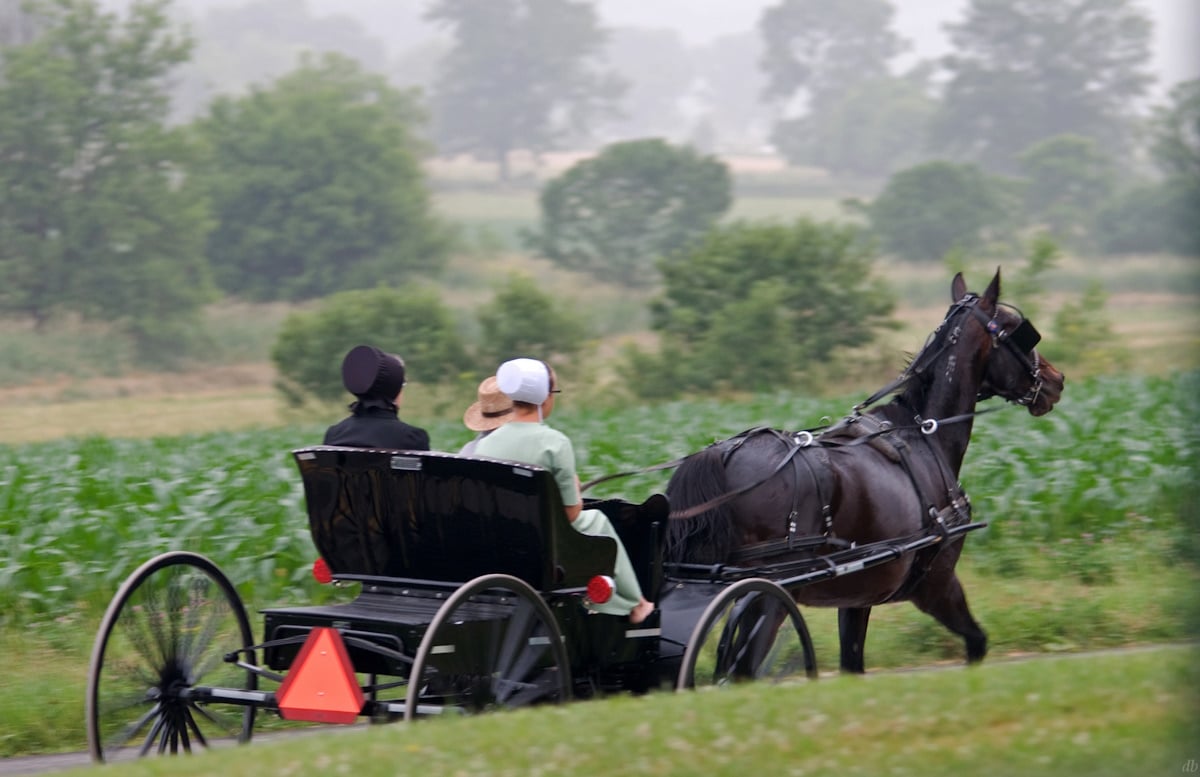
The groups in Holmes County include the progressive New Order Amish, the numerically largest affiliation, known simply as the Old Order (or “mainline”), to the somewhat more conservative Andy Weaver or “Dan Church” Amish, and finally the Swartzentruber Amish, a very tradition-minded group resistant to technological change.
Amish mainly live in the eastern half of Holmes County, though in the 21st century they have settled in greater numbers in the western direction.
Significant numbers of Amish are found in Wayne County, as well as in neighboring Tuscarawas County (near the towns of Sugarcreek and Baltic), as well as in Coshocton County to the south. Holmes County is known for its hilly terrain, which gradually becomes flatter as one approaches Wayne County to the north.
To the west, Amish from the settlement have formed church districts (congregations) geographically distinct from the main body of the settlement, notably around the town of Lakeville.
Berlin is the small tourist-focused town at the heart of the Holmes County community. Mount Hope is another town notable for its auction house and proximity to numerous Amish-owned furniture shops.
Other towns in the community include Winesburg, Charm, Farmerstown, and Becks Mills, as well as Millersburg, the county seat. Holmes County is notable for the Holmes County Trail, a renovated railbed which has been converted into a recreational trail extending into Wayne County. Amish frequently use the trail for travel. One half is designed to accommodate the horse-and-buggy.

Amish in Holmes County work in a variety of occupations. Farming has long been in (relative) decline in the face of growing populations and scarce land. A minority remains in dairy farming, with some Amish raising produce.
Small business is popular among Amish in this settlement, with many Amish furniture shops, manufacturers, and homebuilders operating out of the settlement (read more on Amish furniture in Ohio).
The tourist industry, though not quite on par with that seen in Lancaster County, is also well-developed in Holmes County. It is largely centered around the towns of Berlin, Walnut Creek, and Sugar Creek.
Holmes County is also notable for having a high percentage of Amish children who attend public schools. While still a minority compared to those attending Amish-run schools, many more parents elect to send their children to local public schools than do so in the similarly-sized community at Lancaster County.
The Swartzentruber Amish
The Swartzentruber Amish are arguably the most conservative Amish group. They originated in 1913 as the result of a division in Holmes County, and it is here that they have their largest population today.
Swartzentruber buggies are easily discerned by their lack of orange slow-moving vehicle triangles. Swartzentruber Amish resist change and have only slowly adopted modern conveniences. The presence of an outhouse, lack of indoor plumbing, and dirt lanes are all signs of a Swartzentruber home, and reflect the group’s emphasis on plainness and tradition.
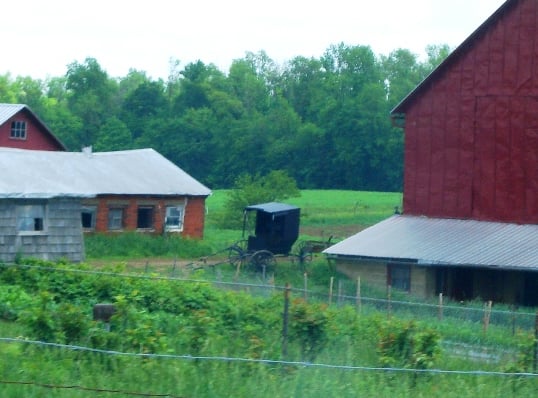
Swartzentruber Amish have also stayed on the land to a greater degree than their more progressive cousins in Holmes County, opting less often for the home enterprises that have become popular throughout the settlement as a way of making a living.
Another sizeable Swartzentruber settlement is found a short distance away in the Lodi area of Ashland and Medina Counties (see “Conservative communities in Ohio” below).
The New Order Amish
New Order Amish, comprising only a small percentage of all Amish, find their largest grouping here in Holmes County. The New Order group is distinguished from other Amish affiliations in that most New Order churches hold Sunday Schools on alternate Sundays. Additionally, one could say they have a more “outward-looking” approach to Christianity. While, like other Amish, they do not actively proselytize, they have exhibited their relative openness to outreach by printing tracts and pamphlets outlining their beliefs.
Interestingly, New Order Amish tend to be generally more progressive when it comes to technology, but are quite conservative when it comes to use and cultivation of tobacco, as well as youth courting standards, creating a dichotomy that prevents easy labeling. The New Order Amish came about in the 1960’s, and have since spawned a few other groups, including the “New” New Order, which allows a greater degree of technology and electricity. Read more on the New Order Amish.
The Old Order Amish
The mainline Old Order Amish are the largest affiliation in the Holmes County settlement. Old Order Amish live next door to their neighbors of other affiliations. Like other groups, Old Order Amish do not exchange ministers with Amish of other affiliations, but cooperate with other Amish churches on numerous levels, including in such matters as business, road safety, and schooling.
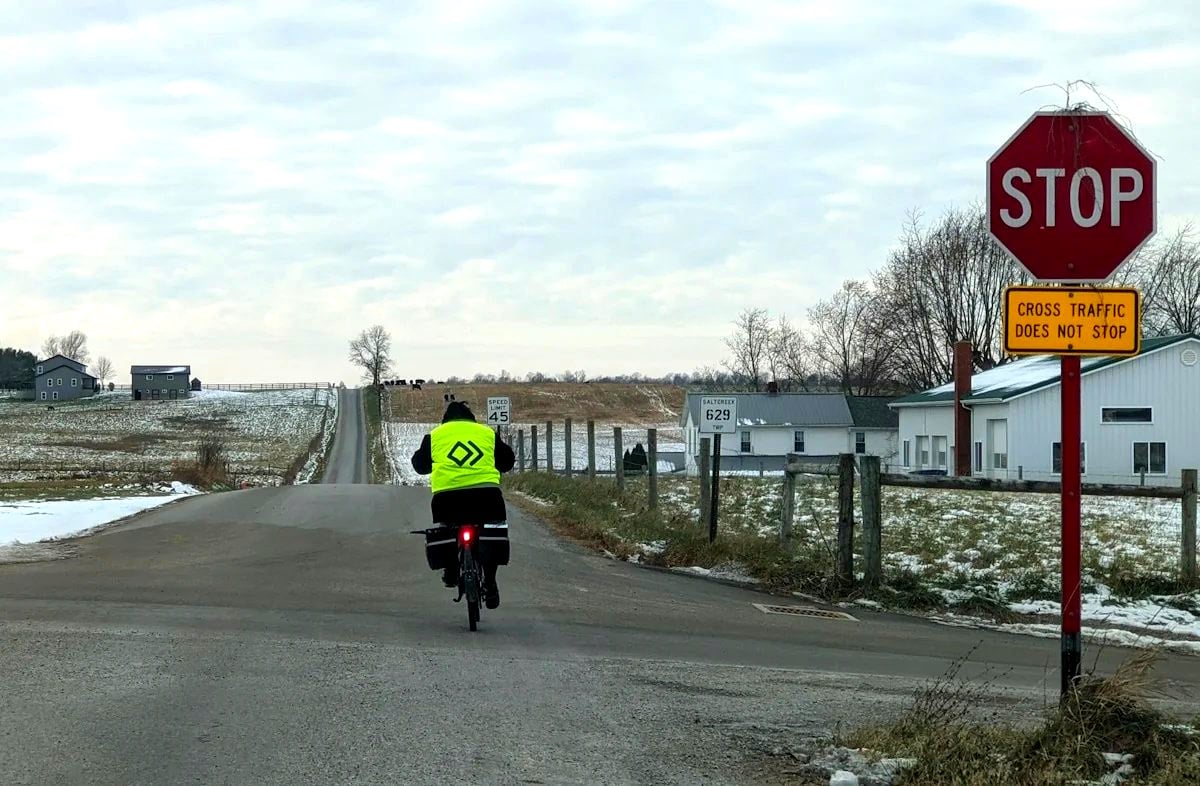
Unlike in the Lancaster County community, a significant percentage of Holmes County Old Order Amish send their children to the local public schools, which in turn have often adapted to accommodate Amish practices.
The Andy Weaver Amish (aka “Dan”Church)
The Andy Weaver Amish affiliation emerged in 1952 over disagreements concerning the application of social shunning. The name “Andy Weaver” comes from an early leader – while the commonly-used nickname “Dan” church comes from the fact that at one time, a number of leaders in one church all bore that first name.
Andy Weaver Amish are known to be technologically conservative, and also stricter on church matters than the Old Order Amish. Andy Weaver Amish hold to a strict interpretation of the doctrine of social shunning, which sets them apart from the Old and New Order affiliations (and would bring them more in line with the traditional practice of Amish in Lancaster County, PA, for one).
Andy Weaver Amish are more liberal regarding tobacco and alcohol use, but also have stricter youth standards, such as a prohibition on ownership of cars while living at home. Andy Weaver Amish have daughter settlements in other communities, including in New York. Read more on the Andy Weaver Amish.
The Geauga County Amish community
Not too far to the north of Holmes County lies the Geauga County settlement. The Geauga County community is the second-largest Amish settlement in Ohio and fourth-largest in North America, with 165 church districts and a population of approximately 22,125 Amish as of 2026 (see Young Center, “Twelve Largest Settlements”).
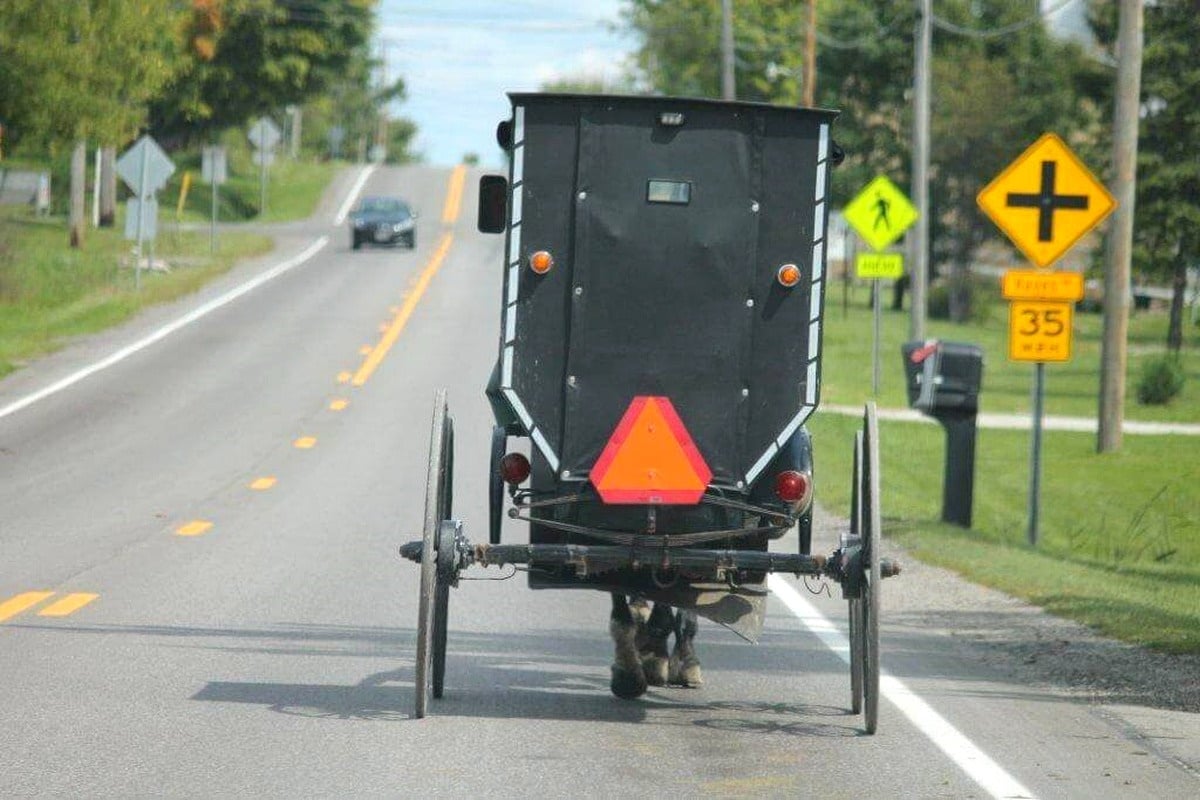
The Geauga County settlement was founded by Amish from Holmes County, who made the trek north in search of farmland. Amish arrivals from Holmes County first settled here in 1886.
Like Amish in other settlements, Geauga County Amish make a living running small businesses, farming, and doing manual labor. Factory work is quite common here as well, more so than in many other communities.
Among the businesses are furniture and machine shops, stores, and construction companies. Some Geauga County Amish also supplement their income selling maple syrup, tapping into the extensive maple forests in the area. A tourist industry exists, though it is somewhat less-developed than that of other large settlements.
The Geauga settlement is centered around the town of Middlefield, and today stretches into Trumbull, Ashtabula, and Portage Counties. While the Geauga community was started by settlers from nearby Holmes County, today ties between the two communities are not as strong as one might suppose, given their close proximity and common roots. Geauga County is home to two main groups – a “mainstream” group, and a number of more conservative church districts, locally referred to as the “number twos”.

The Geauga County community has developed a reputation for wild youth behavior, including cases of excessive drinking and large youth parties. Incidents of Amish youth misbehavior have been covered in the media fairly regularly, including stories of intoxicated buggy drivers.
The Geauga County settlement is to some degree overshadowed by the Holmes County settlement to the south. Nonetheless it is a major Amish population center in both Ohio and the country as a whole.
Conservative Amish Communities in Ohio
In addition to the large Swartzentruber presence in Holmes County, Ashland and Medina Counties (1952) are home to a collection of conservative Amish churches. With a population of 2,550 people in 17 church districts, it is the third-largest Amish settlement in the state (though a distant third).
Amish here are of Swartzentruber affiliations, and represent all three sub-groups within the Swartzentruber family. This group is commonly referred to as the Lodi Amish, after a nearby town.
One finds numerous small businesses in Ashland and Medina counties, most of them oriented to the low level of technology permitted by the Swartzentruber affiliation. These include greenhouses, small-scale furniture makers, food producers, as well as shops that cater to the Amish, including harness shops. Amish here also maintain a strong farming tradition, with both dairy farming and produce farming common. Read more on the Ashland and Medina County Amish.
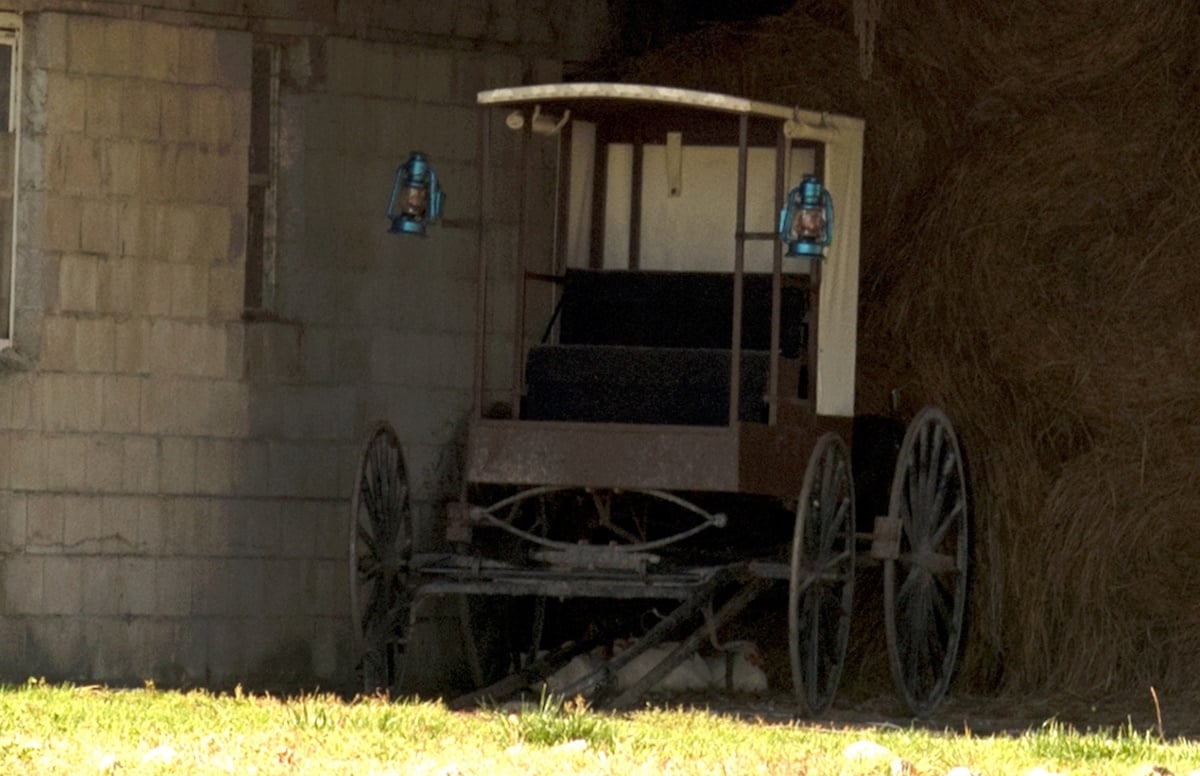
Ohio is also the only state besides Pennsylvania with a population of “Nebraska” Amish, located in the eastern part of the state near the town of Andover (1992), and numbering three congregations in size, and approximately 150 people.
The white-topped buggies of the highly conservative Nebraska group mark them as distinct from others in the state. The group’s nickname comes from the origin state of an early leader and members. Read more about the Nebraska Amish affiliation.
Other Notable Ohio Amish Settlements
Sizeable Amish populations are also found in other locations around the state. Ashland County is home to another community, of 955 people (founded 1954), notable for their use of gray Slow Moving Vehicle triangles, outlining a smaller orange triangle in the center.
Amish near Kenton in Hardin County (1,355 Amish, founded 1953) also employ gray rather than orange reflective material, arrayed in an unusual pattern. Knox County, near Fredericktown and Bellville is home to another sizable community, numbering 2,090 Amish in 15 church districts (1973).
Small Ohio Amish settlements
One of the oldest, yet among the smaller Ohio Amish settlements is found at Hicksville (founded 1914) near the Indiana border. Founded over 100 years ago, today this community remains a relatively small size, with around 200 Amish living there.
The long-lived Amish settlement at Hartville in Stark County recently went extinct after more than a century in existence (1905-2007). A similarly long-lived community existed at Plain City (1896) in Madison County, yet ceased to exist in the 21st century.
Numerous other communities exist across the state. Many of them have been started in recent years, with well over half (44) of the state’s 78 communities having been founded since 2000. Most of these settlements number just one or two church districts (congregations) in size.
For a full list of Amish settlements in Ohio, check the “Amish Population in the United States by State and County, 2026” resource linked at bottom.
Old Order Mennonites in Ohio
In addition to Amish, Ohio is home to a substantial Old Order Mennonite population at Shiloh in the north-central part of the state. Old Order Mennonites are also known as horse-and-buggy Mennonites, and share many things in common with the Amish, including plain clothing, the Pennsylvania Dutch language, and common religious beliefs.
This group at Shiloh originated in Lancaster County, and has lived in the area for a number of years, farming and operating small businesses. One Old Order Mennonite family operates a large variety store featuring fabrics, pottery, and a number of other items, and housed in a large converted barn.
The Buckeye State: Home to a large and diverse Amish population
In total, Ohio is home to over 87,000 Amish, spread across over 700 individual church districts (the largest number of congregations in the nation). Ohio also has the largest number of individual settlements, with 78 as of 2026.
Since first settling here in the early 1800s, Ohio’s Amish population has grown to become one of the largest, and most diverse of any state in the country.
For more, see:
- “Amish Population 2026” Young Center for Anabaptist and Pietist Studies, Elizabethtown College https://groups.etown.edu/amishstudies/amish-population-2026/
- “Amish Population in the United States by State and County, 2026“
- An Amish Paradox: Diversity and Change in the World’s Largest Amish Community, Charles E. Hurst and David L. McConnell
- “Plotting Social Change Across Four Affiliations”, Donald B. Kraybill, The Amish Struggle with Modernity, eds. Donald B. Kraybill, Marc Alan Olshan

Adams County
Adams County, Ohio also has Amish communities. I think they came there in 1976. It’s my understanding that if a community grows too big, some Amish families will move, always going where there is good farmland. I enjoy traveling to Amish communities. They sell very well made products! I would really like to attend an Amish church service but an Amish man told me that they do not invite people to their services. A big event for our family has been the benefit for the Amish school in Adams County.