
Saloma Miller Furlong on Why I Left the Amish
Saloma Miller Furlong was raised Amish in Ohio. Why I Left the Amish is the story of her childhood and adolescence, and eventual departure from Amish society.

I enjoyed meeting Saloma for the first time this summer while in PA, and have always appreciated her comments here on the blog. I just recently had a chance to read Why I Left the Amish and found her story to be filled with tough moments but quite a page-turner (maybe for that very reason).
Saloma’s story is not a rose-colored version of Amish life but a real look at one person’s experience growing up in difficult circumstances. Saloma has kindly answered a few questions today about her Amish experience and book.
Why I Left the Amish book giveaway
Saloma has also offered a copy of Why I Left the Amish for a lucky winner. To enter this book giveaway contest, just leave a comment or question in the comments section.
For an extra entry, share this interview on Facebook (just email amishamerica@gmail.com letting know you did). We’ll draw and announce the winner next Thursday, Feb. 2.
Saloma Miller Furlong interview
Amish America: Can you share a bit about yourself and your Amish background, and also how this book came about?
Saloma Miller Furlong: I grew up in Geauga County, Ohio, in a family of seven children. My family was a dysfunctional one (mentally ill father, a mother who did not protect us, and an abusive older brother). I often felt that my life was unbearable, and yet I thought there was no help for my family because the people in the community were not inclined (nor were they equipped) to deal with our family problems.
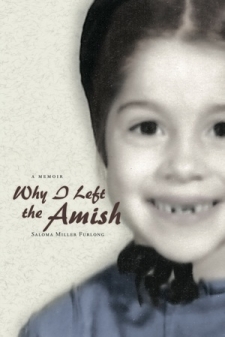
Then I found out that there was indeed help for our family, but we had to reach into the outside world to get it. My mother refused to allow an intervention, which is when I escaped at twenty years old. My book concludes with the first time I left.
The first time I thought about writing a book about my life experiences was the second time I was leaving. The Amish had hired a van driver to bring the bishop and his wife, my uncle, who was also a minister, and his wife, my brother, sister, and a friend to go to Vermont to escort me back to the community. I did not think I had a choice, so I returned and stayed nearly three more years before I left a second and final time. So when I was leaving the second time, an “English” friend urged me to write my story and soon, so that I would remember the details. She was the first, but she was not the last to say, “You need to write your story.”
What I didn’t know when I left the second time is that I could not just turn my back and walk away from my past. There came a time when I had to reckon with the abuse from my past, which led me to therapy. During this healing process, journaling became important. When I finally felt I had come through the hardest part of my healing, I had the urge to write for others. I began that process 17 years before my book made it into print.
How typical or atypical was your experience growing up Amish?
Saloma: I have often been asked this question at my book talks, and I always say, I simply do not know. Wherever there is abuse, there is also a cloak of secrecy. I believe the first step in breaking the cycle of abuse is to break the silence that shrouds it. Because of the insular nature of the Amish community, that cloak is thicker and more impenetrable than ever, which makes it nearly impossible to find out how much abuse exists in their communities.
I believe there are well-adjusted Amish families, from what I saw while I was teaching school for two years. I just have no idea what percentage.
In your book you describe the abuse that you and your sisters experienced, the difficult relationships with your parents and older brother. But what are your happiest memories from your time at home?
Saloma: I loved what I call “homemade fun.” I remember we used to take a blanket and fold it in half. A small person would lay down on it, and then two bigger people would hold two corners each, making a swinging hammock. We’d swing the child back and forth, and then “land” him or her on the couch.

I loved jumping rope. And I used to love to swing on the rope swing hanging from a tall branch of an oak tree next to the woodshed. My sisters and I played “house” for many hours in the woodshed or the corncrib. In the fall we used to rake together freshly fallen leaves into a big pile, and bury one another. Sometimes our pile was big enough to bury three or four children at once. We also used to try to catch the falling leaves, which were as elusive as butterflies.
Your detail the tribulations of dating in an important section of the book. How does dating work in your community?
Saloma: Erik, you would have to ask me that. I’m always embarrassed to answer this question. My home community practiced “bed courtship.” It is believed that this practice derived from “bundling” in which a board was placed between the man and the woman during the time our ancestors were being persecuted back in Europe. This allowed young people to hide from the authorities in upstairs bedrooms, which were often cold.
Bundling allowed both people to stay warm under the bedcovers, while ‘visiting.’ Many generations ago, the board disappeared, leaving the bed courtship rituals. Even the Amish who still practice bed courtship (and most communities no longer do) are embarrassed to talk about this practice, because it is hard to explain to outsiders that they are not encouraging their young people to have sex, even though they allow them to go to bed together.
There’s much more about this in my book.
How many youth do you think join church the way you describe your own baptism–uncertain and reluctant?

Saloma: I have no idea. Most people’s feelings were well-guarded, so I would not have been privy to how they felt about their baptism. These kinds of things were just not talked about. I sure could not share with anyone Amish how I felt about my own.
What are the good and bad sides of life as an Amish female?
Saloma: This is a very general question. I wouldn’t begin to try to answer this for anyone else. A positive for me was that I didn’t like doing farm work. Though I had to do some, if I had been a male, much more would have fallen on my shoulders. I enjoyed the women’s gatherings, such as quiltings or getting together for the day to take on some project. I think I’ve already mentioned the feeling of having no power, especially as a young girl. This was the down side for me — especially having so few directions that my life path could possibly take if I stayed Amish.
What ties do you still have to your home community?
Saloma: My ties to the community are dwindling. My parents are both deceased, and one family I used to visit when I went back to Ohio, moved to Kentucky. All my sisters have left the community. When my parents were still alive, we visited them regularly, and we attended both of their funerals.
Had you grown up in a healthier family situation, would you still be Amish today?
Saloma: I have often been asked this question at my talks and it’s one I cannot give a definitive answer to. For one thing, I’d have to have been endowed with a different nature — one that does not have fundamental questions boiling up from within. And that begs the “nature versus nurture” question — was it my circumstances that gave me that insatiable desire to ask questions, or was it inherent in me when I was born — who knows?
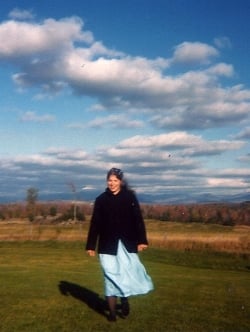
But this I do know. Even if I’d had a good Amish childhood, I imagine that I’d still have yearned for more education. And that alone may have been enough for me to face the loss of community that comes of leaving the Amish. Maybe. This is a question I simply cannot answer.
Why I Left the Amish ends when you arrive in Burlington, Vermont, having finally taken the step of leaving home. Will you continue the story?
Saloma: Yes. I am co-writing the second book with my husband, David. He and I had met during my first stay in Vermont, which was only four months. We had been dating for about seven weeks when the Amish came to take me back. David had to watch this happen, knowing it was not my choice, and also knowing there was nothing he could do about it. He visited me in Ohio (the second time resulting in a thorough rejection) and he kept in touch with me via letters.
Finally, two years after I rejected him, I wrote to him, which started the four-month process of the two of us renewing our relationship. We married a year and a half after I left the second time. David’s voice is important in this story, because he has a perspective of many events that I don’t — I had no idea at the time that I had turned off all my feelings like a faucet at the kitchen sink turns off the flow of water when the Amish came to fetch me back to the community. He claims there was no light in my eyes and no feeling in my voice.
For an excerpt of our book (about our first date), you can visit my blog.
Where can readers buy your book, and find you online?
Saloma: The book can be bought at the following locations:
1. A signed copy directly from me online (Or come to one of my book talks: See my schedule of events.
2. Your local bookstore — most bookstores are happy to order the book if they don’t already carry it.
3. on Amazon
4. On Barnes and Noble
You can visit my blog and website. Also, I will be telling my story in a documentary called “The Amish” that will air on American Experience on February 28, 2012. After that, this documentary can be seen on their website. (They have chapter one of the film available now).
Photo credit: 1st Saloma Miller Furlong photo by Kerstin Martin
Why I Left the Amish winner (and excerpt)
Today we have a winner and excerpt of Saloma Miller Furlong’s memoir, Why I Left the Amish. Thanks to all who participated and a special thanks to Saloma for taking the time to respond to everyone’s comments. There were some very interesting discussions.

I’ve added in the extra Facebook share entries, and used random.org to generate the winning entry (if you left more than one comment, that is perfectly fine, but for contest purposes we just count the first one). The winner:
#35 Christine Slaughter
Congrats, Christine. Please send a physical address where you’d like your book sent to amishamerica@gmail.com, and Saloma will get that out to you.
We’ve also got a short excerpt from the book:
Why I Left the Amish – excerpt
I couldn’t sleep all night. I tried not to toss and turn or wake Sarah, who was sleeping in the same bed. I kept thinking about the little suitcase only a few feet away, behind the closet door. I played the scene in my mind over and over. I’d wait in my room, in my gray dress, coat, white scarf, and boots until Mr. Pell drove into the lane. Mem would certainly announce when he came. Then by the sound of her voice, I would know whether she was in the living room or the kitchen. If she was in the living room, I would go quickly through the kitchen and out the door before she discovered I had a suitcase in my hand. If she was in the kitchen, I would tell her I was babysitting overnight at the place where I worked. This would also give me the extra day I needed to get out of town before anyone found out that I was gone.
I got up earlier than usual, but not so early that anyone would suspect. The yellow car drove in. Mem announced it from the kitchen. I went quickly down the stairs and came face to face with her. She was sweeping around the table, but she stopped and looked pointedly at the suitcase in my hand.
“I’m babysitting tonight at the place where I work.”
Mem looked at me hard, then at the suitcase, and realized she had no choice in this one. “Well, just don’t let it happen too often.”
“I won’t,” I said. I went quickly down the steps and out the door before she could call me back.
As Mr. Pell drove out the driveway past the kitchen window, I saw Mem looking out at me. Without thinking about it, my hand went up and I gave her a wave. I wondered if I would ever see her again. I knew it would be really hard for her when she found out that I had left. I also knew that if I started feeling sorry for Mem, I would not be able to leave. The car kept going. I was not running away blindly, I told myself. I had made plans and had money. I would be all right.
—–
You can purchase Why I Left the Amish from a variety of sources, including Amazon and Saloma’s site.


Re: Salomas book
I was raised in Tuscarawas County, and have had the opportunity to know and love some Amish families. However, it has always bothered me that the Amish lifestyle is portrayed like a Disney movie. I knew of the more private sadness, instead of the popular views.
My heart goes out to you for what you have been through, and I am so grateful to God for where you are now. One of the hardest things to do is to face ourselves- and you appear to have succeeded in doing this in a way that helps others. I would love to win this book and learn more of your story. Good luck to you and your husband in the success of the second book.
Lynn, thank you for your comments. The “Disney” version of the Amish bothers me too. But so does its opposite… the idea that the Amish can do no right. I find myself defending the Amish when someone wants to portray them as the latter at my book talks.
Thank you for your supportive sentiments about my life now. I am also grateful for everything that makes my life what it is. Thanks also for the good wishes for the second book.
I hope you get to read this book.
giveaway
Please enter me in the book giveaway. A very tho’t
provoking topic today. Glad to know more about Saloma.
Denise, thank you and good luck.
The other side of "cover-up"
While the “cover-up of abuse” is, unfortunately, certainly among some Plain People, the flip side is that there is a hesitancy to turn to civil authorities because too often the civil government’s way of dealing with abuse is to stick the abuser in a jail full of other abusers and sexually perverted people (some of whom dont want to be changed). Not exactly the best place to put someone who wants to be redeemed from his/her mistakes and failures…
And you cant really blame the civil authorities, since everybody who abuses someone will probably claim they want redemption and have no plans to continue the abuse. So it becomes a tough shot to call as to when to give someone a second and third or even fourth chance. And when that third or fourth chance is given (in agony, hoping for the best)… it will be seen as some as a “cover-up” when indeed it was meant to be an attempt at redemption. The alternative is letting the civil authorities slap a jail term, to sit for years among others with the same problem. Not to put down government … but the civil penitential system doesnt have a very good track record for redeeming.
I am speaking from past church experiences, and know the agonizing decisions ministers have to make, the hours they spend in counseling abusers sometimes, the tough decision to determine as to whether the repentance is real and will endure …
Then they extend the pardoning hand, praying and groaning in spirit that the offender will find victory.
And, yes, sometimes the offender does overcome, and although there are scars and wounds to heal, they soon fade away into a beautiful story of redemption. What if that fourth chance had not been offered?
Then there are those who are offered the fourth chance, and they fail again.
That hurts. Everyone. Then come the nagging questions, from within the minister’s own heart and from others. “Why did you give this person another chance??”
Just trying to share the “other side of the coin.” Sign me on for the book. 🙂
Mike
PS. This has nothing to do with Saloma’s particular situation. I know nothing of the details in her particular case. Unfortunately, “cover-up” does exist …
Mike, you bring up good points. This is all true whether the person is Amish or not. As one of my professors once pointed out: in our society, we don’t have a clear directive of what our penitentiary system should be doing — Redeeming? Protecting society from criminals? Punishing the wrongdoer? Educating? Or all of the above?
It isn’t always clear about whether a person wants to change, either. Sometimes offenders say they do, but they are using it as a way to abuse yet again.
I do know that the Amish system of making public confessions and having their wrongdoing “forgiven and forgotten” does not work for repeat offenders. It only adds to the vicious cycle. And it’s all they’ve got in their repertoire. They do not recognize that there is a psychological basis for some deviant behaviors.
Response to Primitive Christianity & Saloma Furlong
Re: 2nd chances &/or more, the offender has the responsibility to stand in front of the bishop,etc or the civil authority & confess his/her own actions. If an offender’s actions have to be reported by another, the offender must receive justice first, not mercy, because he/she didn’t confess & therefore is unrepentant.
The offender’s own actions lead to the consequence of civil prison or community shunning. The offender’s soul can’t be first; the victim (s) must be considered first. The sin/victimizing must be stopped.
Saloma, you will recognize me as a survivor from my attitude, I’m sure. Thank you for your attitude of not bashing the whole Amish community(ies).
Erik, please don’t enter my name in the giveaway; I’ll check it out at the library. Simple living for a bookworm means not holding onto as many books as I’d like.
cont. Response to Primitive Christianity & Saloma
I forgot to mention how excited I am to see this on American Experience. I will definitely be watching as I adore PBS shows.
Carolyn, thank you for your perspective. You make good points. I appreciate your commitment to reading the book.
Primitive Christianity, I so can see your viewpoint. I have an old friend who is an OO Mennonite bishop – he was faced with just such a situation as you describe. An older well respected man in his community was accused of improper conduct. They researched his case, dealt with it, and moved on. Years later, a non-Mennonite who had been abused by this man, went public. Turns out the abuse had not stopped, and my friend the bishop was accused by others in his community of being too lenient. They claimed to have known that the abuse had never stopped. Why did they not inform the appropriate people if they knew the older man was a homosexual pedophile? The bishop did his best with the information he had. And, yes, above all the abuse must stop!
Char, thank you for your comments. It sounds like you are very well versed in Amish ways. I’m so glad to know you don’t use the bonnet fiction as your authority on Amish culture and that you are reading the scholars too. I agree, Erik is doing much important work on the Amish. Thank you, Erik!
Thank you for your blessings. Many blessings to you as well.
interesting
Looks like quite an interesting read.
Thank you, David.
Would like to learn more
How interesting to read the interview. I would like to know more about the journey.
Thanks Gary. I hope you get to read the book.
when we first had the amish move to this area… i was searching for answers… the best thing i learned from her blog was that she felt the amish culture was overly romanticized. that has stuck with me since i read it over a year ago. it helps me remember that the amish face the same trials and tribulations as we do. never had a chance to read her book… but i’d love to!
Thank you, Sarah, for your comments. I’m glad my message stayed with you. I hope you get a chance to read my book.
@saloma… i am excited to read your book soon. your blog has offered me much insight to the lives of our new community members. while i have become very close to a select few, i am still having a hard time understanding their way of thinking. for instance (trivial as it may be) chairs… they’re only allowed chairs without padded arms? i questioned this… and my friend’s response was that it is how it always has been and she didn’t know why. to question why would lead to no good? if i don’t know why something is done a certain way, i question it… i just cannot understand that way of thinking… oh well, to each their own i suppose…
Leaving the Amish
I cannot imagine how difficult it must be to walk away from all of your family; even those who are cruel are still family. I admire your courage for doing so. It becomes a matter of survival.
I would love to read your story and will certainly be watching American Experience to see it.
Thank you for sharing it with us all.
Karen, thank you for your comments… you are absolutely right… it was a matter of survival. I hope you get to read the book.
GREAT interview, I love reading about the Amish and would absolutely love to have this book. I’ve added it to my wish list!
Wendy, thanks and good luck.
Saloma
I’ve just been to your blog… I find myself amazed at your balance in perspective. Despite the lack of true repentance from your abuser(s), and the pain that those you loved and trusted did not protect you from – still you seem to have been able to genuinely forgive, which for me doesn’t involve forgetting, not one bit. I too was abused as a child, in a different closed religious system and family. So I know how difficult the journey of recovery is. So thankful you found your “gemini twin” along the way, and have continued the journey with him. Your writing seems so important, on so many levels. Thank you for finding the courage to share your story. Blessings, Sara
Sara, thank you for your compliments. I try to strike a balance, and it’s gratifying that you think I do. As far as forgiveness goes, I still struggle with some of that. I feel I have more fully forgiven my father than I have my brother and to some degree, my mother, because the issues I have with them are more complex. It is an ongoing journey. Thank you very much for your appreciation of my story. I hope you get to read my story.
It is funny that we talk about the Romanticized Amish. There are a few author’s of Amish fiction that come to mind immediately. I am not fond of their writing. I have numerous books about the Amish written by scholars as well as fiction. I think what many English folk get swept up in is the higher standards we seem to put upon those that are Amish and for what reason do we do that? Because they are religious? Because they are more connected to their families? This is a question I ask myself over and over.
Not taking away from the abuse you endured Saloma as I feel NO person ever should live in a world of any type of abuse but why is that the English then stereotype the Amish and say “oh well they a beat there kids, or they all have puppy mills” This I find frustrating as it isn’t said in the same way when it is an Englisher doing it?
I am very eager to get your book, I was actually looking for it yesterday as I just finished Irene Garrett’s Crossing Over story.
I cannot imagine the heartache and pain you went through while making your decision. I cannot even being to fathom what you endured when you were taken back home after you had escaped. I as a woman am very proud of you for never letting go of hope and freeing yourself to a life your inner workings and God knew was for you.
I believe Amish/English can have an equal kinship with God. It is not a race, relgion or cree that is not with out the love of the Lord.
Thank you for sharing this truly amazing interview and should I not win I will have to order myself the book!
Somehow this comment was placed out of line… here it is again.
Allyson, you raise an interesting question… why don’t we hold the Amish to the same standards as anyone else? I think for many, the Amish represent the model of a good society, and so people don’t want to know about these things. And they also represent a defenseless society, so to hold them responsible to the same degree as we do anyone else looks like we are going after them. One Amish woman told me she was told by a social worker that she doesn’t know how to handle abuse from within the Amish. This Amish woman said, “Deal with it like you would with anyone else.” I wholeheartedly agree with this.
Love to win
sounds very interesting If I dont win I will be buying it
Barb, thank you for this.
Saloma, I am so very sorry that you had to go through this. I was blessed that your answers were straightforward and not judgmental. I can hear the healing and humbleness in your words.
Thank you, Lisa, for your thoughts.
Very informative and interesting interview. Saloma, it is very nice to “meet” you here. I have been contemplating buying this book from amazon for a few days, so I’m very glad to have this opportunity to read the interview and get to know you a little more. Even if I don’t win this, I will be purchasing it. Thank you for sharing your life with us, and being honest. I know it’s not always easy. Growing up in an abusive situation myself, I know it’s hard to tell a story, because even though there were all the bad times, there were also good times to remember. And it is so much easier…and in ways kind of okay in terms of yourself…to have a negative view and say negative things, but it can be bothersome when other people do the same. Even though that is what is provoked in a way when sharing. I’m not even sure I’m making sense now, lol.
Anyway, thank you again. I look forward to reading your book, and will look for the next when it’s released.
Sue
Oops, misplaced again… here is my response to you, Sue.
Sue, thank you for your thoughts. I sometimes think about how all those difficult things in my childhood helped shape me into who I am today. That is what grace is all about. And thank you for your commitment to reading the book.
Book Giveaway Entry
Saloma’s book sounds quite interesting…..I have always admired people whom are very humble and too be able to share their life experience’s……..look forward to reading Saloma’s book..’Why I Left The Amish”
book contest
I would love to read this book, and winning it would be great.
Thank you, Linda and James. I hope you get a chance to read my book.
Saloma's book
I have a profound respect for the way Saloma has come through her trials with a clear vision of herself and her past. From the interview it seems she can see both the weaknesses and the strengths in the Amish culture.
No matter where you go, in every culture, religion, occupation, beneath the traditional dress, business suits, uniforms and habits, people are always people.
I would love to read Saloma’ book.
Amen, Margie. Thank you for your comments.
I would sure like to read her book & find out more about her life in her growing up years , hope she is happy with her life.
Thanks, Rudy. I hope you get a chance to read my book.
Thank you
Thanks to Erik and to you, Saloma, for the opportunity to “try” for your book. I, too, have seen it on Amazon (no libraries in my system own it). I just checked out “Crossing Over” a couple of days ago, but haven’t started it yet. I want to see both sides.
While I read Amish fiction, I also read the non-fiction (history, personal accounts, etc.) and like to know both sides of a story (probably because I’m a Libra, always searching for balance!). I look forward to reading your story and if I don’t win it, I will purchase your book, too.
I also visited your web site, which I plan to return to when I have more time. (Your husband’s miniatures also caught my eye.)
I’ll also be looking forward to your second book, as it seems your story needs to be told, no matter how many volumes it takes. Anyone brave enough and determined enough to leave their community, their family, in order to find a “better way” deserves my admiration and respect. You are an inspiration!
Thanks again!
Alice Mary
Thank you, Alice Mary, for your thoughts. I always say, it was not courage that was the impetus for leaving, it was desperation. When the fear of the known is greater than the fear of the unknown, you leave that situation.
Glad you noticed David’s crafts. He is the talented one in the family… but here I go with that competitive humility again… David accused me of be schooled in it, which really cracked me up.
I try to work toward gaining a balanced view of the Amish and other religious and ethnic groups as well. And I think it is an excellent point that when any group (even just a singular family) isolates themselves, it is not a given that there will be secrecy and abuse, but nor can that possibility be overlooked, especially when the group includes especially vulnerable members. Thanks, Saloma, for your courage! I WILL read this book!
Judy, thank you for this thought. I agree with that… there is no given either way. And that is why I have to simply say that I don’t know. Thank you for the commitment to read the book.
Hi Saloma
One day the world will know about the true meaning of Grace. Isn’t wonderful, Saloma, to know it!
Thank you, Diane. Indeed it is.
Allyson, you raise an interesting question… why don’t we hold the Amish to the same standards as anyone else? I think for many, the Amish represent the model of a good society, and so people don’t want to know about these things. And they also represent a defenseless society, so to hold them responsible to the same degree as we do anyone else looks like we are going after them. One Amish woman told me she was told by a social worker that she doesn’t know how to handle abuse from within the Amish. This Amish woman said, “Deal with it like you would with anyone else.” I wholeheartedly agree with this.
Sue, thank you for your thoughts. I sometimes think about how all those difficult things in my childhood helped shape me into who I am today. That is what grace is all about. And thank you for your commitment to reading the book.
Comment on Saloma Miller Furlong on Why I Left the Amish (giveaway)
Interesting interview. I would love to win a copy of this book.
Johnda, good luck.
Between forgiveness and forgetting
Having already read the book and previously written to Saloma I don’t believe she would object to my responding to the issue of forgiveness. I shared with Saloma our similarities in struggling with the pain we carry from childhood and the need to give forgiveness to those who have neither asked for it nor even recognized the hurt inflicted. After many years and much soul searching I came to understand that all of my pain was buried in a coffin, cased in chains, never to be examined. I was so fearful that dare I venture to look back I would never be able to escape my past. That was my misunderstanding of how memory works. I had to look back before I could understand that I was the one in need of healing and that my healing would not come until I let go of the pain. Through the struggle of letting go I came to understand that God will not play tug-of-war. I had to let go before the healing could begin. Fully letting go of a problem involves a lot of heartache and tears, but once completed is amazingly cathartic.
Peace be with you all.
Merry, thank you very much for your comments. This is all so true.
Thanks for the interview!
Enjoyed this interview! It’s nice to learn more about Saloma. Please don’t enter me in the giveaway, as I already have a copy of her book. It’s an interesting story, and one I am glad she decided to share.
Hi Karen, it’s nice to see you in a different “setting.” Thanks very much for your comments.
Sister!
Saloma, I will be interested to read your blog and, hopefully, your book. It appears we have much in common, though I was never Amish. The culture of abuse, regardless of what group it happens to be in, is a culture of secrecy. Yet you and I (and countless others) have survived. I intend to thrive. 🙂
I believe God can take ALL our experiences and use them to make us stronger. There’s a great verse in Isaiah (51:3) that speaks of God taking our ruins and making gardens from them, giving us joy and “the sound of singing”. I just love that. It gives me such hope.
Blessing to you!
Onward!
Lisa, thank you for your comments. It is so true… our hardships can make us either bitter or better. It is a great feeling to thrive after suffering, then surviving. I have gratitude and joy for that!
Put my name in the hat
Thank you Tom and Nancy, and good luck with the giveaway.
giveaway
Wow what an interesting Q & A … I would love to read your book… Thank you for being honest …
This book sounds like a must-read and I will secure it ASAP. Glad to know you found your way to Vermont. I live in the Northeast Kingdom, have traveled many places around the world and found no place better than here. Both my boys live and work in Burlington and I always look forward for a chance to visit.
Dave, you’re a fellow Vermonter! Great to “meet” you. I love Burlington… I was just there over the weekend. We have so many friends there, which we miss terribly. But I sure don’t miss those long, cold winters. Thanks for stopping by!
book and movie...
Hi,
Went to the site and watched the video clip. Am anxious to see the PBS show, and read your book! If not now, hopefully I’ll be able to attend your spring Indiana book signing event. 🙂
Thanks for your work,
lf
Hello Sprouting Acorn, it;s great to see you in a different place! I also look forward to seeing the film — I’ve not seen any more than the clip. It’s called suspense…. Thanks for stopping by.
I so enjoyed reading your review. Lots of interesting things in it. I have always liked reading Amish books of all sorts for years now. I would like to enter to win this one as I know I will really enjoy reading it . Thanks ; ]
Ann, thank you for your comments, and I hope you get to read the book.
Your Story
My Dear Saloma:
I became very emotional reading your story. We tend to fantasize about the Amish life style as being so simple without the worry of the outside world and the Amish fiction writers of today write such beautiful books which mostly turn out as “they lived happily ever after”.
I had never really thought of your side of the story and you really opened my eyes. I am so pleased that you have found such a wonderful husband and apparently have a very happy and satifying life at this point.
I look forward to reading your book and the next one that you are writing.
God’s blessings,
Linda
Linda, I am gratified that my story touched you. I am also grateful to have found David and to be spending my life with him. I hope you get to read this book and the next one, too.
Your Story
Please enter my name in the book giveaway. The above review has wet my thirst to know more about Saloma.
Now that I am temporarily caught up with responding to comments, I would like to thank Erik for posting this interview and giveaway. Erik, your dedicated following attests to your thoughtful look at the Amish culture from many angles. I appreciate that you are including my viewpoint.
Many thanks to you, Erik.
Comment on Saloma Miller Furlong on Why I Left the Amish (giveway)
I have not read the book just the comments on Amish America. No child or adult should have to live with abuse wheather amish or non-amish. I’m not amish but grew up with a very abusive alcoholic dad. It happens in both worlds.
Linda, you’re right, abuse happens in every culture. Humans have a wonderful capacity for doing good, but we also have a frightening capacity for doing evil. I like to think that most people choose good most of the time.
Thank you for your comments.
Saloma,
NO ONE reads your words with more interest than I. My son became Amish 5 years ago. I wonder and worry about what he has committed himself to, and hope he truly is in a place to find the life God intends for him to have. Friends tell us we have “lost” our son, which is painful to consider. Am I living in denial to think that we have not lost him, but that he’s gone to a life that is much better, at least for him? Edward, now 27, graduated from a top university, with a degree in natural resources. He had met some folks from a small Amish community his senior year, and fell in love with the lifestyle. He was committed from day one. He is now married (as of November) and they are expecting.
I know that if he could visit with you he would grieve deeply for your past, and even rejoice that God brought you out of it. He knows the Amish are not perfect. However, I think he saw enough of modern life, especially how the church in America has embraced the world, that he believed this a good choice to make. With the decline of the family, pursuit of worldliness and the failure of the church to deal with these things, at least the Amish make an attempt to do so. Some are more successful than others. How sad it is that in most “English” churches there is no accountability at all! From the experiences he’s had in his community, they operate very differently, but often do not have success.
Saloma, thanks so much for sharing your life and past with us. You are a treasure to us, and I can’t wait to read your book…in fact, I think I’ll order one for my son.
Many blessings to you,
Anne
Anne, VERY interesting story. I would love to know so much more… which community he joined; what it’s like to be educated and live that way; what his relationship is with the people in his community… If you feel like emailing me, please do: salomafurlong[at]gmail.com
Thank you for buying the book for your son and yourself. I would be interested in his “take.”
Oh, Anne, I meant to say… I don’t think you have lost your son… he is merely on a different path than what you had envisioned for him. I certainly took a different path than what my parents envisioned for me. If this is right for him, then who are we to judge?
Your Book
Your book sounds absolutely mesmerizing. I would LOVE to read it. I read a lot, but books like yours are far and few between. We have a large Schwartzentruber community surrounding the small town I live in.
When I was young I played with Amish children a lot because a family lived on my aunt’s farm in a corn crib. 5 children and 2 adults and they were the nicest people i knew. I played with their girls and was treated very well by their parents.
Cindy, I hope you will find it so. Interesting living situation the Amish family had… I assume they had it fixed up like a house. Thank you for your comments.
Amish vs. English
I have had the opportunity to become aquainted with a few Amish families in Sauk Conty, Wisconsin. I always enjoy our time together. After reading just about anything Amish I can get my hands on and getting to know these families, it seems to me that the Amish are just like anyone else. Everybody has there own personality and quirks, “Amish” or “English”. Regardless of how one dresses or lives, we are children of God.
David, I agree wholeheartedly. Thanks for your thoughts.
Sounds like an interesting book! I can’t wait to read it!
Kristy, I hope you get a chance to read it.
Thanks for sharing part of your story through Amish America, Saloma. I would like to read your book and think I can get a copy
through our library, so don’t put me in the drawing.
It seems like there are several books about why people have left
the Amish. Is there a book(s) on the theme of “Why I Stay Amish”
which has a realistic view of Amish life, the positives and
negatives, yet focuses more on the positives than negatives? If
so, I’d like to see an interview with that person on Amish America.
Hello, Al. I don’t know of any books like what you describe, but that doesn’t mean there aren’t any. I think the decision to leave is much more deliberate, just by the very nature of it. Most Amish I know do not think about why they stay Amish – it is a given. But I think the documentary that is airing on February 28 will have plenty of Amish voices in it, so I think both points of view will be portrayed.
Love the interview and would love to learn more. Thank you for sharing your story.
Thank you, Ianore, and I hope you get a chance to read the book.
I appreciate your willingness to give a copy of your book away, Saloma. I also believe in supporting authors I like, though, so I just bought a copy for myself at Amazon (for my Kindle — it’s the best way to keep book clutter down in my house I’ve ever found!). I look forward to reading it.
I know that questions of abuse are difficult to answer no matter what the culture. And when it’s a culture that has a history of separation from the world and tries to handle its own problems within its own community, I’m sure the problems are compounded. I have great respect for your courage to walk away from the situation, and cannot imagine how painful it must have been. It sounds like you were definitely blessed with David’s support, as well. And not allowing the abuse to define the rest of your life, but instead learning and growing from it, speaks so highly of who you are as a person.
I’ve marked my calendar to watch the PBS show, and am off now to read your book! (That’s the danger of the Kindle — instant gratification! 🙂
Laura, thank you so much for your support in buying the Kindle version. I look forward to hearing your take on it, should you want to share it.
I think you’re right… the insular nature of the community does compound the issues of abuse, just as it would in any other culture that closes itself off from the rest of society.
Thank you for your compliments. Yes, David was there to support me the second time I left. But this first book does not go that far… it only takes you to the first time I left.
Happy reading!
Thanks for the opportunity to win the book.
Thanks for the giveaway I am looking forwared to reading your book. I am sory you had to go threw the things you did to write this book. But are past good and bad make us who we are. I am glad you got help for your abuse. and are able to share, I hope It tuches people to stand up are get help who need help from abuse or someone who is abusing. thanks for the giveaway agin:)
Jennie, thank you for your thoughts – I hope my book can help others. You’re welcome, and thank you for your comments.
You are a beautiful soul
Thank you for the opportunity to read about part of your life in the Amish community. I too, grew up in a restricted church group that is now beginning to question some of its rules and regulations they extracted from the Bible. I have often wondered how ‘real’ the life situations were whilst living in the Amish Community. I am glad for you that you did question the religion you were born into. You have made wise choice, and heart wrenching one, but never the less, you have been true to your self, but mostly to God.
I hope I make the deadline for an opportunity to possible receive the giveaway you so graciously are offering.
Blessings to you,
Teresa
Teresa, thank you for our kind comments. You are well within the deadline for the drawing, and you’re quite welcome. Blessings to you, too.
God bless you and may the trauma of your past continue to heal. I had an abusive childhood and much trauma. It is hard sometimes and I am still working thru it all. Your book sounds very interesting and one I will have to read when I have funds to buy it. I will keep you in my prayers.
Thank you, Michelle. I hope you get a chance to read the book – perhaps your library? Yes, it is a difficult road to healing from abuse. I often wanted to go around instead of through that difficult process, but in the end I was glad I went through.
Blessings to you.
Saloma Miller Furlong on why i Left the Amish
I guess i need to read your book since i always think the Amish have a life i admire but it’s not all rosey. thanks for offering a free book for one of us. God Bless.
Julia, thank you for your comments. I hope you get a chance to read the book.