
Bread Soup, Oyster Stew & More: Favorite Dishes From My Ohio Amish Community
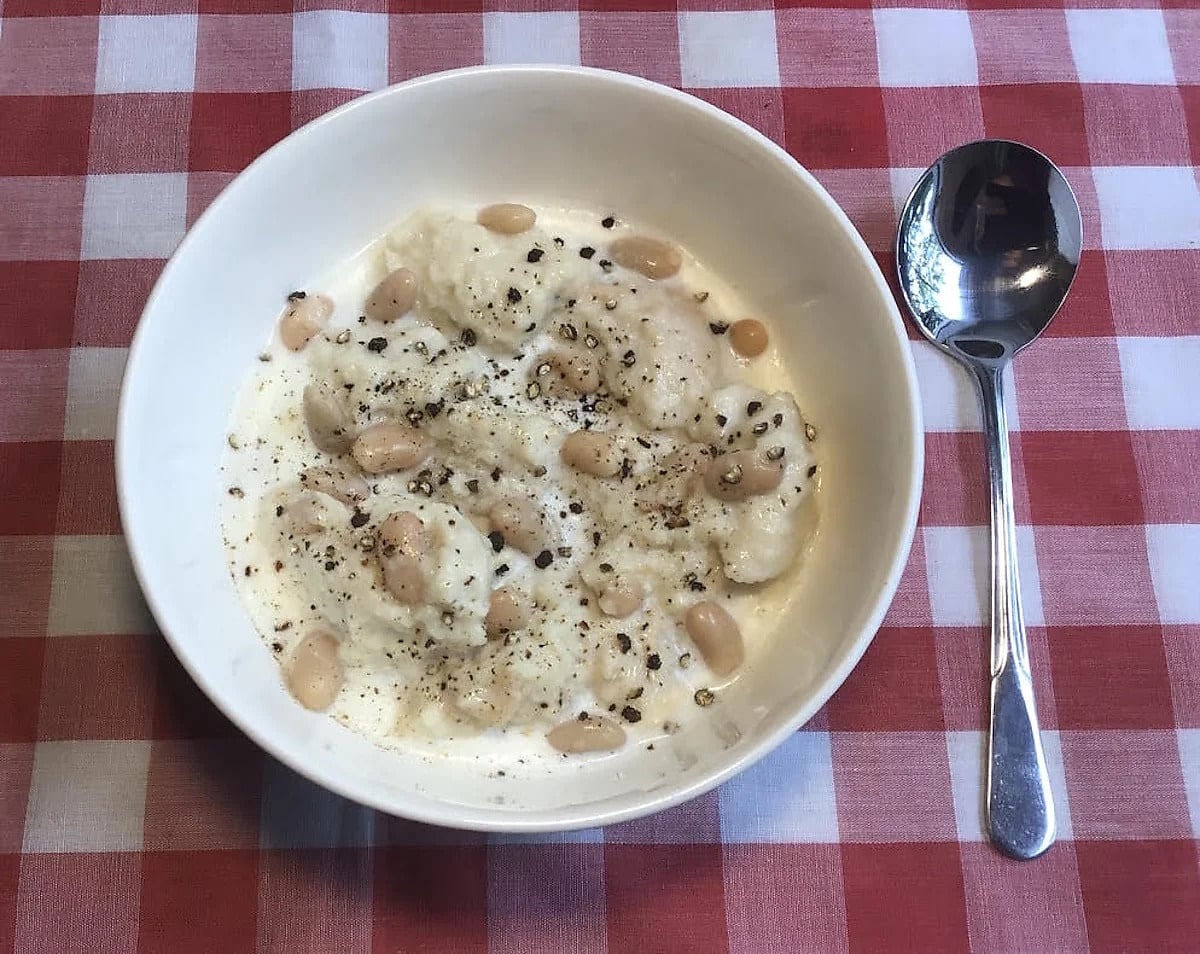
Nora Kurtz is a member of a Geauga County, Ohio Amish church. Today she shares some favorite dishes from her childhood – and some she still loves today, including bread soup and more.
Anyone who lives in or around a large Amish community is probably going to be at least somewhat familiar with “Amish food”.
Fried chicken, stuffing, mashed potatoes, creamed vegetables, pies and puddings are classic wedding fare for the community and can be found in any Amish-owned or Amish-themed restaurant.
Some dishes are more prominent in one Amish community than another. You would be hard-pressed to find snitz pie (made with dried apples) in Geauga County, but it is widespread among the Lancaster, PA Amish families.
Pickled goods such as beets and eggs, cornmeal mush and tomato gravy, whoopee pies and sauerkraut, soft pretzels, homemade root beer and other foodstuffs can be found in varying degrees across all communities.
Milk-Based Soup Tradition
There is, however, a dish much lesser known outside the culture. This is a group of milk-based soups that can be served hot or cold.
The Amish trace their roots to the mountains of Switzerland during the Reformation and later to the Rhine River Valley of southern Germany. Among the lower class of that later region, one dish dominated the foodscape called ‘Mus’, the ancestor of the unique dairy soups and stews the Amish enjoy today.
The base for creating this dish was milk, lard, salt and eggs. Upper class people could afford to add sugar and flour.
The consistency of this soup would range from a thin broth to porridgelike, owing to the addition of various grains. Typically, in the broth form, beans, meat and seasonal vegetables were added.
When eaten cold, fruit and honey replaced the savories, along with the addition of crumbled bread.
There are a variety of dishes still eaten among the Geauga County Amish that reflect this culinary heritage.

Cake & Cold Fruit Soup
Growing up, in the strawberry season, my mother would bake a dense, sweetened biscuit-like cake. This was crumbled into a bowl with heaps of fresh strawberries, a dash of sugar and milk poured over the whole of it. This was a treat, since strawberries were seasonal and it was eaten as a main dish, not dessert.
I am aware that a percentage of our older generation in this community eat different versions of this cold fruit soup. Bananas might be used instead of strawberries and typically homemade bread is cubed and substituted for the biscuit.
My mother would frequently bake a cake as a common dessert. These were always simply baked in a 9 x 13 pan and frosted right in the pan when cool, a time saving maneuver if you have eight little mouths to feed, plus your husband and yourself.
No matter if it was chocolate, butter pecan or white vanilla, we always ate it with milk. Your square piece of cake would be placed in your bowl and milk added along with it. It was ready to eat only when you had properly and evenly mashed everything together.
When I was five years old, I was attending kindergarten in our public school district, the only Amish child in my class. I have a distinctive memory of the lunch lady handing me a tray of food one day and there was a piece of cake included for dessert.
I was thoroughly confused regarding the lack of any appearance of milk — and even if dairy had been included, how was it to be eaten off a cafeteria tray?
I decided to wait and observe how my classmates ate theirs. Needless to say, it was the first time I ever tried “dry” cake. I thought it was quite terrible.
Oyster Soup & Bread Soup
In this community, a popular Christmas dish is oyster soup. The assumption is it was adopted by the culture during colonial days here because it so strongly resembled the ‘Mus’ they were already accustomed to. Made simply with butter, salt, milk and fresh oysters, it is always served alongside ham.
Last, but far and away the most common, is a soup most popular for church meals, especially during the winter months.
You first need homemade bread, cut or torn into large chunks and left out for a day or so to become crusty. Butter is browned well in the bottom of a large stockpot, milk is added, seasoned with salt, and heated until just simmering. When hot enough, the bread is added along with navy beans. This is called bean soup or bread soup and ideally served with lots of black pepper.
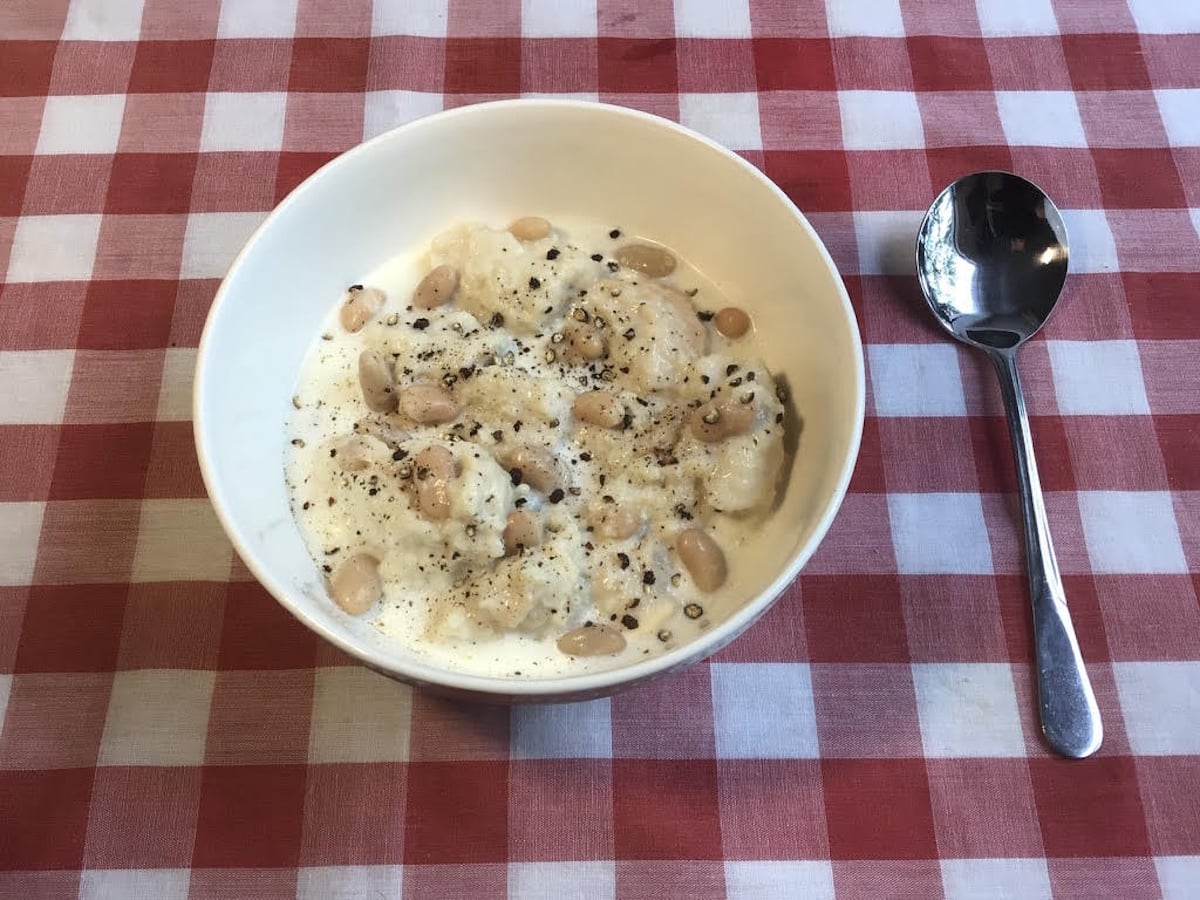
The lady of the home hosting services will leave the service early to get the soup started. As a little girl, close to the end of three hours trying my best not to squirm on the hard backless bench, the tantalizing smell of the yeasty bread and the butter sizzling intermingling with the scent of gallons of coffee brewing would be drifting into the room.
This did not assist whatsoever in my attempts to sit still and to banish the wish that the minister would wrap it up already so we could get to the closing hymn.
My maternal grandparents were produce farmers and we grandchildren would help out during the summer, sometimes spending several days and nights or up to a week there at a time.
One evening, my grandmother announced that bread soup and apple pie were on the menu for supper. I was happy with this. I loved bread soup and certainly had no complaints about apple pie either.
I was also the only cousin at the table that evening with my grandparents, which was rare and rather special. After Grandpa said grace, I watched in amazement as he placed a large wedge of pie in his bowl, ladled the soup directly over the top, and tucked in.
Grandma laughed at my dumbfounded expression and encouraged me to try it. I did, and to this day, I love the surprising medley of flavor and texture.
Today, I can make a fairly decent bread soup when I get a craving for it. (it’s not served nearly enough for church meals to suit my liking) However, it’s a dish much better eaten infused with the atmosphere of community.
I was made aware that my love for these dishes may be somewhat of an acquired taste, when a friend from another Amish community was in for a visit and tried the bread soup for the first time. In her careful words, “I would probably eat it again, but not right away.”
We also have several extended family members who did not grow up eating oyster stew for the holidays, so we serve ham and potato soup as well for Christmas.
Foods that bring back memories of the past can satisfy the soul as much as the palate. May we all be so fortunate to occasionally indulge in good memories brought back by the simple act of eating a nostalgic food with loved ones.
Nora Kurtz grew up in Geauga County, Ohio and is a member of an Old Order Amish church in that community. She serves as Director of Operations at the Geauga Amish History Center.


Great post
Hey great post I love to try the Geauga version of bean soup In Lancaster a bean soup without bread is served for supper after communion services . We do have snitz pie nearly every church service meal So I will trade you a snitz pie for bean soup or better yet Geauga Bean soup for the main course and snitz pie for dessert Traditionally oysters were very much part of the old culinary tradition because of the close proximity to the Chesapeake Bay We still enjoy oysters today
Great Job Nora and welcome to blogosphere or blogiverse
Thank You Ben
My confession is I have never seen, much less tried a single bite of snitz pie. I would be open to a collaborative meal:)
Bread Soup
Oh my goodness–brown bread soup was our go to when I was a little girl whenever we were sick. While we weren’t Amish, my mom would melt butter in a saucepan, add salt then add torn up pieces of bread, stirring it until it was nicely browned and crispy. Then she would pour in water, bring to a gentle boil. It was the best for upset stomach, colds, headaches, the flu, etc. Thank you for bringing back such precious and sweet memories of my mom and my childhood.
Fun article. I consider myself culturally Amish. Actually ‘English’ but grew up in Lancaster Co and of German descent. When it comes to food that is where my heart is. I have lived in Alaska for over 50 years but sweet bologna still whets my appetite, and my cooking is still quite ‘plain’,
I Hear You
I’m always up to trying new foods, but my heart is with the simple dishes I grew up with.
Cookbook
Nora, I’m curious, have you written a cookbook?
I grew up in the south but I will always try a dish new to me. I think we grew up that way, to not be so picky. Many years ago a friend had her Sunday school class to her home for lunch. She asked if I liked corned beef and cabbage, with carrots, potatoes and onions. I said no (love regular beef stew with the vegetables).
She asked if I had ever had it. I said no. Just something about the name “Corned” beef did not sound good. Well, I tried it. To my amazement I ate more than anybody there. And have loved it ever since. I think it was a mind thing…but what if I hadn’t tried it?
Not Yet
So true about the mind thing, I get it. But I’m glad you tried it! Food is so rich in history, culture, community and stories.
I have not done a cookbook but we are currently in the process of collecting old recipes from previous generations in this community in hopes of publishing one in future. We want to preserve the recipes that are slowly being lost.
Cookbook
When you do get a cookbook together be sure to let Erik know as soon as you can so that we can order it. I’ll look forward to it.
Thanks for the Interest
I’ll be sure to do that:)
Yes to cookbook
Yes Nora I second a cookbook At one of our son’s wedding’, his uncle in the opening sermon’ spoke of a man who sent for a marriage enhancement book and recieved a cookbook .
Quite a few people smiled into their beards and capes
Also my brother’s Italian uncle in law says, Just remember ” Josh cooking lasts kissing don’t
So Nora a cookbook would be quite a contribution to societal well being