
Speaking ‘Amish English’
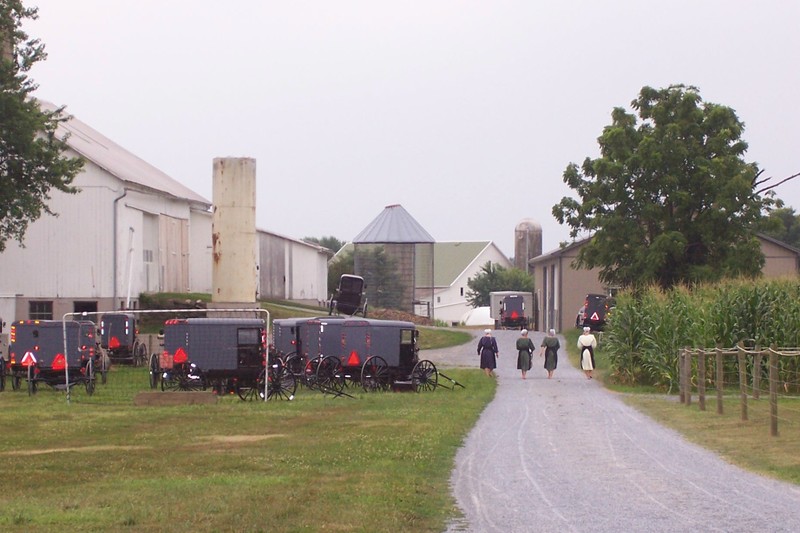
A quick note on language…as we know the first language of the Amish is Pennsylvania Dutch. Picking up English and learning it from Amish-raised teachers in school means that certain traits of speaking and accent get passed down the lines.
I rather enjoy hearing a good thick ‘Amish English’ accent. Sitting with Abe and Rachel in their farm home, I appreciated both the conversation as well as the almost musical quality to the language I was hearing. The Amish often pronounce words in unusual ways. This post from last year goes into it in more detail.
Unusual turns of speech get passed down as well. No ‘thees’ and ‘thous’, but Abe, like other Lancaster Amish, often uses the phrase ‘it spited me’, meaning something angered me or caused me regret. After returning home after being out awhile one morning, Abe said ‘it wondered me’ when I’d get back. Abe addresses his siblings as ‘Brother Paul’ and ‘Brother Eli’.
Little Lizzie over at Daniel’s gave me instructions using the less-often-used-in-colloquial-speech ‘you may’ rather than the more common ‘you can’. ‘You may sweep up the manure now, Erik.’

The Lancaster ‘Amish English’ accent and phraseology is a bit different from that of Holmes County or northern Indiana. If I were better at describing the way things sound I’d take a crack at it. I’ll just say it’s got more of an upward lilt on the vowels.
One of my Lancaster buddies who has a business tells me that Amish on the farm tend to have thicker English accents than guys like him who are out dealing with the public a lot more. Makes sense, and I’d have to say that in my experience I’ve seen that to be true.
On getting home to Ma and Pa in NC, I caught myself speaking in a bit of an ‘Amish English’ accent. Could have been all the shoofly pie. Actually I’d say it was mostly unintentional but I have to admit enjoyable.
After a week spent chatting with Amish all day long, it sort of stuck with me. Unfortunately, it wore off after about a day, and I returned to my mongrel semi-Southern/international neutral/Polish mix, whatever that actually is.
(Today’s photos courtesy of Laurie Frey. Thanks Laurie and keep them coming!)
 Interested in the language of the Amish? You can learn to speak it! We are developing a fun & effective PA Dutch audio learning program. Sign up below and we’ll let you know when it’s ready.


One of the biggest larks for me is when my wife or her family unintentionally mimic my Amish accent. I still mispronounce words. It’s a cultural influence that happens because Amish people read more in English than they speak or even hear spoken. And like you said it gets passed to the kids and is never corrected.
Amish English and other accents
At the same time ‘Amish English’ is still a lot more intelligible than some of the heavier accents from my neck of the woods! I sort of dodged a thick Southern accent maybe because I grew up in the city and because my mom speaks with a very, slight almost British foreign accent which may have kept it at bay. My pop’s hometown is in eastern NC where the Southern fried accent is a lot more prominent, though he doesn’t have it so bad. When I’m in the South I just find I switch into a bit more Southern…when I’m teaching someone in Poland a phrase in English though the accent goes a lot more neutral as I try to enunciate clearly.
Pronunciation I think is a relative thing.
Pronunciation may be relative. Ignorance isn’t. Amish leaders deliberately promote ignorance for the sake of social control. Mispronouncing a word is actually an expression of fealty. Do outsiders like you or Kraybill willfully ignore this or don’t you see it? How would you feel about it, if it occured in your culture?
And what accent in English is the right one, exactly? from the States (which States?), from the British, from the Iraish or the other speacking part of the world?
I agree accent is relative… The main thing is to get understood and to understand.
Great work, Eric as usual.
(By the way I’m going to work a paper on the “Amish” dialect- do you know any book about the question?)
My references to ignorance and mispronouncing are about a disregard for the integrity of language, not accent.
I think there is a direct connection between western culture’s success as a society and the importance it attributes to language. The Amish in contrast only value language as a means of control, and by extension, of oppression.
“(By the way I’m going to work a paper on the “Amish” dialect- do you know any book about the question?)”
Have fun finding a book on “Amish dialect”. They don’t care enough about their “mother tongue” to document it. If it’s being done it’s probably an outsider, whose motivations may or may not align with the Amish communities welfare.
Erik, were obviously talking past each other. I tried to clarify that I’m not talking about accent. I agree with you on that part. You may not be aware of Amish people’s restricted language skills and the less than benign reasons behind it. will try to elaborate. (gotta go to work)
Amish or PA Dutch English as one of many regional accents
Easy I think you’re stretching the point of my post to make your own point. It sounds like you are arguing that there is an absolute truth to language, a right and wrong way to pronounce each word, and that somehow you feel the Amish are in the wrong. If that’s true, then I wonder who you’d feel is the ultimate arbiter of that truth.
I would argue the Amish speak one of a large number of regional accents existent in the US. To try to make a point about social control over a slightly different way of pronunciation is I think a bit of a stretch.
Amish crack up at hearing Southern accents. I’ve joked with them about it. It’s not always the king’s English. But who really speaks the king’s English in America nowadays anyway? Accent is relative.
To answer the question, if it occurred in my culture, which relative to other ‘cultures’ with different ways of speaking it does, I actually wouldn’t care, because I generally don’t get too hung up on things like how I pronounce tomato versus how you pronounce tomato.
On the other hand I appreciate the lyrical quality of language and accent, and regional and international differences in ways of speaking, and that is what the post is about. Language and accent can be beautiful things.
Thanks Emma, there are at least one or two books on Pennsylvania Deitsch I know of. One of them is a fairly slim dictionary that is based on the Holmes County version of the dialect. Can’t say offhand who put it together but might be a nice place to look.
Easy said:
“(By the way I’m going to work a paper on the “Amish” dialect- do you know any book about the question?)”
Have fun finding a book on “Amish dialect”. They don’t care enough about their “mother tongue” to document it. If it’s being done it’s probably an outsider, whose motivations may or may not align with the Amish communities welfare.
I was refering to scholarly type of book. It’s for a work for university….
You know your remarks (on oppression etc.) are interesting…Here in Quebec, people refer to the French language rules (very much emphasized in France), as oppressive and a way to keep the Quebecers culturally subjected to the Continent or at least to the dominant French speaking culture of the wealthier class. I personnaly consider it’s important to respect the structure of a language but that each group has the right to differences which anyway is going to happen.
Language(s) are definitely relative (and very much part of what we are and/or what we want to be…).
Thanks for your answer, Eric. I think I found some interesting books at my University. 🙂
A little late in this conversation, but only recently found this site. I currently have a pair of draft horse mares being trained by a young Amish produce farmer in South Texas. I had questioned him about the commonly used languages in the community. He said they spoke a “Swiss” language, which they called Swabish and, of course, English. In the few instances I have heard him speak in Swabish I thought it sounded familiar. When I google it, I find that it is an Alemannic form of German and is closely related to the Alsatian language that my mothers family spoke in the Alsatian communities in the Medina Valley, south and southwest of San Antonio, Texas. Though it has almost entirely died out now, 50 years ago when I was a youngster it was quite common to hear the older people at least great each other in Alsatian. When I study a little about the Amish I understand the linkage better. Thanks for the great site. I’ll visit often.
The dialect means nothing really?
Erik, this is an excellent interpretation about the language in general. I speak a more pronounced German dialect than the PA Dutch language, all Amish understand what I am saying. I think some people just tend to certain beliefs according to what they want to hear, not what is really being spoken? This life is too short to worry about dialects or according to where you are from, some English don’t know that most Amish can thrive in speaking the PA Dutch Language in Germany, some or very few would have a few difficulties but, overall The Amish can communicate in the German country with very little difficulty. I spent time in Germany myself, and they all have different dialects there as well, if you are from the south, and wish to speak to someone from the north, you compensate, again they may laugh a bit, but in general they understand. When I say a number to any Amish they understand, counting in my dialect from 1-10, Eines, Zwei, Drei, vher, funf, sechz, seben, acht, noin, zene. 100= Eine HUNDERT, ECT., It makes no difference really? It’s the same if someone asked me if I speak German, Iche Spreacken sie Gosse Deutch! There is so many dialects to worry about, however like I said: All Amish understand my more pronounced German language even though it’s not PA Dutch.
Great job in explaining things as always Erik,
Cheers!
Arthur
I appreciate it Arthur, and thanks for the comment. You’ve got me wondering what region your dialect might be from. And have you come across the book on Pennsylvania Dutch by Mark Louden? You might enjoy it given your language aptitude and interest in the Amish.
I lived a great deal in Wiesbaden which is south of the Rhine river
Erik,
I lived a great deal in Wiesbaden, Germany, so this is where my German comes from. I’m sure you have heard of the Rhine river, very large body of flowing river in Germany. I lived in and around smaller towns, and larger villages close to Frankfurt, ect. The German I spoke is an older order of German, most of my friends were affluently in their language and culture, they worked as police officers, teachers, and some were even college students. I loved it in Germany, wished many times to stay there but, for me there was too much violence going on there. I still see this today, as certain people have taken over parts of Germany like any populated area. I thought Germany was a very nice and beautiful country, even though not very big. I have not read the book Pennsylvania Dutch by Mark Louden, I will check it out now though because I always had a strong desire to learn as much as possible, some Amish tell me I do also speak Pennsylvania Dutch by many words I use, I just don’t use them all. I wanted to thank you for telling me about Mark Louden, its always a blessing to get these gifts, because they help me in my journey to communicate with my brothers and sisters in christ.
Blessing as always Erik,
Danke
Arthur