
20 Years After The Nickel Mines Amish School Shooting, A Girl’s Parents Still Forgive “Again And Again”
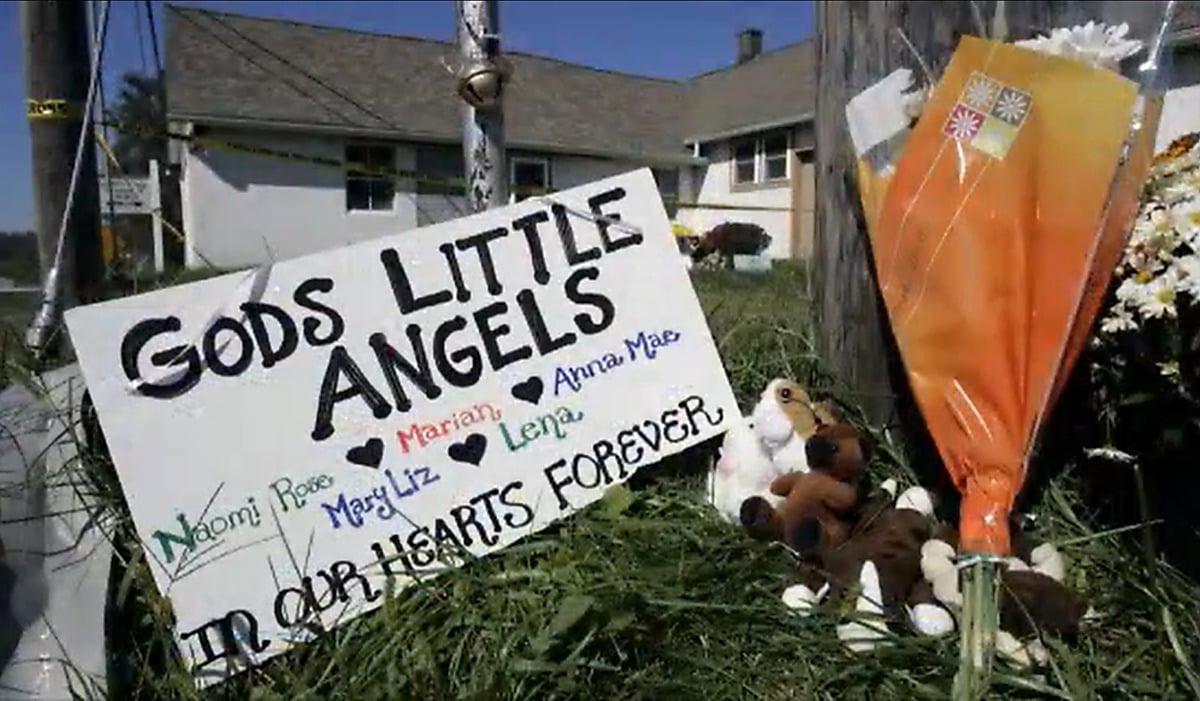
It’s hard to believe it’s been 20 years since the events of October 2, 2006, when a mentally disturbed milk truck driver entered the West Nickel Mines school in Lancaster County and took five Amish girls’ lives.
I happened to be on vacation at the time, and still remember how I learned about what happened – seeing the front page news complete with photo of the emergency response aftermath…on an actual physical newspaper in the hotel lobby.
The surviving children in the school that day are now all adults — some no doubt with children of the same age as they were that terrible day. A lot of time has passed, though for some, I imagine it doesn’t seem like it.
Ten girls were shot, with five dying, and five left badly injured. Tragically, a sixth girl eventually lost her life as well. Two years ago, Rosanna King passed away at age 23.

Earlier this year, we heard from the shooter’s wife at the time, Marie Monville, who described how members of the Amish community came to her home to offer forgiveness for what her husband Charlie did, and compassion for her family.
Naomi Rose Ebersol’s Parents, 20 Years Later
Today CBS 21 ran an interview with Amos and Kate Ebersol, whose daughter Naomi Rose was one of the five girls killed that day. She was seven years old.
The Ebersols talked about how they’ve gotten through the years since.
They keep a cabinet in their home with Naomi’s toys and dolls, dried flowers from her memorial, and cards with her name on them. The outpouring came from all corners:
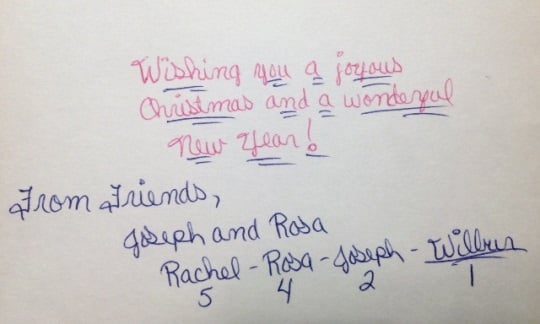
After the shooting, Amos and Kate received cards from all over the world expressing their condolences. Amos said he remembers one card from England.
The letter was addressed vaguely to “Nickel Mines, Pennsylvania,” but still somehow made it to their mail box.
The family still has the cards in storage, Kate said.
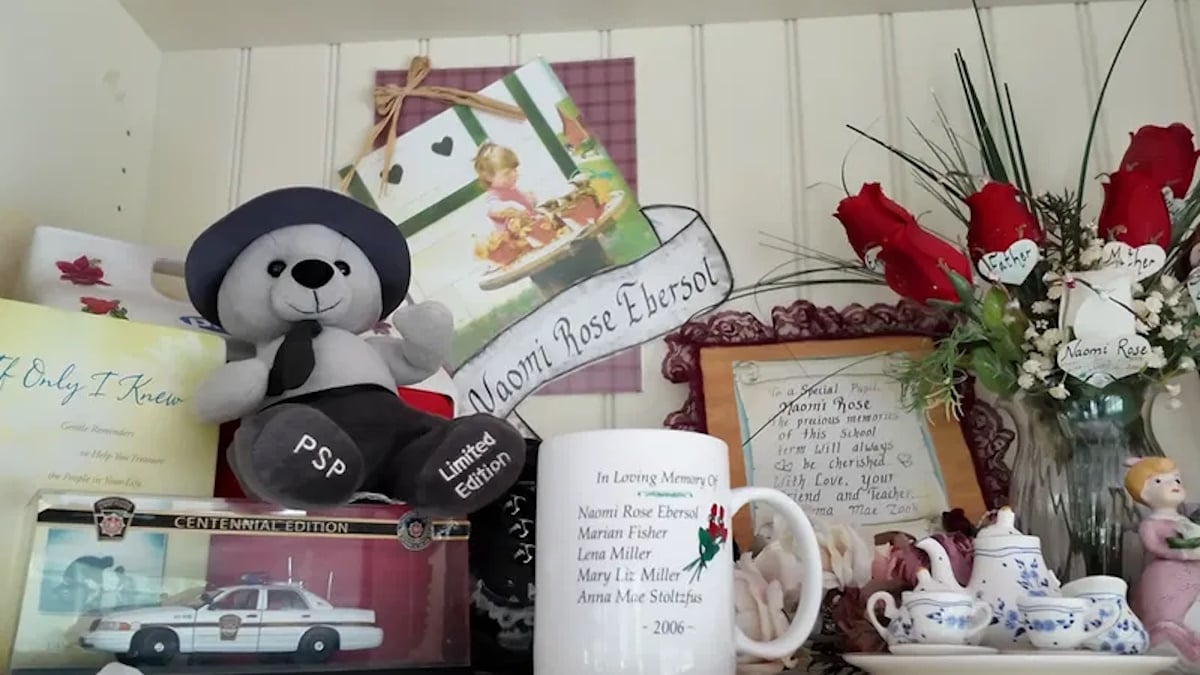
Among the keepsakes is a model state police car, still in its box, given to the family by the trooper who carried Naomi out of the school that day. They also spoke about forgiveness:
Naomi’s parents said they decided early-on to choose forgiveness, but it’s not just a one-time decision.
Kate said it’s a conscious decision that has to be made again and again—especially at this time of year, when Kate said she is confronted with feelings of missing Naomi and longing to be with her.
Amos emphasized that this is God’s story—forgiveness and all. “It felt like God wanted people to know about forgiveness,” Kate said.
“Jesus is very real to us,” Kate said. “Heaven is even more real because of her being there.”
The school itself was torn down 10 days after the shooting. Five pear trees were planted in memory of the girls, along the fence line where it once stood.
Remembering Nickel Mines – And The Amish Response
Here’s a video I did on the 15th anniversary of the event, in which I look at the Amish response and reflect on what it meant at the time and still means today. I’ve included a transcript of the video below if you’d prefer to read it.
This is the transcript of the above video, published five years ago on the 15-year date:
It’s been fifteen years since the Nickel Mine school shooting event happened in Lancaster County, in an Amish schoolhouse. I wanted to take a few minutes to look back at that event, and especially at the Amish forgiveness story.
If you’re not familiar with it, on October 2, 2006, a local milk-truck driver entered an Amish school and took ten of the schoolgirls hostage. He ended up shooting them and killing five of them.
They were ages six to thirteen. Their names were Anna Mae, Marian, Mary Liz and Lena, who were sisters, and Naomi Rose.
This event, as you can imagine, was a tremendous shock. After all, how could this happen in an Amish community of all places? What made the story even bigger, let’s say, for lack of a better term, was the response of the Amish: they reached out to the family and offered comfort and forgiveness shortly after the event—actually, within hours.
What did that mean in practice? Amish people went to the shooter’s family—his wife, his parents, and his parents-in-law—and offered comfort and forgiveness to them. They also said that they forgave him.
At the shooter’s funeral, of the 75 people who attended, over half of them were Amish. They decided to attend, support, and offer their condolences to the shooter’s wife. This was something kind of unheard of or amazing. In the era of school shootings, you’d never really heard of this kind of response before, so the story traveled very far. It was covered internationally; it went around the world. It was in the media in Europe, Japan, India, and all over the place.
Amish community members ended up maintaining relationships with the family for years after that, particularly with the shooter’s mother.
The story inspired multiple books and even a movie. One of those books was Amish Grace: How Forgiveness Transcended Tragedy. In that book, they look at the events of that day and what came after, but also, in particular, the Amish approach to forgiveness. Where does that come from? How does that happen? Is it easy for the Amish?
Just to quote one Amish bishop from the book, he said that forgiveness was “a decided issue.” It’s just what they do as non-resistant people. It was spontaneous. It was automatic. It was not a new kind of thing. He also said it’s just a normal part of their living.
Another Amishman said, “It’s just standard Christian forgiveness. It’s what everybody should be doing.”
Where does that belief or practice come from? The Amish draw it from their Christian faith and the teachings in the Bible, and in particular, Jesus’ teachings and example. They’re taught to forgive from an early age.
One important source is the Gospel of Matthew. There’s the parable of the unforgiving servant. Jesus tells Peter to forgive not seven times, but seventy times seven.
Another very important source for this belief and practice would be the Lord’s Prayer. The Lord’s Prayer is very present in Amish society. “Forgive us our debts as we forgive our debtors” is the part of that prayer that’s relevant here. It’s repeated everywhere: in every church service, in morning prayers, and as part of evening prayers. It’s one of the first things young children are taught.
One thing that’s important to remember, though, is that just because forgiveness is described as automatic, or as something “we just do,” doesn’t mean it’s necessarily easy for the people who are called to forgive.
There was one report not too long after the shooting where an Amish person said, “We want to forgive him, but we have to not just do it one time. We have to do it again and again.”
The Amish are human, after all, just like anyone else. Just because they live the way they do doesn’t mean it makes things automatically easier when they’re dealing with a loss or when they’ve been wronged.
Another man who lost a daughter said, “Our forgiveness is not in our words, it’s in our actions. It’s not what we said, but what we did.”
An Amish father who lost a daughter and then had another one injured—and this might actually be the same man I just quoted; I’m not sure, because the Amish here are anonymous—basically said that forgiveness takes time.
Paraphrasing here, he took issue with some of the coverage after the shooting, which suggested that the forgiveness was instantaneous. He said that by choosing to forgive, the Amish chose not to become bitter, even though the forgiveness process took years and years.
Now I’m quoting him: “If they chose to follow God’s word, look for the potential good in whatever happens, and forgive whoever wronged them, then they could become better persons. If you decide that person is so evil and I can’t forgive that man, then bitter is the only thing that will continue.”
The same man basically said that the Amish have the same struggles as anyone else, but faith in God helps to make those struggles easier.
The point there is that the Amish, again, are human too. They choose to forgive, but that does not automatically make it easy.
I wanted to come back to this topic because, well, it’s been fifteen years. I realized that a number of people may not be familiar with the story anymore. Even though for me it seems like just yesterday, a lot of time has passed.
As horrible as the events of that day were, I think the forgiveness story is a pretty powerful example of good.
The Amish are not a people who try to draw a lot of attention to themselves. They don’t evangelize; they don’t try to pull people into their own community. They’re pretty quiet in a lot of ways. But the way they live and their example do a lot of speaking for them.
I think the example of forgiveness here spoke pretty loudly. Some people had a hard time believing it. We don’t usually see these kinds of responses after a shooting. We don’t see people coming out and offering forgiveness and spending time with the shooter’s family, which is kind of amazing if you think about it.
But the Amish did that, and they continued to do that. They had relationships with those people afterward.
We don’t know how many people that story inspired, but I have to think it had to be a positive thing in a lot of people’s lives. Because, after all, it went around the world.



forgiveness
Well do I know that forgiveness is a process, and often needs to be a repeated choice – it is something I have had to learn and apply though my life.
I say the Amish certainly “have it right” on this
Blessings
Maxine