
1-800-CHATGPT: How Some Amish Are Using A.I.
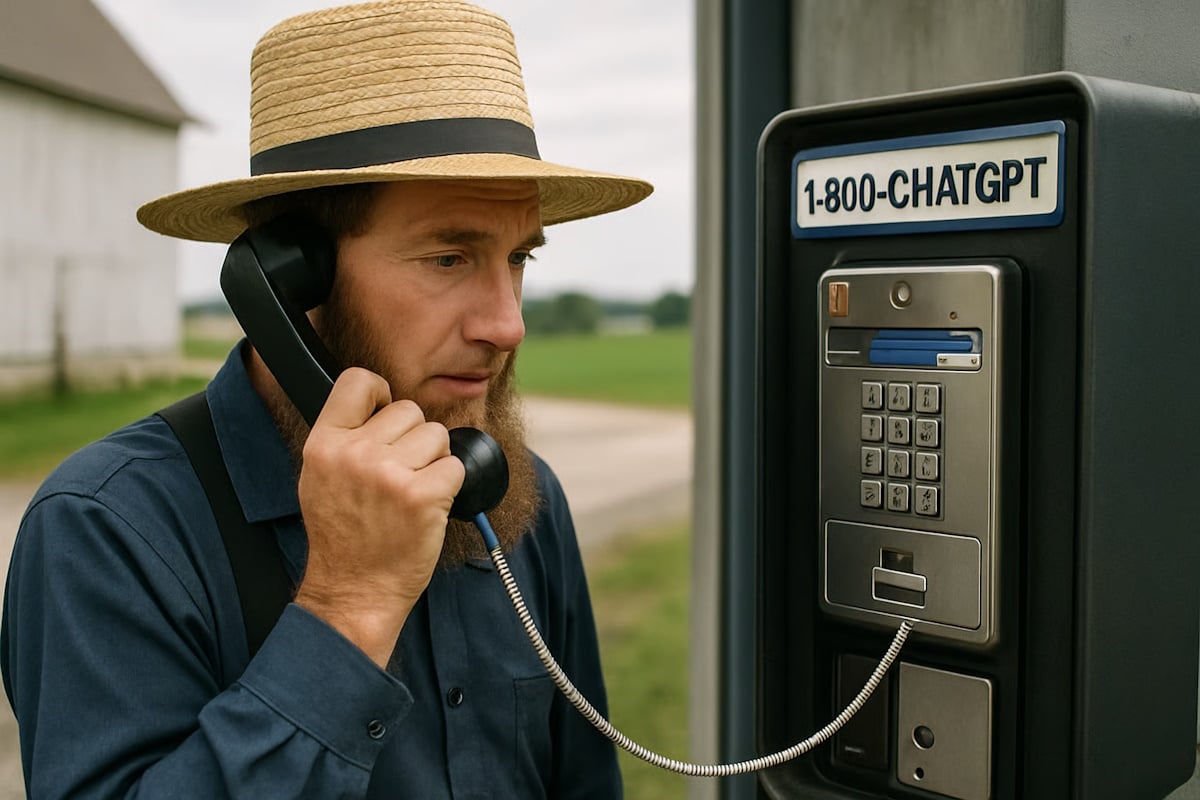
An Amish man named Lewis Wengerd needed to research an excavating machine. He didn’t have computer access at the time. His church bans smartphones. So he picked up his flip phone and dialed 1-800-CHATGPT.
That’s not the only way the Amish are using AI — but it might be the most memorable. I had never known Chat GPT has an actual number you can call – to talk to an AI-generated voice.
But that’s just one of the curious details revealed in a New York Magazine’s Intelligencer piece by Erik German on AI adoption among Old Order Amish in Holmes County, Ohio.
The surprise for a lot who’ll read Erik’s story, I imagine, is of a type as we’ve seen when Amish have been found using computers, the internet, or smartphones in the past.
Namely, the idea of the “Amish people playing against type“, by using this or that currently fashionable technology – sometimes in rather “Amish” ways.
But as with those technologies, it’s all in how you use it – and whether your church community feels it is something that can help more than hurt. As in previoius examples, it’s not all Amish who are using A.I., or even that many of them when you look at the group as a whole. It’s expectedly people in larger, more progressive communities who also have business-driven motivations to dip into the tech. More on that in a bit.
A Love Letter & An 800 Number
German opens the piece with a visit to a member of the Wengerd family, a surname you might recognize from past looks at their long-running horse-drawn implements business, once known as Pioneer Equipment (a business which was recently sold and rebranded, as we saw here).
The piece opens with a humorous anecdote of how Daniel Wengerd used it to write a love note to his wife:
Valentine’s Day was weeks ago, yet Mary Ellen Wengerd is still tickled about the love note her husband, Daniel, co-authored with generative AI. “ It was so eloquently written,” she says, biting back a grin. “Reading this, I was like, This is so not my husband.”
….
“And I was like, ‘Did you write this?’” Mary Ellen says, looking at Daniel. “‘Or did you ask ChatGPT to put a little love letter together?’ And he was like, ‘Ummm —’”
“I actually did!” Daniel says as laughter erupts in the room. “But I made a couple changes!” We seem to be on well-trod comedic ground. Daniel’s blushing on the couch opposite Mary Ellen, stroking his wavy gray beard.
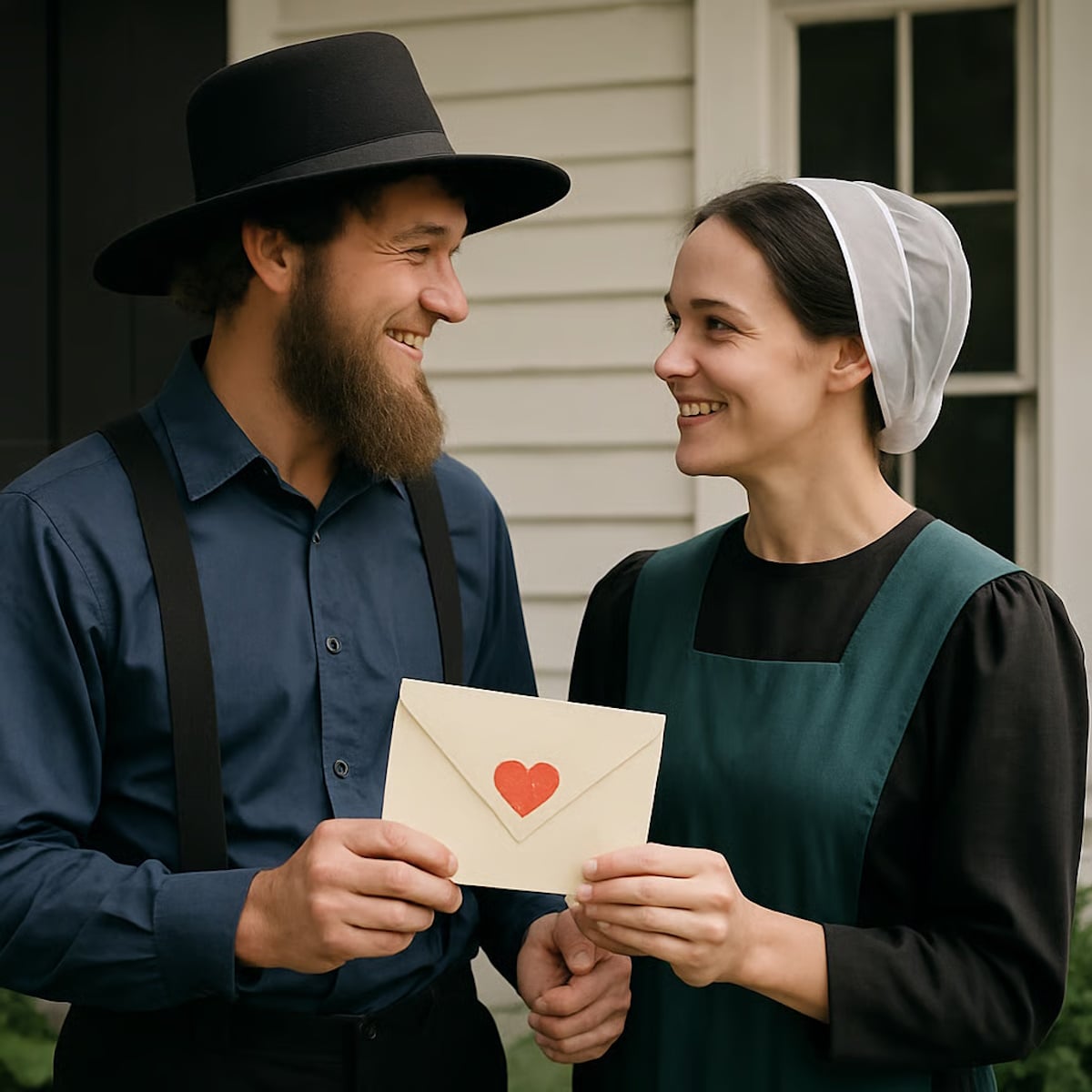
Daniel presumably generated that ode to his wife using Chat GPT in the conventional way – through a screen. But there is an alternative, as we learn, if a computer or smartphone are not at hand. Namely, an 800 number, as we see in the example of Lewis Wengerd:
John’s brother, Lewis Wengerd, 21, works for a concrete contractor who tasked him with researching an excavating machine the company wanted to buy. “At the moment, I didn’t have good access to a computer,” Lewis tells me. “So I called the number from my flip phone.”
I must seem confused, so Lewis tries to explain. “I run a Sunbeam F1 Pro Spruce,” he says, indicating his device, marketed as a “rugged dumb phone,” because his church bans the smart variety. That isn’t news to me, I say, but I confess I’d never heard of 1-800-ChatGPT, let alone dialed the number.
“Have you never done?” Lewis says, laughing. “You ought to try it. It’s pretty neat.” (I did try calling 1-800-ChatGPT later. The female voice that answered — millennially lifelike down to the touch of vocal fry — responded to my questions until I felt slightly spooked and hung up.)
800 numbers got their start over 60 years ago. Suffice to say, it tickled me to consider someone using a 2000s gadget (flip phone) to access a 1960s-era interface to tap into the latest 2020s technology. Amish workaround indeed.
Besides these fun examples, it sounds like a lot of Amish users are doing with it what you might expect – using A.I. in more mundane ways, to enhance their business operations. As the article details, that might mean improving client communication emails, reviewing contracts, or tracking key production analytics.
How many Amish people are using A.I.?
None of this is entirely out of character for the Amish, especially those in larger communities with progressive and business-oriented elements, a profile which Holmes County fits well.
We’ve covered e-bikes becoming commonplace there, Amish women using Instagram for business in similar-in-some-ways Lancaster County, robotics in the above-mentioned Pioneer Equipment example, and the quiet workarounds that let Amish entrepreneurs stay competitive while keeping their churches happy.
If you’re wondering how many Amish people might be using, or at least dabbling in, A.I., Marcus Yoder of the Amish and Mennonite Heritage Center estimates fewer than 10 percent of internet-connected Amish in Holmes County have tried generative AI. And he estimates that fewer than half of the Amish there have access to the web.

So if you do the math on a settlement of around 40,000 Amish people, that would come out to a couple thousand people, or less. I’m not sure how that takes into account the youth, though, some of whom have more ready access to smartphones and the like than your average Amish adult.
Next In Line To Be Sorted Out
Of course this isn’t the only recent coverage of AI meeting the Amish world. Earlier this year I wrote about a fake AI-generated Amish Instagram influencer named “Melanskia” who has accumulated 300,000 followers and counting.
That was someone using AI to package the Amish image for an outside audience seeking health and food advice. In this example we see in some sense the reverse – Amish people putting the tool to use as anyone else would.
How far it goes remains to be seen, and the usual open boxes remain as to whether, on balance, it helps or in the negative version, ends up interfering with community and family.
But it’s not as odd, or earth-shattering, to consider Amish people using A.I. as some might think on coming across this piece. Each technology presents its own challenges and considerations, of course. But A.I. is just the latest technology to come along that Amish people will have to figure out whether or not to use, and if so, how.





1-800 CHATGPT
This is unheard of for me and yes, I am Amish. The picture of the couple with the envelope, it says he has a wavy grey beard and its a brown beard in the picture and she is most definitely coming through as not Amish with her covering. I could be wrong, but it looks more like a PA “cap” and he is not looking like a PA man. But like I said, I could be wrong and there are many different communities.
Well we were in the same boat on this one as far as not hearing of it! Not sure I’m keen to try it out but interesting to learn of it.
And yes in keeping with the theme of this post, the three images in it were made with AI (I put a note on that in the captions), and the woman’s look especially is not quite there. It was better than some of the ones it produced, though 🙂