
The Amish in Kansas: 2026 Guide (17 Communities)
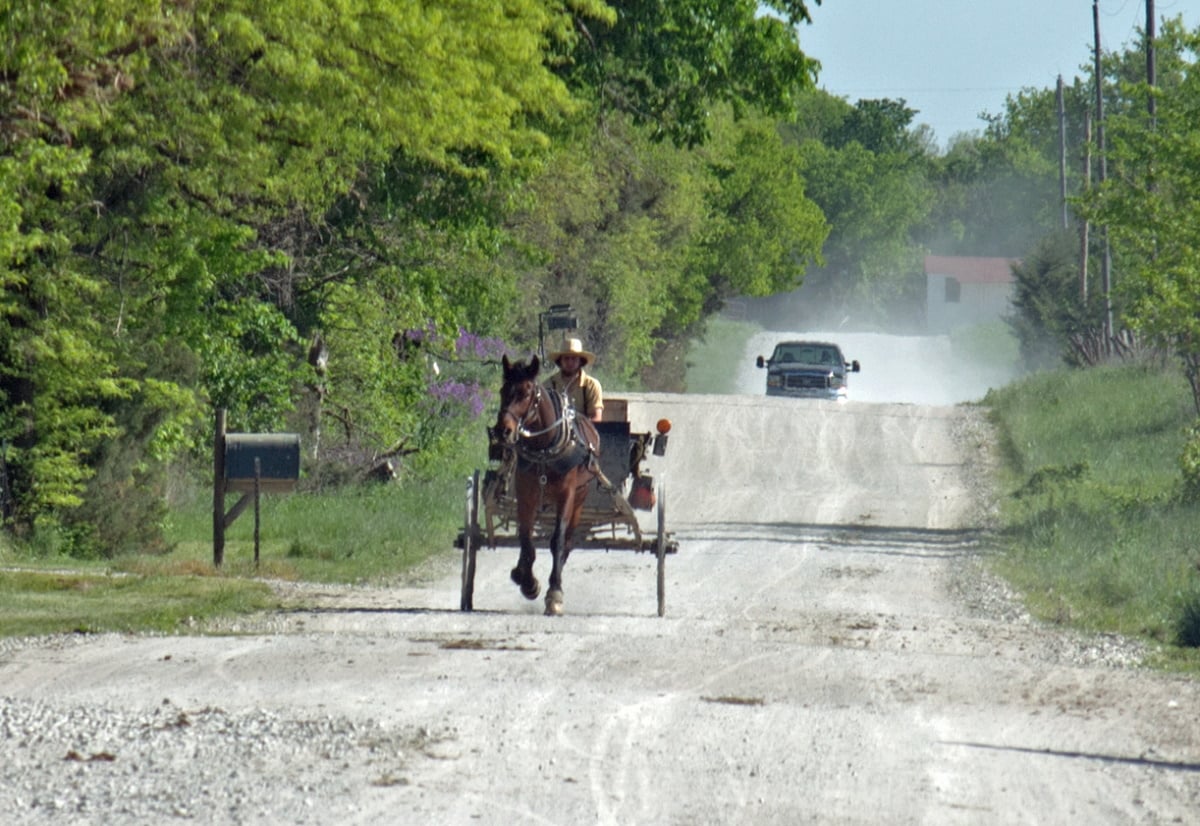
Kansas has long been home to Amish people – but it has never had a very large Amish population. Kansas Amish communities are either very old (well over 100 years in age), or very young (founded in the past two decades).
Recently, however, Amish have been adding new settlements in the state. As of 2026, there are seventeen separate Amish communities in the Sunflower State. Kansas’ Amish population has in turn grown to around 3,085 people.
- Yoder (Reno County) – The Yoder/Haven settlement, the state’s oldest community, is located in central Kansas
- Labette County – This county in SE Kansas has the state’s two largest Amish communities
- Hutchinson – The Hutchinson Amish community is one of the state’s three oldest
- Garnett – The Garnett Amish in Anderson County are one of the more progressive groups
- Other Kansas Amish Communities – At least ten Amish settlements have been founded in Kansas since 2017
- Past Amish Communities – Kansas has a history of defunct Amish settlements
Yoder Amish Settlement
The village of Yoder has an interesting tale of origin. Yoder was founded by Eli M. Yoder, the son of an Amish bishop from Maryland. In the late 1800s Yoder came to the newly-minted state of Kansas to homestead in Reno County, settling in a location about a dozen miles southwest of the city of Hutchinson.
In 1886 the Missouri Pacific Rail Road constructed a track from Hutchinson to Wichita, which resulted in about 5 acres being split off from the rest of Yoder’s farm. Yoder used the separated area to construct a post office and general store, which became the nucleus of the village.

During the 1880s, Amish migrants from Shelby County, Illinois began to arrive and settle in the region, with the new village of Yoder becoming the center of the community (see GAMEO, “Yoder (Reno County, Kansas, USA)”).
Yoder was once the largest Amish settlement in Kansas, but has been overtaken by some much younger communities (see below). As of 2026, around 300 Amish live here.
The Amish at Yoder are among the most progressive when it comes to technology. They allow bulk milk tanks, rototillers, and tractors for field work (see Living Without Electricity, Stephen Scott and Kenneth Pellman).
Due to the high heat in this region of the country, some field work may even be done in the evening.
Although Yoder is the center of this community, and still maintains a post office, most Amish homes in this settlement are actually listed as Haven addresses.
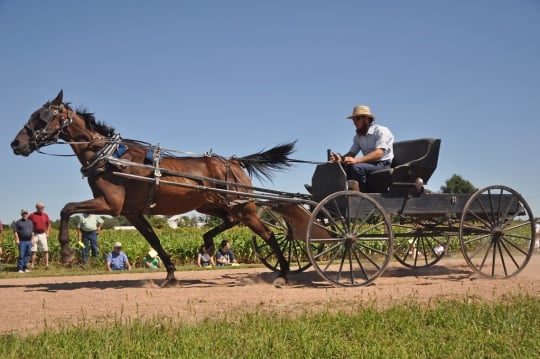
Yoder is known to put on an annual Heritage Day celebrating its history. This gathering features a variety of events, including a buggy race featuring Amish buggy drivers. The Yoder/Haven community lies very close to another Amish settlement near the town of Hutchinson.
Labette County (Two Communities)
As of 2026, the state’s two largest Amish settlements can be found in Labette County. Both founded in 2006, they have grown relatively quickly to surpass much older communities in the state in size.
The community in the area of Galesburg and Parsons (also lying in neighboring Neosho County) is Kansas’ largest, with about 910 Amish residents in seven church districts (congregations). This is a settlement with Swiss Amish roots and origins in Missouri.
The settlement at Chetopa has a population of around 340. It is a relatively more progressive group, permitting solar power. Telephones are allowed in small phone shanties on the property, and Amish here hire drivers when needed (a practice not permitted everywhere).
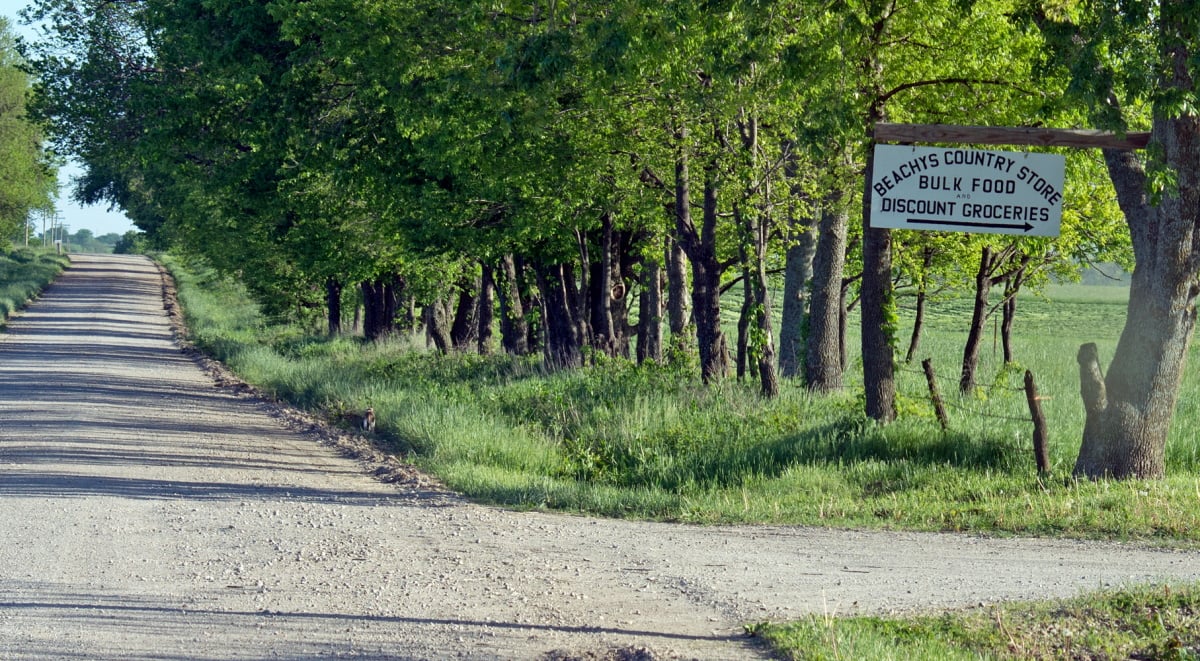
Amish-run businesses in this community include a greenhouse, saddlery, horse supplies and horse training, a leather workshop, windows and siding, baked goods, as well as a bulk food and discount grocery store.
Hutchinson Amish Settlement
The Hutchinson Amish settlement is in fact located to the southwest of the city of 40,000, near the hamlet of Partridge.
What ended up becoming the modern-day Hutchinson settlement originated in an early community – started around Partridge by Amish arriving at the same time as those who settled near Yoder.
Only about 13 miles separate the two villages. The Hutchinson and Yoder area is home to at least two outlets retailing Amish-made furniture, among other Amish stores and businesses.
The Hutchinson Amish settlement is two congregations in size, about 150 people. Like the Yoder/Haven settlement, it has seen little growth over its 140-year history.
Garnett Amish Settlement
The Amish group at Garnett in Anderson County is the youngest of the three “old” Kansas communities, having been founded in 1903. Anderson County is located in the eastern part of the state, roughly 50 miles south of Lawrence.
Like its counterparts in Yoder and Hutchinson, the Anderson County Amish presence remains small today. It is just two church districts in size – around 210 Amish people total.
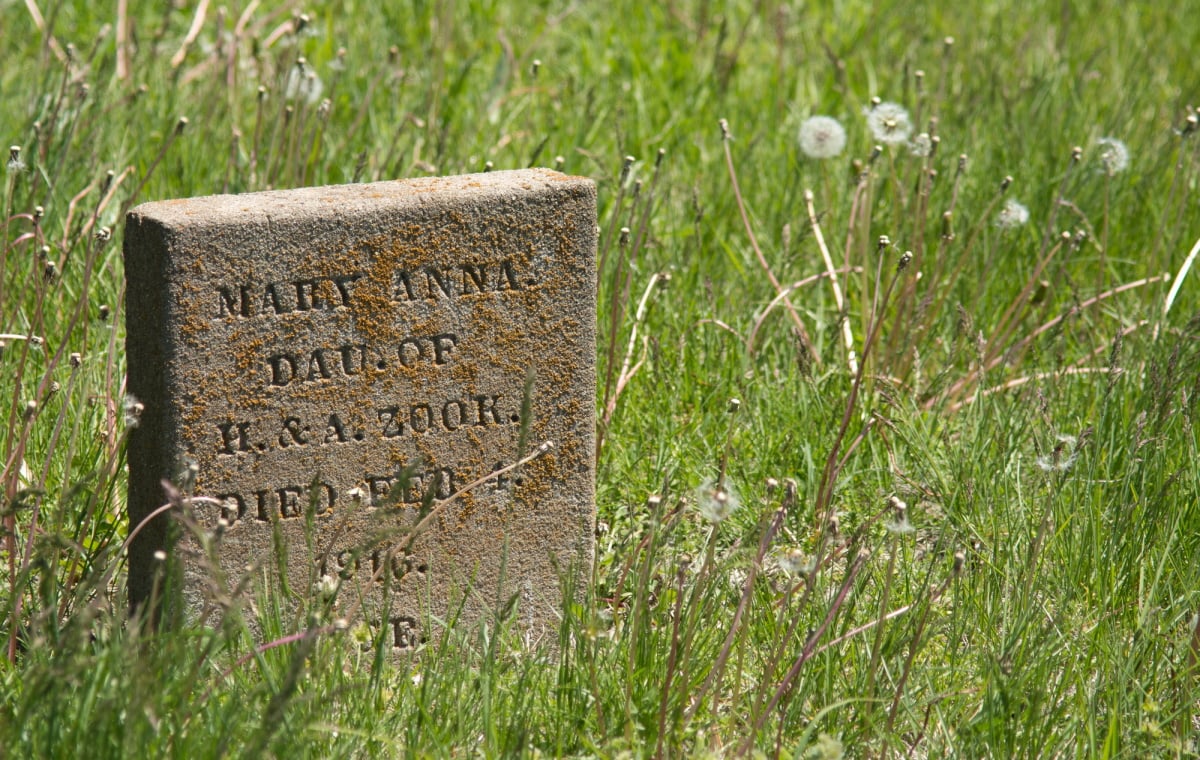
The Amish community itself is located about five miles west of Garnett. Consisting of numerous scattered farms and homes, the settlement spans about 10 miles north to south, and six miles east-west (see Meindl, “Language Use in an Old Order Amish Community in Kansas”, p. 28).
Amish at Garnett farm and have also branched out into small businesses, such as carpentry, cabinet making, dog breeding, and selling food products at markets (Meindl p. 32)
The Garnett Amish are liberal when it comes to use of technology. Like other Kansas Amish communities in Reno County, Amish at Garnett use tractors for farming. Tractors are also used for road travel when visiting town (Meindl p. 31). These are both atypical practices in Amish society, with tractors mainly being used in limited ways on the farm for their engine power.
Most Amish children in the Garnett community attend a small public school in the hamlet of Mount Ida at the southern end of the settlement. Unusual in Amish society, Sunday school is held in this community at two separate locations, as well as a summer Bible school (see Oklahoma-Kansas Directory, Yoder and Yoder).
The Garnett Amish settlement was founded by Amish from the Haven area of Reno County, Kansas. A year after the arrival of the Reno Amish, they were joined by seven families from a Mississippi Amish settlement (GAMEO, “Anderson County, Kansas Old Order Amish Settlement”).
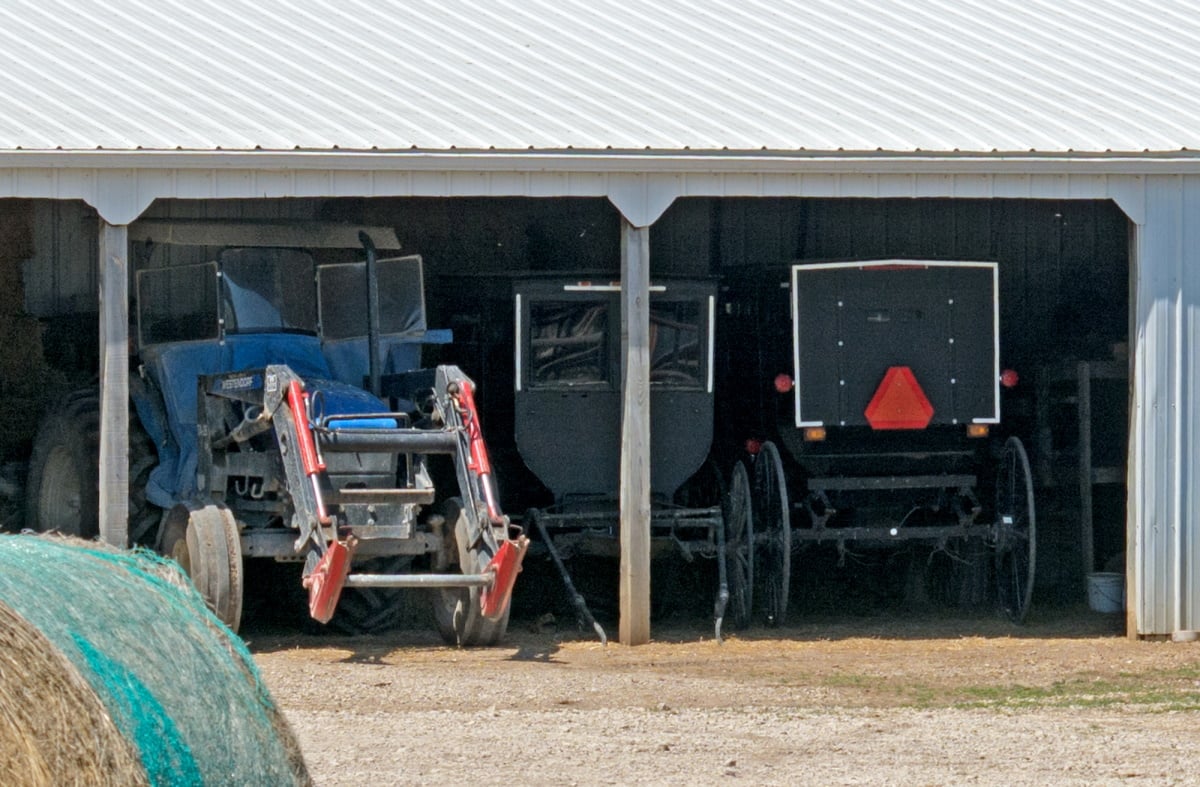
Over the course of the next century, the Garnett settlement fluctuated in size, never growing much larger than a few dozen families.
Families moved away while others arrived from places such as Illinois, Oklahoma, Arizona, Oregon, Arkansas, Colorado, and other settlements in Kansas. A low point came in 1947 when the settlement had dwindled to five families (Meindl, p. 26) .
By 1959 the Garnett Amish community had reached a size requiring it to divide into a north and south district (Yoder and Yoder). Today the size of the community has changed little since that division, numbering about three dozen households. The Amish in Anderson County maintain ties with those in Reno County (Meindl p. 102).
Other Kansas Amish Settlements
A number of other settlements have been founded in Kansas over the past two decades.
In 2005, Amish started a community in Bourbon County near Fort Scott, which has since grown to around 300 people in size. This is a more conservative group than the Amish in Reno County or Anderson County.
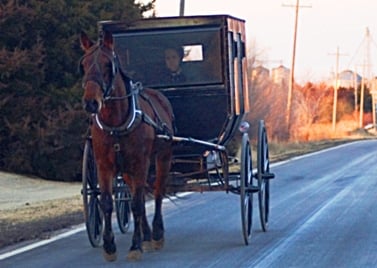
A second community founded not long after, in Marshall County near Axtell and Marysville, has remained small in size.
Since 2017, several other communities have been founded, including Clay, Greenwood, Lyon, and Woodson counties, all remaining small in size. The communities in Osage County (2018) and Clay County (2019) are the largest of this group, at around 180 people each.
Finally, the year 2023 was a big one for new Kansas Amish communities. In that year, Amish settled in three different locations – Waverly in Coffey County, Wamego in Pottawatomie County, and Independence in Montgomery County. As you’d expect, these settlements remain small at this point, each with just a handful of households. Two more have been added since – Glasco in Cloud County (2025), and Havana in Montgomery County (2026).
Historical Kansas Amish Settlements
Amish began settling Kansas in the mid- to late-1800s. Communities began springing up in various locations across the southern half of the state. Some of these communities were destined to last a long while – sometimes even a few decades. Others disappeared in a matter of years.
The first Amish presence in Kansas was recorded in Lyon County, where a settlement existed from 1869 to 1894. This community eventually disbanded.
The settler families left due to poor harvests as well as (likely) over disputes regarding progressive religious ideas, such as a plan to build a meetinghouse (Amish traditionally do not build church structures, in favor of home worship).
Another noteworthy settlement was found in Ford County at Dodge City, aka the “Cowboy Capital of the World”. Amish first began arriving to the area a few miles south of Dodge City in 1906, attracted by advertisements placed in the Sugarcreek Budget newspaper.
Promoted in Amish circles by a local land agent, the settlement grew rapidly. The rough climate challenged the Amish settlers, however. Drought caused many to begin to move away, until the settlement expired in 1929.
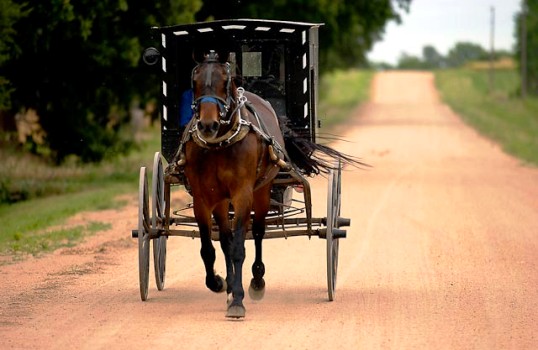
A short-lived settlement existed near Hesston in Harvey County, today home to a large Mennonite population. The few Amish who settled here came from Pennsylvania beginning in 1885.
Historian David Luthy explains that this small group never had a resident minister, and thus attended church with Amish-Mennonites who had arrived at the same time. After a few years most of the Amish families returned to Pennsylvania, bringing this settlement to an end in 1890.
The longest-lived of presently extinct Kansas Amish settlements was found at Conway Springs in Sumner County. This community lasted from 1914 to 1951.
Other Kansas Amish communities were once found at Ness County (Arnold, 1894-1922), Meade County (Plains,1913-1923), as well as another settlement in Ford County (Bucklin, 1903-1922) (this section see Luthy, Settlements that Failed 1840-1960 pp. 123-164).
Is Kansas becoming an Amish “hot spot”?
Kansas has long attracted Amish settlers. That said, its relatively low Amish population today suggests that Amish have had some difficulty flourishing in this Great Plains state.
As of 2026, the Kansas Amish population of 3,085 people ranks at #13 out of 33 states. Like neighboring Oklahoma, Kansas has seen a fair share of Amish settlement over the years, but has seen only limited population growth.
However, that trend may be changing. Of the seventeen Amish communities currently found in the state, thirteen have been founded in the past twenty years. New groups of Amish have been drawn to settle the Sunflower State, a trend which appears to be continuing.
Even within its small population, however, Kansas Amish show diversity. This can be seen in the differences in church rules (aka Ordnung), among its communities. The state is home to some of the plainest, and some of the most progressive Amish.
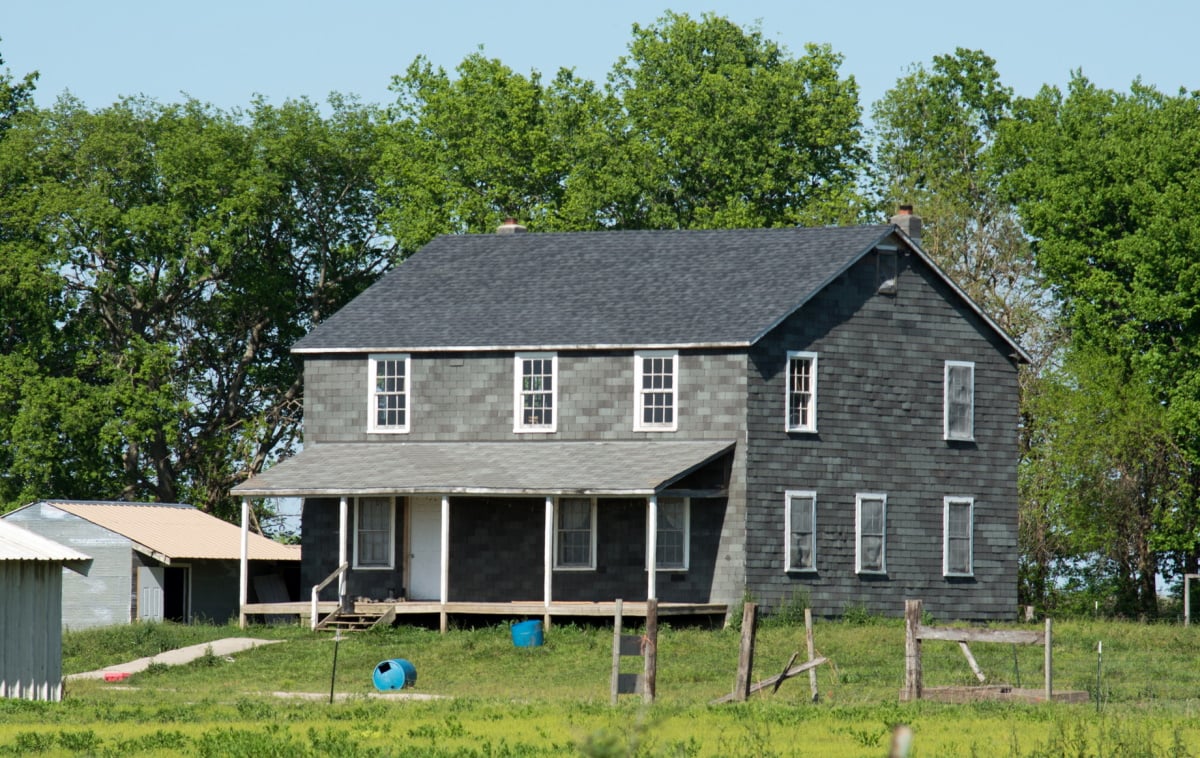
For instance, the church standards of Amish in Reno and Anderson Counties are generally progressive when it comes to technology, seen in their allowance of a wide array of farm machinery, hydraulic power, as well as using tractors for field work.
On the other hand, the community at Parsons/Galesburg are more restrictive when it comes to technology. To take another example, Amish in the community at Fort Scott do not permit indoor plumbing or engines.
Differences in Ordnung also reveal differing attitudes toward permissible social behaviors. For example, while the Thayer community permits smoking, Amish in the Anderson County settlement do not (Meindl p. 100). In this case, smoking is viewed as the more “traditional” behavior, with more progressive Amish churches tending to reject the practice.
For more, see:
- “Amish Population, 2026”- Young Center for Anabaptist and Pietist Studies, Elizabethtown College
- “Amish Population in the United States by State and County, 2026” – compiled by Edsel Burdge, Joseph F. Donnermeyer, and Adam Hershberger
- “Language Use in an Old Order Amish Community in Kansas”, University of Kansas PhD dissertation, Jörg Meindl
- Oklahoma-Kansas Directory: Choteau, Clarita, Garnett, Haven, and Hutchinson (2004). Enos Yoder and Freda Yoder, ed.
- The New American Almanac, Raber’s Bookstore (Baltic, Ohio), Ben J. Raber
- The Amish in America: Settlements that Failed, 1840-1960, David Luthy
- Living Without Electricity, Stephen Scott and Kenneth Pellman
- Diener, Harry A. “Yoder (Reno County, Kansas, USA).” Global Anabaptist Mennonite Encyclopedia Online. 1959. Web. 20 November 2010. http://www.gameo.org/encyclopedia/contents/Y61.html.
- Beachy, Jonas S. “Anderson County, Kansas, Old Order Amish Settlement.” Global Anabaptist Mennonite Encyclopedia Online. 1953. Web. 20 November 2010. http://www.gameo.org/encyclopedia/contents/A53503.html.

Hospital services in El Dorado Springs, Missouri
I represent Cedar County Memorial Hospital, its clinics, and physicians in El Dorado Springs, Missouri. We’d like to reach out to the Amish community in Ft. Scott, Kansas to see if healthcare services are needed and if we can facilitate that. Please reach to me via email. Or you can call the hospital, and they can give you a direct phone number to me. The hospital’s phone is 417-876-2511. Thank you.
Where horse poop go??!!
Hi. Really curious if the Amish have to stop and clean the horse poop up while traveling along the highway. Thx.
An Amish driver
I have been driving the Amish on trips for the past 9 months and I live in the middle of 7 different communities which most of them vary. I am near the most conservative of Parsons / Thayer to some of the most progressive of Anderson County Kansas. All are very friendly and interesting.
Russell Stover Bulk Specials for Chocolate and Taffy
This is Nicole with Russell Stover. I wanted to reach out about special bulk pricing for our premium chocolates and saltwater taffy. We work with many similar communities, providing simple, high-quality treats that are perfect for special occasions, gifts, or everyday enjoyment.
If this is something that could be useful for your community, I’d love to be your point of contact and see how we can help. Let me know if you’d like to discuss further!
Chicken Coop
I would like a Amish chicken coop built. I know there is a small Amish community near where I live. I’ve not found them yet. I was hoping to get some assistance in locating them. Im in Milford, Kansas.