
Descendant Tracks Down Lost Ohio Amish Cemetery — Using An 1819 Deed Signed By James Monroe
After a three-year search, a descendant has located a roughly 200-year-old Amish cemetery in Holmes County, Ohio, where her fourth-great-grandparents are buried — and it was right where a 1975 directory said it would be.
As reported in the Bargain Hunter, a woman named Linda Schrock Schneider managed to find the burial ground of Holmes County pioneers Jacob and Anna Shrock in a stand of trees in a cow pasture near Walnut Creek. A new granite stone listing names of the 11 people buried there was placed on October 7.
Amish cemeteries are typically modest and maintained on a small piece of land, often sectioned off from a community member’s acreage and enclosed by a fence. Gravestones are typically simple stone markers.
Community members take care of their cemeteries; when an Amish community disbands, the community’s cemetery is typically the last sign of a former Amish presence to remain years after a settlement has gone extinct.

But after 200 years, old burial grounds can be hidden over the course of time, even in large active communities like this one. Schrock Schneider’s starting point was Leroy Beachy’s 1975 Amish Cemetery Directory of Eastern Holmes County. As it turns out, this cemetery had been long neglected, and even half a century ago was hard to distinguish. From the report by Dave Mast at the Bargain Hunter:
She said Beachy described the site as being so overgrown in the 1970s that he didn’t think even a hunter would recognize it as a burial ground. He said having no inscriptions on the stones made it seem like an impossible task.
“But if anyone knew Leroy Beachy, they would know that he was ‘the authority’ on Amish history,” Schrock Schneider said.
Beachy’s book placed the cemetery 3 miles east and a half-mile south of Walnut Creek, on the Laura Machan farm.
Schrock Schneider was told the area had been stripped and there was little hope of finding the cemetery intact. She checked with Holmes Limestone, but a former employee who researched its land records found no cemetery.
Through the U.S. Bureau of Land Management’s online land records, she then found the original 1819 deed for the 160 acres her fourth-great-grandfather purchased, signed by President James Monroe.
The Holmes County auditor’s website showed a David Machan owned land in the same section. She wrote him a letter, and a few days later he texted back that he had always hoped a relative would claim the cemetery. The land had been his grandmother Laura Machan’s farm.
The acreage around the cemetery was stripped years ago, but Machan saved the burial ground because his grandparents had told him about it when he was a child. The two met at Machan’s farm in August:
“It is in a cow pasture but within a stand of trees. It is laid out exactly as Leroy Beachy had mapped it back in the 1970s — right down to a large tree in the middle of it.”
A New Burial Stone
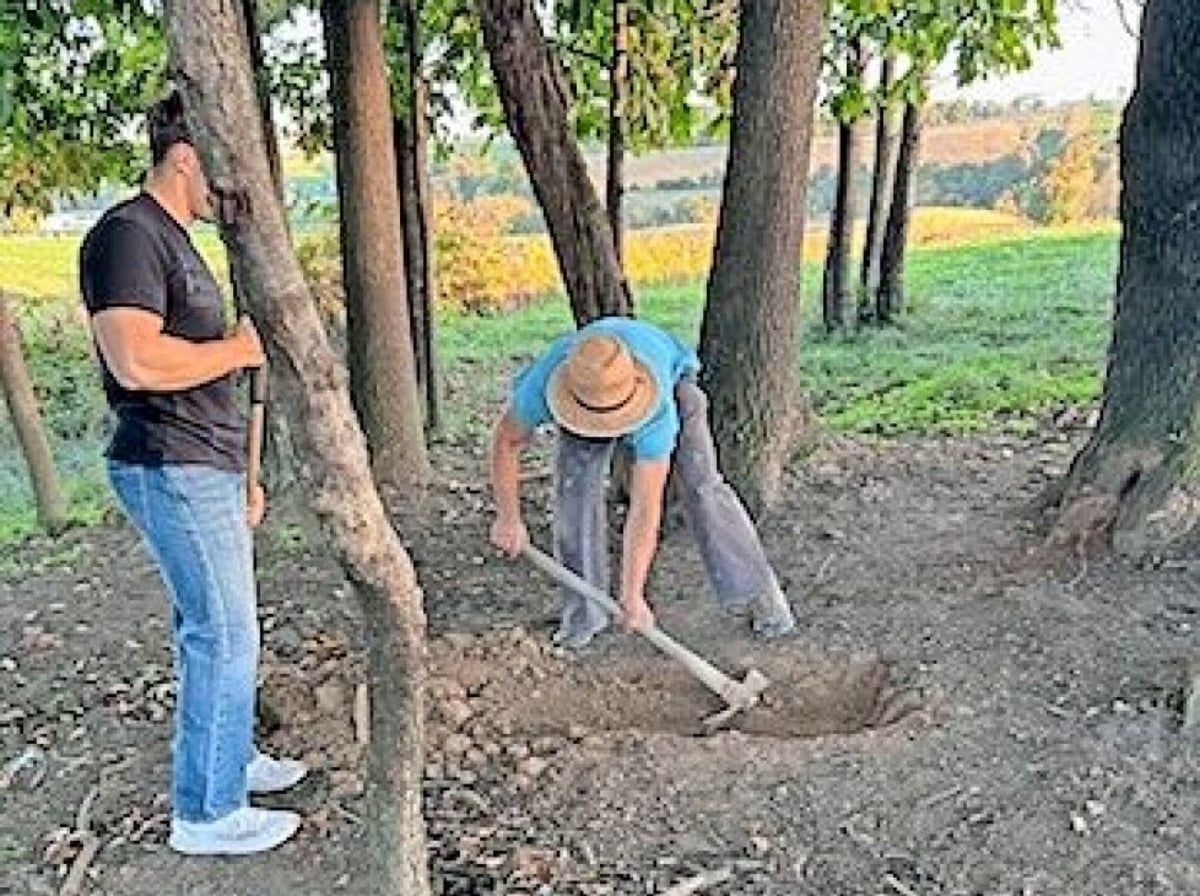
With Machan’s permission, Thompson Memorials made a granite stone inscribed with all 11 names. Schrock Schneider, her cousin Jeff Shrock and his grandson Josh built the foundation and installed it earlier this month, with help from neighbor Robert Miller.
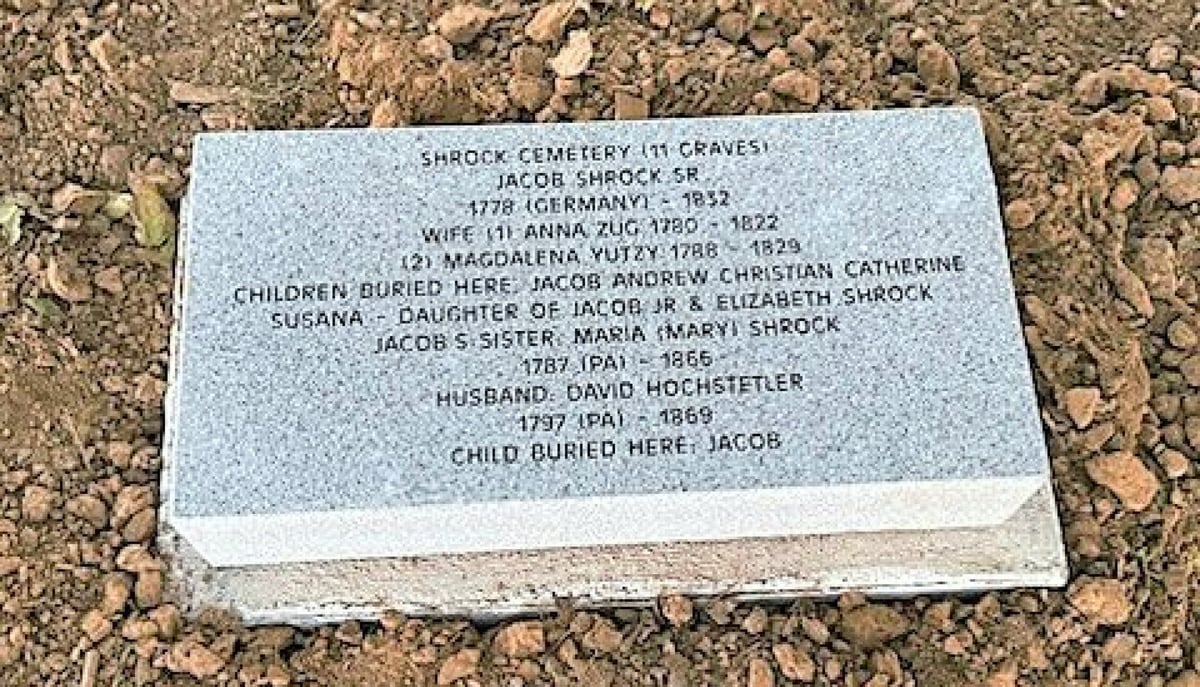
- Jacob Shrock Sr. (1778 to 1852), born in Germany
- His first wife, Anna Zug (1780 to 1822)
- His second wife, Magdalena Yutzy (1788 to 1829)
- Four of Jacob’s children: Jacob, Andrew, Christian and Catherine
- A granddaughter, Susana, daughter of Jacob Jr. and Elizabeth Shrock
- Jacob’s sister Maria (Mary) Shrock (1787 to 1866), born in Pennsylvania
- Her husband, David Hochstetler (1797 to 1869), born in Pennsylvania
- A child, Jacob
Jacob Shrock came from Germany with his father, John Shrock, in 1785. They spent time in Pennsylvania before arriving as pioneers in the Walnut Creek area in the early 1800s. Maria and David Hochstetler lived on the adjoining farm.
“It is a dream come true to have this burial ground recognized as the Shrock Cemetery,” Schrock Schneider said.
To be honest, I’m a bit surprised that no one from the Amish community had done this already. Especially given the appreciation for history in the Amish community, their knowledge of their ancestors well-preserved in ancestry books common in Amish homes, and the fact that these were Amish ancestors buried here. Regardless, this is a remarkable story and Schrock Schneider deserves a big hat-tip for her persistence and desire to see it through, preserving a piece of her family history.




Bezüglich Verlorene Gottesäcker
Ah, die deutsche Sprache: Zwei Wörter für einen Begriff: 1. Der Friedhof, eine Zusammensetzung aus Fried(en)=Schalom und Hof! 2. Der Gottesacker, oder ,,Acker Gottes!” Die letzte Ruhestätte nach unserer irdischen Pilgerschaft. Hut ab, Frau Schrock Schneider: was allzu leicht in Vergessenheit hätte geraten können, haben Sie ganz respektvoll, gar liebevoll wieder ans Licht gebracht, und den lieben Ahnen eine besondere Ehre zukommen lassen. Gott segne Sie, liebe Frau Schrock Schneider!
In Alsace & Lorraine
Here in my region of Alsace and in the Lorraine area, there are several Amish cemeteries whose exact locations are unknown. One that comes to mind is the one in Hohwald. The land that served as a burial site is known, but the exact locations of the graves are not. This is especially true because, prior to 1880, the Amish did not use headstones here. And in some cemeteries that are known and still used today by families descended from the Amish, one can see gravestones with a distinctive shape marking burials from the late 19th century, as well as presumed locations of graves dating from before the 1880s right next to “modern” graves for the most recent burials.