
Judge Rules Amish Mother Ruth Miller Not Guilty By Reason Of Insanity In Son’s Drowning Death

Judge Michael Ernest delivered his verdict this morning in Tuscarawas County, Ohio Common Pleas Court in the case of Ruth Miller, charged with aggravated murder in the drowning death of her 4-year-old son, Vincen.
Judge Ernest found Miller not guilty by reason of insanity, following her waiving of a jury trial last week. From WKYC:
NEW PHILADELPHIA, Ohio — Ruth Miller, the Amish mother accused of killing her 4-year-old son at Atwood Lake last summer, was found not guilty by reason of insanity by a Tuscarawas County judge following a bench trial on Tuesday.
“That’s the only conclusion that can be reached in this case based upon the evidence that has been presented to me,” said Tuscarawas County Common Pleas Court Judge Judge Michael Ernest as he announced the verdict.
This was not exactly surprising, as we already knew that three separate expert evaluations found her to be suffering from a “severe” mental illness at the time of her actions.
Moving to a bench trial meant the the judge was to evaluate five exhibits, three of which were those evaluations, and deliver his decision.
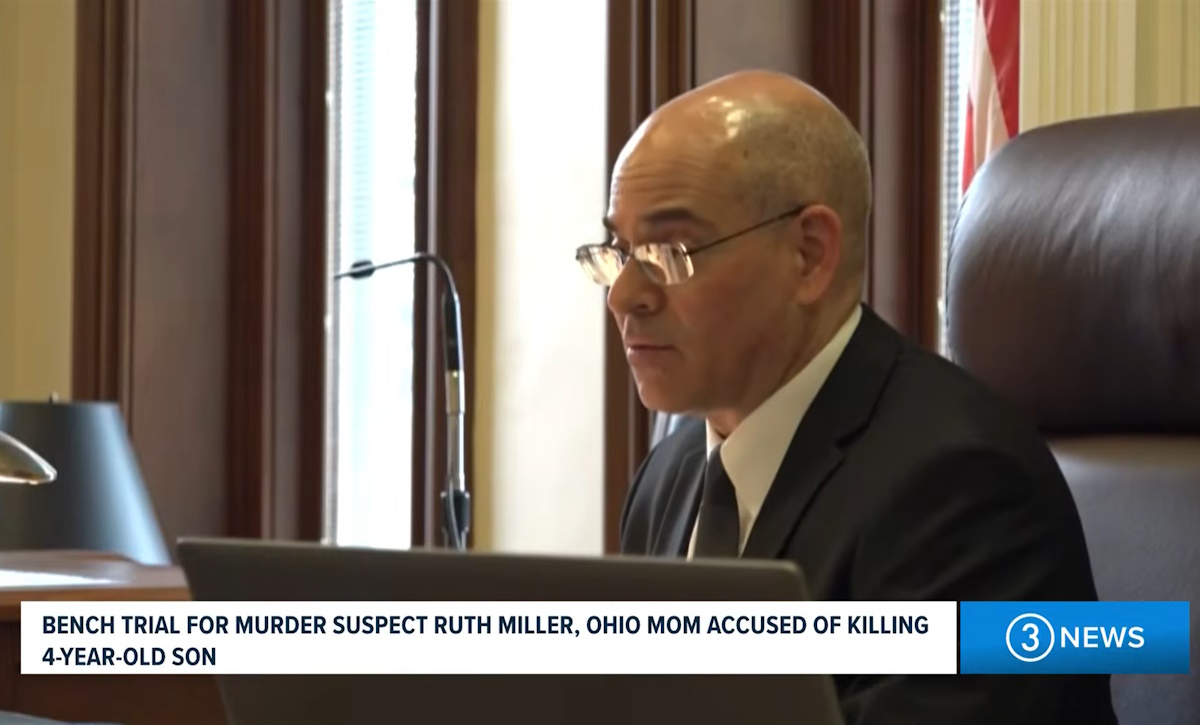
After watching the proceedings last week – with both prosecution and defense in agreement on the main facts of the case, and with both sides’ experts having reached the same general conclusions – it felt like this was the most likely outcome.
The judge further explained that the not guilty by reason of insanity verdict applied to all seven counts against her, which also included domestic violence and child endangering charges related to her actions towards her teenage children later in the day of the incident.
As the verdict was being delivered Ruth Miller remained expressionless.

More Insight Into Ruth Miller’s State of Mind
In the lead-up to delivering his ruling, Judge Ernest also added the following, as far as other witnesses to Ruth Miller’s state of mind:
“It’s not just the three doctors who came to this conclusion, that you did not recognize the wrongfulness of your acts. There are numerous witnesses who have contact with you on the days leading up to this event, that have contact with you on the day of the event, and also shortly thereafter, and to some extent, their observations and opinions here are relevant as well.”
For example, one summary cited by the judge included the following details about her in the weeks leading up to the alleged offense. She was described as having:
“short and erratic sleep, she described having a euphoric mood at times, which felt like she was getting married all over again, grandiose and distractable, at times had racing thoughts….grandiose, delusional thinking…she also believed that God had asked her to be swallowed by a fish, and she asked that her husband at one point in time to suffocate her. These reflect delusional and distorted thinking that she did not otherwise have outside of mental health episodes.”

A “Disease”, Not A “Defect”
There was also this distinction noted about Ruth Miller’s mental condition:
Opinions of three doctors determined Miller did have a severe mental disease, but did not have a severe mental defect. And as a result of the severe mental disease, she did not know the wrongfulness of her actions.
I’m not sure why this distinction is made, or what the implications might be in a legal sense or for what comes next.
But my understanding is that while the terms are similar, “disease” suggests a state of illness that presumably can be treated, while a “defect” would be something non-treatable or non-curable and unchanging.
“Reckoning” To Come; Ruth Miller’s Lawyer Addresses A Misconception
Ruth Miller’s lawyer Ian Friedman previously had the following to say, on a misconception about the not guilty by reason of insanity (NGRI) verdict. Via FOX 8:
“The judge has been presented with the three reports and all of them determined the same thing, that Ruth was unable to appreciate the wrongfulness of her conduct on that day,” Friedman said.
Friedman said the biggest misconception about being found not guilty by reason of insanity is that it somehow excuses illegal conduct and is a free pass from prison.

He also spoke of a “reckoning” as the article describes it, for those who perform harm while experiencing such mental conditions:
The longtime Cleveland attorney is convinced that Miller would have never harmed her children if not for severe mental illness, and he said in many cases with treatment and reflection, there is a reckoning.
“All of the sudden coming to a place where they realize what they were involved with and just being at an absolute loss as to how they could have been involved in that place. Imagine how painful and terrifying that must be,” he said. “And I certainly think that Ruth would be no exception to that.”
It is hard to imagine what a mother would experience when coming to that realization once in her “right mind” again.
Next Court Appearance
The next step will be a court appearance on March 13th, “as the prosecution and the defense will have the opportunity to present their positions on her placement moving forward.”
Friedman had previously noted that if she received an NGRI verdict, she would then undergo treatment monitored by the court.
In the meantime, Ruth Miller has been returned to Tuscarawas County Jail to await the next steps. You can watch the bench trial proceedings in full here:






Why no comments?
Two days after this story has been posted and still no comments. That is almost unheard of for any of your posts isn’t it Eric?
You make a good point differentiating between a mental disease and a mental defect. My question is are either or both of these hereditary?
Also it be nice to know if she is taking any medication and if she was taking any medication before the incident in August and if the medication has changed since her arrest, and if she was off medication at the time of the incident. Would not all of these things be relevant for the judge in making a determination as to whether her mental disease could have been controlled???
For instance if she voluntarily and intentionally stopped taking medications and then killed her son by throwing him in the water and it could be proven that the medications might have kept her from doing that wouldn’t that support a charge of intentional and voluntary manslaughter etc??
Everybody simply wants to feel sorry and get it behind them but to make a society better should not these questions be asked and the public educated on this subject more fully?
All very complicated
It’s reasonable to argue that to charge someone with manslaughter as a result of medical decisions about managing their mental illness would be deeply unethical: it would amount to giving the medical profession legal authority to damage people with mental health problems. It would work just as well towards the end of rendering people reliably safe to incapacitate rather than treating, and that is much easier to do. I think most people in the modern west would be horrified if a doctor wanted to lobotomise and a court judged a person guilty for what their illness had caused on the BASIS of their refusal to have their illness controlled by the losses of human functionality inherent in that “treatment”; yet people were once completely convinced of the appropriateness of that surgery.
People who choose not to take medications for mental health usually do so because the side effects are unbearable or the medication is actually making them worse in some way. Unless someone has engaged in dangerous conduct in the categories it is appropriate for others to interfere with, or is out of things in a way that makes it essential for next-of-kin to act for them, it matters that people are allowed to make their own choices about medical treatment – and in all circumstances where supervision is justified, it’s important that people who supervise it are paying attention to the actual effect the medical treatment is having on an individual and are not just arrogantly imposing some sort of regime.
Medical autonomy actually looks to me as if it’s going to be the next great human rights battle: that is, protecting the right of people to make their own choices about medical interference and not to be subjected involuntarily to doctors’ fallible decisions about what ought best be done to their bodies. Most medical treatment would be defined as criminal assault in most legal systems if it was not medical treatment: consent is ordinarily a necessary criterion for allowing it an exception.
(Of course, following an incident like this, I do think it is entirely appropriate that someone supervise ongoing mental state to make sure, for everyone’s sake, that appropriate intervention is provided before anything happens again: I would however still argue what is and is not permissible is very complicated: similar ethical problems to handling issues like typhoid carriers would apply).
By the way, I have to admit to being seriously puzzled by the lawyer’s comments as quoted. Not guilty by reason of insanity is usually a judgement that no illegal conduct took place on the basis that the person was at the time deprived by illness of the agency required for something to be judged to be CONDUCT. That is, “not guilty by reason of insanity” is usually a judgement that the person concerned is innocent. And if someone is innocent, there should be no question of punishment, only of care and safeguards.
I don’t mean, of course, to underestimate the emotional impact of going through that sort of nightmare, and coming back to consciousness to find the things that happened were actually real, it’s just that I’m bothered by the apparent dichotomy between judging someone to be not guilty of an offence and then talking as if they really deserve punishment and suffering anyway!
Anyway, prayers for Ruth Miller and everyone else involved as this moves onto its next stage.
Further explanation
Flowering tree, your thoughts and expressions make for interesting reading and show you as a person with a mind of great insight.
For instance your comprehension of the attorney’s statement about the words ” not guilty by reason of insanity “, are part of the system of American jurisprudence that is invoked for the purpose of having a trial. A defendant cannot plead guilty or admit to guilt and still have a trial generally because the judge would say it’s simply a matter of determining the sentence if you are guilty. So nearly all defendants plead not guilty even though they may be guilty just so they can have a trial by jury or bench trial with the judge. The plea of not guilty by reason of insanity is inserting a conditional clause that must be considered during or before trial. In this case the defendant is given evaluations to determine their mental competency, and if all the evidence from professionals diagnose the defendant as being mentally incompetent or deranged or lacking the ability to comprehend the seriousness of their crime or that what they were doing even was a crime, then they may be found by the judge, without having a trial, to be not guilty because of insanity at the time they committed the crime. So that means the final stage will be simply imposing a sentence that usually involves medical treatment with confinement until the person may be deemed to have overcome their medical condition and safe to be released back into society and they have in a defacto sense escaped trial and judgment because of their mental condition at the time they committed the crime does not allow for them to be held accountable. Most likely those who are mentally unstable spend many years if not their entire life in a type of confinement either with or without medical treatment to make them hopefully stable and safe for release. If they refuse medical treatment they may simply be confined indefinitely, while their attorney may periodically petition the court for review of their condition to see if they could possibly be released.
Your other comments about having a lobotomy to control a person’s actions and thoughts, caused me to click on your name and go and read some of your other writings regarding homeschooling and the school systems and how authority manipulates and controls people. It would be an honor to be able to visit with you in person someday because you think very deeply into society’s norms and conventions with analysis of the consequences of how modern society’s function. Thank you for taking the time and energy to write your comments. I will enclose my email address in case you or anyone else wishes to contact me if Eric permits it.
leon_moyer@yahoo.com