
Jacob Hochstetler Mural Memorializes Tragic Attack & Nonresistance Lesson For Amish & Others

The Jacob Hochstetler story is one well-known in Amish circles, as an example of one Amish man’s steadfast faith and commitment to Anabaptist principles of nonresistance.
Hochstetler lost his wife and two children in a brutal wartime attack – but refused to defend himself or to allow his sons to use force against the attackers, in keeping with his deeply-held faith.
Your Ohio News is now drawing attention to a mural well-known in some Amish circles – a depiction of the fatal attack on the Hochstetler household during the French and Indian War.
This painting, measuring four feet by eight feet in size, has now been acquired by the Jacob Hochstetler Family Association. Hochstetler has many descendants among the Amish and Mennonites, and many will be glad to learn that this mural is now in possession of the organization.
The Jacob Hochstetler Story
We’ve looked at this famous event before in other instances, but here is a summary of what happened:
On the night of Sept. 19, 1757, during the French and Indian War, a band of Native Americans, believed to be from a group of Delaware Indians who had allied with the French, attacked the Hochstetler homestead.
A peaceful night turned to terror — the family awakened by barking dogs and gunfire. Jacob and his sons Joseph and Christian had muskets, and while the boys were eager to defend the family and homestead, Jacob’s commitment to peace won out and he refused to allow any attempts at killing another human being, consistent with their nonresistant faith.
As the family hid in the cellar, the attackers burned the house, killing Jacob’s wife Anna and two of their children. Jacob, Joseph and Christian were taken captive and forced to travel with their captors.
Over time the captives were separated and lived among different Native communities for several years, and while Jacob grew to know and understand his Native captors, he eventually escaped and returned home around 1763, after peace was restored.
His sons Joseph and Christian were later released through negotiations and returned, although it is said Joseph desired to remain with his Native family.
Paul Miller, a former director of the Amish and Mennonite Heritage Center, shared on the importance of the painting that it “is a reminder of the values that shaped our Anabaptist forefathers, even to the point of death.”

It has always amazed me when I come back to this story to imagine what Jacob Hochstetler must have gone through during and after the attack, and imagining how he was able to make the decisions that he did.
I suppose that is where strong faith comes in…and you wonder what role that faith must have played in the aftermath of the attack when dealing with the hardships of captivity – and when considering that fighting back may have saved the life or lives of your loved ones.
I suppose that is why the story remains so powerful for Hochstetler’s descendants and others.
Miller noted that one of the goals is to learn more about the painting, including discovering who actually painted it…
Acquiring the Mural & The Unknown Artist
The mural itself has an interesting and somewhat mysterious history, with its author unknown. Here is more on that – and how it ended up where it is now:
While the artistic origins of the painting remain a mystery, the Hochstetler descendants knew of its whereabouts, the mural residing as part of the Roadside America attraction located near the Jacob Hochstetler Farmstead in Berks County, Pennsylvania.
It is believed that in the late 1950s Laurence Gieringer, founder of Roadside America, commissioned an unknown artist to paint the attack, using details passed down through the generations.
Accompanying the mural, which is painted on a piece of plywood, were several pen and ink drawings and several wooden figures to enhance the display. Following Gieringer’s passing, the display was taken down and stored before being sold to Bob and Carolee Powell, owners of the Pennsylvania Dutch Campground in Bernville, Pennsylvania.
They installed the mural in the camp recreation building, where it stood for three decades.
When the Jacob Hochstetler Family Association found out the mural was being sold about one year ago, JHFA board member Eli “Small” Hochstetler of Berlin offered to drive to Hamburg, Pennsylvania to pick up the mural.
Hochstetler says that the detail in the mural is historically correct, and that it will now travel “from place to place” around the Midwest, with no permanent destination at the time being. It is currently on display at German Village in Berlin, Ohio (Holmes County).
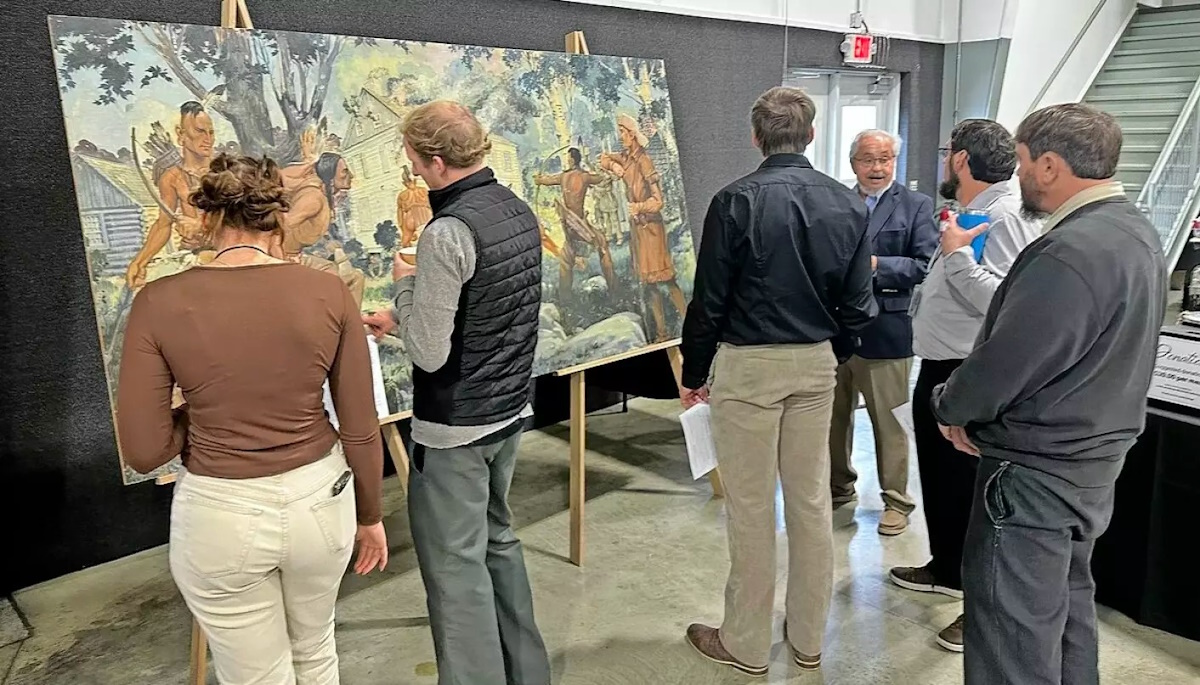
It does have one definite place that it will be in future though. The mural will make an appearance in Shipshewana, Indiana in 2028 at the Jacob Hochstetler descendants’ reunion.
On that note, there are an estimated 500,000 to one million descendants of the Amishman, according to the Jacob Hochstetler page.
They won’t all be there in Shipshewana, but a good number should be on hand to appreciate the mural and the important faith lessons it underscores.




One in a million
Jacob Hochstetler was my sixth great-grandfather.
For a very well done historical novel about the murders, kidnappings and surprisingly humane captivity of Jacob and his sons through the years, I recommend the book “Northkill” by Bob Hostetler and J. M. Hochstetler.
Northkill is the name of a creek that ran through the area. Kill is Middle Dutch for creek.
Thanks for mentioning that one Boyce, we had an interview with the authors about 11 years back for anyone who’s interested: https://amishamerica.com/northkill-jacob-hochstetler/
Comment
I had the privilege of seeing this a few days ago! I love the story it was in the Descendants of Daniel Miller Book I have….such a sad occurrence but it has been part of the history of Amish suffering and choosing peace over violence. I am so glad that this hasn’t been forgotten about. I pray this piece will give the next generation the inspiration to continue to live in a manner that says we are followers of Christ’s teachings…and to choose peace and love over violence. I hope they move this piece to the Amish/Mennonite Heritage Center on CR 77….maybe Ray Miller can share this story as well as he does with the Behalt. Aufwierdersehen!
That’s great, and will be interesting to see where it goes and where it ends up!
Reply
I had the privilege of seeing this piece a few days ago! Such an inspiring and tragic story…I actually had just learned about this story a couple years ago when I purchased the Descendants of Daniel ? Miller genealogy book. I hope this will be inspiration for the next generation to continue to live in a way that mirrors the teachings of Jesus Christ. Peace and Love prevail…violence leads to destruction.
Comment
Forgot to put…I hope they move it to the Amish/Mennonite Heritage Center on CR 77 here in the Berlin/Bunker Hill, Ohio area or Menno-Hof in Indiana. Would love to hear Ray D. Miller present this one like he does the Behalt at the Amish/Mennonite Heritage Center.