
Amish Country Homeowner: Board Would’ve Pushed This Overgrown Business Off Farmland Long Ago “If It Was Amish-Owned”
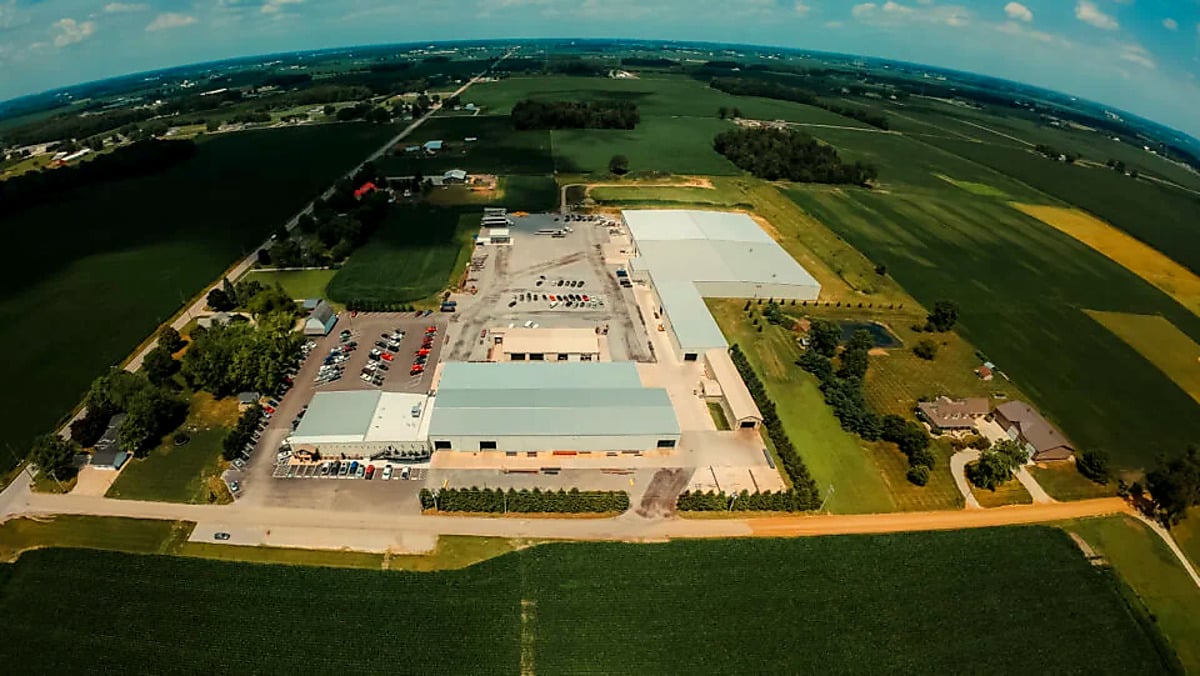
A local resident whose home sits next to a fast-growing business in the Nappanee Amish community says officials would have forced the company off farmland years ago – “if [the business] was Amish-owned.”
The business in question is called PWI, which builds custom cranes, mezzanines, and other manufacturing support products. Over the years they have experienced a lot of success and corresponding growth. Now, they would like to put up a new 200,000-square-foot building in an agricultural district in Kosciusko County, Indiana.
But after hearing from nearby homeowners who oppose it earlier this month, the county Board of Zoning Appeals held off on a decision.
InkFreeNews reports that PWI president and CEO Ryan Miller came before the board on October 13 to ask for an exception allowing the expansion. The new building, which would include an office, would sit between County Roads 1000N and 1050N outside Nappanee, which is home to the country’s sixth-largest Amish settlement.
Miller told the board the company is experiencing “an explosion of growth” and is currently sending work out of the county to keep up with demand. PWI currently has 238 employees. He said construction would likely happen in 2028.
This business lies in the heart of Nappanee’s Amish Country; the area is home to over 6,000 Amish residents. In its defense, the company says it has taken steps to lessen the impact of a large manufacturing facility in a rural area.
Miller said the company steers traffic away from a nearby Amish school, stays in regular contact with neighbors, and plans to build privacy mounds for the homes around the property.
Neighbors Speak Against The Expansion
Understandably, not everyone loves the idea of an already pretty-large-for-the-countryside business getting a lot larger. And it’s not surprising the immediate homeowners would be most unhappy with the situation.
A man who lives next to PWI named Elmer Miller spoke against the request, saying the company has grown up around him since he bought his property in 2006.

Back then, by his count, it had around one-tenth of the employees, and wasn’t anywhere near his house. Miller did not mince words at the meeting:
“Previously today, you didn’t grant a variance for a business and I agree with you, you did the right thing,” said Elmer.
“They are 100 times bigger than what he is. This should have been shut off 20 years ago. When I bought that property, where I live now, in 2006, they had 20 employees, maybe 30, and they weren’t anywhere close to my house. If I go to sell my property right now, it will have zero worth.”
Technically it will certainly have some worth, but I get his point. All things considered, it’s not going to be nearly as desirable a residential property with what feels like a giant manufacturing facility right next door, and one that wants to expand. He’s going to have a harder time selling it as such, and if and when he does, it will be below the value he’d get if there were acres of corn where PWI sits today.
In the above aerial photo via the PWI website, we do see several homes in the immediate vicinity of the business. The image comes from a section of the site titled “Campus Expansion” and contains the caption: “PWI expanded it’s facilities every year from 2018-2024, increasing it’s office and manufacturing space to 230,000 square feet.”
Elmer Miller also told the board he had looked into the company’s history with the BZA, and that this was PWI’s 12th request for an exception or variance. To him, that is a “sure sign” the business doesn’t fit where it’s currently located. I also really empathize with this:
“Is there anything else in Kosciusko County, a commercial building, zoned ag, that is that size? It doesn’t belong in the countryside. If I had known they were going to grow around me, I never would’ve built my new house, my father-in-law would’ve never built a new house. We wouldn’t be there.”
Elmer Miller bought his rural abode two decades ago with the assumption, rightly or wrongly, that the next-door business wouldn’t eventually be 10 times larger, and now be pushing to nearly double that, to boot. Cannot be a good feeling.
He added that Ryan Miller had sent him a letter inviting him to call or stop by the office with any concerns. But in his view it should be the other way around, that it’s on the company to come to him.
A second neighbor, Wilbur Troyer, who lives on CR 1050N, also opposed the request, citing property values and flooding. There are no further details on the cited flooding issue.
“If PWI Was Amish-Owned”
Elmer then made the claim that stands out most in this story:
“If PWI was Amish-owned, you would have made them move into an industrial park a long time ago,” said Elmer.
“To me and to a lot of the Amish community, that’s the feeling a lot of people have. I just wish everybody would be treated the same. That’s all I’m asking.”
Miller and Troyer are both common Amish surnames, and Elmer speaks of the Amish community’s feelings on this, in a way that makes it sound like he’s a part of it. The report doesn’t explicitly say whether either man is Amish. But given the context, I’d say it’s more likely than not that’s the case.
One thing that makes this story unusual is the direction of the complaint. You more often see this type of story running the other way – non-Amish residents arguing that Amish businesses and builders get a pass on rules everyone else has to follow, like the New York mayor who said Amish builders aren’t on “a fair playing field” last year.
Here we have the opposite charge – that a non-Amish company has been permitted to grow in a place and a way that an Amish one wouldn’t. For whatever reason, the comment reflects a sense that Amish business owners have been treated unfairly in the past.
I don’t have any context or additional information from the piece to comment on how valid that is in this community, but welcome any comments from those who might.
Balancing All Concerns
PWI no doubt employs a lot of local residents and I would guess a good portion from the Amish community. So it is undoubtedly having a positive impact on the local economy, and county authorities have to balance all parties’ concerns.
For one, this is a business providing an income for a good number of area heads of household, and with its track record of expansion and current plans to nearly double its square footage, you have to assume it’s probably going to be adding dozens more jobs for local people.

Northern Indiana is a rural area – but it is no stranger to manufacturing, with the heavily-embedded RV industry being a key employer for decades in the Nappanee area, and in the significantly larger neighboring Elkhart-LaGrange community. In fact, a majority of Amish men in both communities have worked in RV plants, according to figures from Steven Nolt. PWI’s business helps supply the equipment used within those RV factories, at least as a part of what it does, so they are integrated within the larger powerhouse RV-based economy.
Would PWI consider buying Elmer Miller’s and others’ properties at more-or-less market rate? Perhaps they could put the homes to use as offices or other facilities. I have no idea whether the homeowners would even want to sell, but that seems more likely than getting the outcome where the company leaves its current facility completely. Given the company’s success – based on what I see on their website and from their CEO’s comments – perhaps that is something they’d consider doing.
The BZA continued PWI’s petition to its November meeting, to give the company and its neighbors more time to talk.



why doesn't the company just buy out the adjacent homes, at fair market price -just like an eminent domain situation or better yet purchae the next house for these affect property owners?
see all in comment title area