
Building “Plain” Computers for Amish & Mennonites Made This Mennonite Man Unpopular

Allen Hoover makes toned-down, “offline” computers for the Amish and Mennonite community. And not everyone in the community likes him for it, according to a new interview.
Hoover is an Old Order Mennonite man in Lancaster County, Pennsylvania who has been providing “Plain” computing solutions for Amish and Mennonites for over two decades.
The appeal of these machines: devices which provides business functionality – but without the full-fledged internet access of a modern computer.
That way, users can complete necessary business tasks, but cut out the temptation to use the internet that a standard machine would provide.
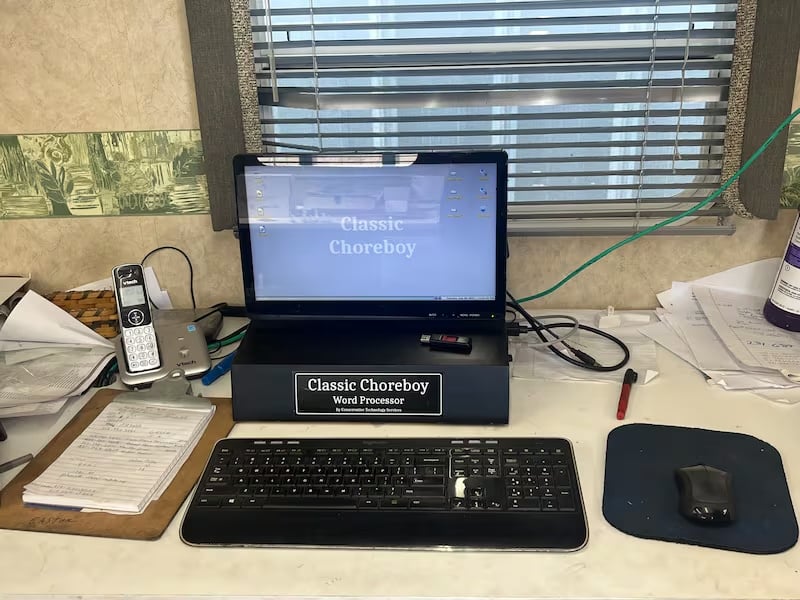
One example of these, which we’ve covered here before, is the Classic Word Processor. Here’s an old ad for a model called the Classic Steward (not the only model available):

Hoover Tells His Side
The Philadelphia Inquirer is running an interview with Hoover where he shares how his business has developed, and just why his business “has not made me a popular person.” An excerpt:
From his machine shop among corn and bean fields on Kurtz Road near Ephrata, Lancaster County, Allen Hoover sells 1970s-style word-processing computers, upgraded to internet speeds, at the rate of more than one a day.
For some, Hoover’s machine fits fast-changing business with timeless faith; others fear the computers have fed into a wave of covert internet use that threatens a formal split among his Amish customers.
Since 2004 the machines, originally priced at $800 each, have been adopted by dozens of Plain religious communities to run local systems, with names like Classic, Chore Boy, and Steward, to accommodate and monitor members’ text notes and business records, without video, corporate media networks, or Apple and Google apps.
Hoover says that “Our real goal is to live a separate life and not to be so influenced by popular society around us” and summarizes what his machines do to that end:
For our Plain people, we wanted it to be separate from the world. So it should have no connectivity. Not to the internet, email, or even fax. Just a stand-alone unit. And then of course no amusements of the world, no games, music, nothing like that. Just a business tool.
Hoover found that off-the-shelf solutions just didn’t cut it – almost all internet-connected, or too specialized for their needs.
We wanted one like the old word processors, where every unit was exactly alike. No additional programs, no apps that you can put on to listen to music or whatever.
The programs included are a word and a spreadsheet program. And a drawing program, and a computer-aided design program. We developed our own comprehensive business accounting system. With inventory control, invoicing, all that.
It seems like his intentions are good, and he was and is addressing a real need. Amish and Mennonites aren’t “just” dairy farmers anymore.
Economic realities have propelled many to go into business activities more tied in to the non-Amish world – and with different demands than those faced by their fellow church members in traditional agriculture.
Not Everyone Likes It
So how did he become unpopular to some, if he was trying to address a need in a way that respects Plain Anabaptist values? Hoover explains the community’s reaction:
It was mixed. In the beginning, it was a huge whoop of joy: Here is something we can use. Once a year there is an expo in Lancaster County, focused on the Plain people and Plain businesses. I got a booth and it was the star of the expo. People were lined up because it was the new thing.
Some Plain communities reacted by banning them because it was coming too close to the computer world. And I understand that perfectly. No hard feelings about that.
What happened more often was that communities started with it, but then became dissatisfied that we didn’t allow them to put more programs on. So they made their own and eventually drifted into the internet world.
It has not made me a popular person. For the ones that feel we should not have gotten into computers at all, I am the bad boy. For the ones that feel we should have allowed more connections, I am the bad boy.
He also notes that at the start, “We had a few meetings with interested businesspeople, to see what the need was. Probably made a mistake, we never asked the church for permission.”
Thousands Of Customers & Counting…
This is of course just Hoover’s side of the story. If you ask others, they might add to it. However, I see no reason to think he’s not telling it as he sees it.
In any case, it is another example of someone filling a real business need in the Plain community. And clearly Hoover has done a good job of it. The community has purchased several thousand machines since he started – and is still buying them at a clip of around 400 per year.
Hoover has some further interesting comments, including that he expects there to be a “big split” among the Amish in Lancaster County, at least in part related to technology. Check out the full interview linked above for more.




A big split?
The Anabaptists have been splitting ever since they split from the Catholic Church!! What’s one more split?
He wrote a book about abuse? Seems like there is more going on here. He likes the attention? Not a fan of the Amish? Making these machines is a subtle way of wanting to change the Amish? He knew he should of gone to church leaders first but chose not to?
Also, he is old order Mennonite who has had this business for over 20 years. My question is, how did he learn about these computers and how to make them? He would need exposure to this technology before starting this business.
He knows technology like this is tempting, luring, some Amish into the world, not separate.
I see plenty of Amish who do business with people who arrive with their laptop. While the Amish sit there with pen and paper.
Big split? Split has already happened and continues to happen as different groups are consistently formed.
I know plenty of Amish who use flip phones but the kids can have the smartphones. The Lancaster Amish are diverse and plenty of them are more modern than people who romanticize may want to believe.
I understand Allen Hoover does rub some folks (a lot of folks?) the wrong way (and maybe rub some folks wrong is an understatement for some). I don’t know the guy, so just going based on public info and what I’ve heard.
There are many ways of being Amish, and this device fits for some and not others. Whether it is something that would really accelerate computer adoption, I think that is a reasonable concern but at face value seems a reasonable compromise – not unlike how the Amish restrict other technologies (eg steel wheels on tractors or phone shanties). But yes this is something in the digital arena, and in some sense different in nature to most other, more visible, and less potentially powerful “disputable” tech.
I interpreted his statement about there going to be a “big split” to be more about how things will eventually shake out and become codified into different groups in the end. Acknowledging, as you do, that it is still ongoing and the “final” state of the split is probably TBD. There are still attempts at something like reconciliation or at least understanding happening now. Doesn’t feel like toothpaste is going back in the tube though.
The "C's"
Controversy is not necessarily a bad thing. It often raises important questions and can encourage critical thinking. Communication is almost always a good thing. By his own admission, Hoover dropped the ball on that point. These computers are tools. The Amish/Mennonite Communities get to decide whether to adopt and use them just as they have historically. Yes, there will be controversy. But I foresee no “big split” in Lancaster County in a large part because of the diversity.
TOTAL CONTROL
This guy is not who you think he is. He has been controlling the Amish, Mennonite and Old Order Mennonite communities through his “Chorboy”. His ultimate goal is to control monies made by the church. If you are not submissive to him, you don’t get to have healthcare that you pay into. You get totally cut off! He is law when it comes to anything that happens in the communities and their faith. Participating in Communion is a Christian’s right as they acknowledge Christ’s sacrifice. Hoover decides whether or not individuals are allowed to participate in receiving communion. That is wrong and not to be dictated by any person. That makes him a deceiver and false prophet.
It seems as though he has entire communities brainwashed that he is God. Wake up people!