
Anabaptism At 500 Years: Impressions From The 2025 Conference
Impressions from the conference “Early Anabaptism in Global Perspective: Past, Present, and Future at 500 Years”
As a rural sociologist steeped in statistical analyses of data to test hypotheses, I had my doubts about attending a conference focused on the 500th anniversary of the Anabaptist movement. Too much history for me, I thought!
Organized by the Young Center for Anabaptist and Pietist Studies, and held on the campus of Elizabethtown College from July 22-24, I questioned if any of the presenters would discuss topics of interest to me.

Well, in three words, I was “wrong, wrong, wrong.” Every session and every plenary address held my interest constantly because almost inevitably, presenters linked past events to the contemporary times for Amish, Brethren, Bruderhof, Hutterite, and Mennonite communities.
Further, speakers described the care with which they gathered information and provided interesting interpretive frames for their findings. If asked how I would characterize the conference over-all, I would reply, “entertaining and exciting scholarship.”
My mental conversion to the joys of historical research derives from three lessons I learned collectively from conference speakers. Perhaps re-learned is the better word, but nonetheless, each taught me a new appreciation for scholars who use historical and archival sources for their work.
Lesson #1
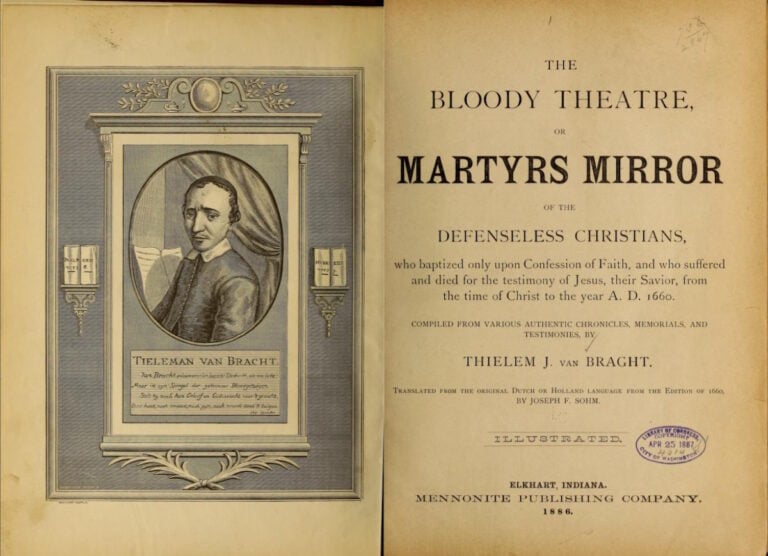
The first lesson is that I realized that recorded history on parchment and illustrated in books, and even material objects like large, cumbrous, leather-bound bibles from the distant past, are data for contemporary scholars of history. I imagined how much these supposedly dusty and often obscure forms of evidence are in fact clues to the vitality of historical events, the events that happened them, and the people these events affected.
For example, Tomoji Odori from Musashi University in Tokyo narrated a fascinating story about the similar clandestine actions taken by Japanese Christians several centuries ago to the ways that Anabaptists in the 16th and 17th centuries adopted various tactics to practice their faith, yet avoid arrest and persecution.
To do this kind of comparative work required access to historical accounts about two very different places separated by half the circumference of the globe, and a lot of tedious, systematic, hard work. Indeed, the final address of the conference by Elizabeth Miller (Goshen College) described a plethora of archival sources and also emphasized the importance of guiding research questions to instill evidence from the past with greater significance today.
The session in which Professor Odori spoke also included presentations by Breanna Nickel (Goshen College) on the social, theological and political contexts of the theologian, Balthasar Hubmaier (1485-1528) during the first half of the 16th century.
These were both exciting and dangerous times, with the Protestant Reformation in full swing and the short-lived but bloody Peasant’s War of 1524-1525. From his office in Berlin, Germany, Martin Rothkegel (Theologische Hochshule Ekstal/Ekstal Theological College) described a short-lived Anabaptist underground movement in the Dominion of Venice as significant for illustrating how new religious movements struggle to survive and even thrive against the power of state-sponsored institutions.
Again, without proper documentation that idly sat on library shelves, unused for decades and even centuries before an inquisitive scholar examined them, we would know nothing about these early Anabaptist dynamics and how they inform Anabaptism today.
Lesson #2
The second lesson I learned was how much nearly every speaker in every session I attended spoke to the sometimes conflicting and always competitive ways that various leaders attempted to define and clarify Anabaptism in those early days, and how much these dynamics play out today in an unbroken succession of debates, disagreements and resolutions to differences.
Scott Holland, Bethany Theological Seminary and the Earlham School of Religion, cited an influential work from a 1975 Mennonite Quarterly Review article that brought to the forefront the fact that Anabaptism’s development was one of polygenesis, that is, more than a few dominant thinkers of the past.
He also referred to books published decades ago that called attention to the diversity of 16th and 17th century Anabaptist leaders. As well, in that same session were presenters who talked about the work of such past and present scholars as representing a rich continuation of the very dialogues that took place when Anabaptism first emerged.
Lesson #3
My third lesson is perhaps the most important of the trio. It is the idea that past experience and context applies to contemporary times. History is not really about the past so much as it is about how the past shapes and informs the present.
For example, I attended the seminar session led by Peter Sensenig from the Eastern Mennonite Missions, on “Incarnational Hospitality: An Anabaptist Approach to Meeting Muslims.” His focus was not on conversion, but on events, or shall we say, occasions of contact and sharing, that is, quite literally, incarnational hospitality.
Sensenig’s seminar touched on the border between two very different cultures, based on large religious differences, a theme addressed also by Danang Kristiawan of the Gereja Injili di Tanah Jawa Synod in Jepara, Indonesia, located in the northcentral region of the island of Java.
The Gereja Injili is the oldest Mennonite conference beyond Europe and North America. Noting the diversity of Anabaptism, both past and present, he describes what he called an “experimental multi-textual approach…to construct an Indonesian Anabaptist peace theology.”
Arguably the most interesting presentation from my perspective was the plenary address by the Nicolas Terpstra, who is a Professor and Chair of History at the University of Toronto. Titled “Horizons of Expectation: Space, Sense, and Religious Reform in a Globalizing Age”, he discussed how European societies in the 16th century struggled with a world that was changing quickly and formed the context for how religious differences in a time of rising nationalism were expressed through what Terpstra called “purification and purgation.”
As I sat and listened, I realized that much of his presentation sounded familiar. Indeed, he was talking about the sociological concept of community, and the experiences of people from common faith communities of the past as they were affected by the larger forces of social change.
In other words, the experiences of individuals are contextualized within the specific places (i.e., spaces) where they live and the times in which they struggled, because that is when and where change was real for them.
To those unfortunate enough not to attend the conference, there are good chances that some presentations will find their way to the Journal of Plain Anabaptist Communities and Mennonite Quarterly Review as articles.
I wish I could get in a time machine, ala the H.G. Wells novel about time travel, and return to the Leffler Chapel and the Bucher Meetinghouse at Elizabethtown College at 1 PM, July 22, and attend all the concurrent sessions I did not select from the first time around.
If they prove as interesting and informative as my first selections, I would likely find myself in a series of time loops (Einstein and Hawking would love it), revisiting each presentation and learning more. Wow! Was I ever wrong!
Joe Donnermeyer (donnermeyer.1@gmail.com)
Co-editor, Journal of Plain Anabaptist Communities (https://plainanabaptistjournal.org/index.php/JPAC)


Immersed in data
All I know is that Anabaptists are for baptizing as adults, or rebaptizing the right way as adults, known as ‘believer’s baptism,’ by full immersion and I totally agree with that, as it says in Acts 8; 37. It is futile to baptize unless you believe ‘with all your heart,’ which is impossible for a baby to do.
; )