
Lawyers Say Amish Will Leave New York If They Lose School Vaccine Mandate Case
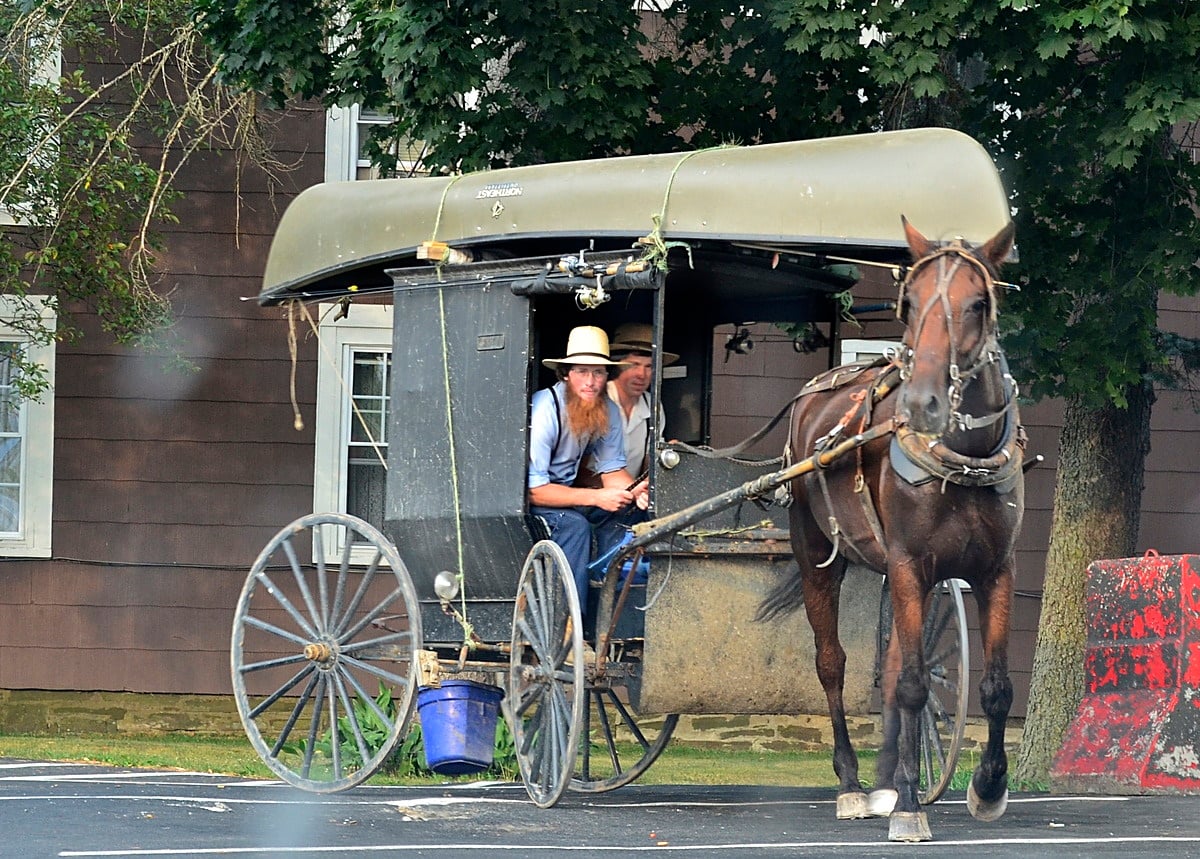
Lawyers for the Amish plaintiffs in New York’s school vaccine mandate case say their clients will petition the Supreme Court next month – and that if they lose there, the families intend to leave the state.
That comes from the New York Post, which reported from the Fort Plain and Canajoharie area this week. Both points answer questions left open when we covered the Second Circuit’s ruling on July 1.
That post ended by asking whether there would be another appeal, and whether the families would end up looking for somewhere else to live. The lawyers are now saying “yes” to both.
We also take a closer look at a remarkable letter, signed by 26 Amish parents, which they filed several years ago. In it, they write they are “sincerely sorry” for causing the state a problem, and add “We love our state of N.Y.“
But they’re also very clear about why they have an issue with the vaccine mandate.
Where The Case Stands
New York allowed religious exemptions to its school immunization law from 1966 until 2019. That year, the state legislature removed them following a measles outbreak. Medical exemptions remain in place, but that removal of the religious exemption was the catalyst for this case.
Three Amish schools in three separate communities – Shady Lane in Clymer, Pleasant View in Heuvelton, and Dygert Road near Canajoharie – were fined a combined $118,000. The state counts every day an unvaccinated student attends as a separate violation, at up to $2,000 each.
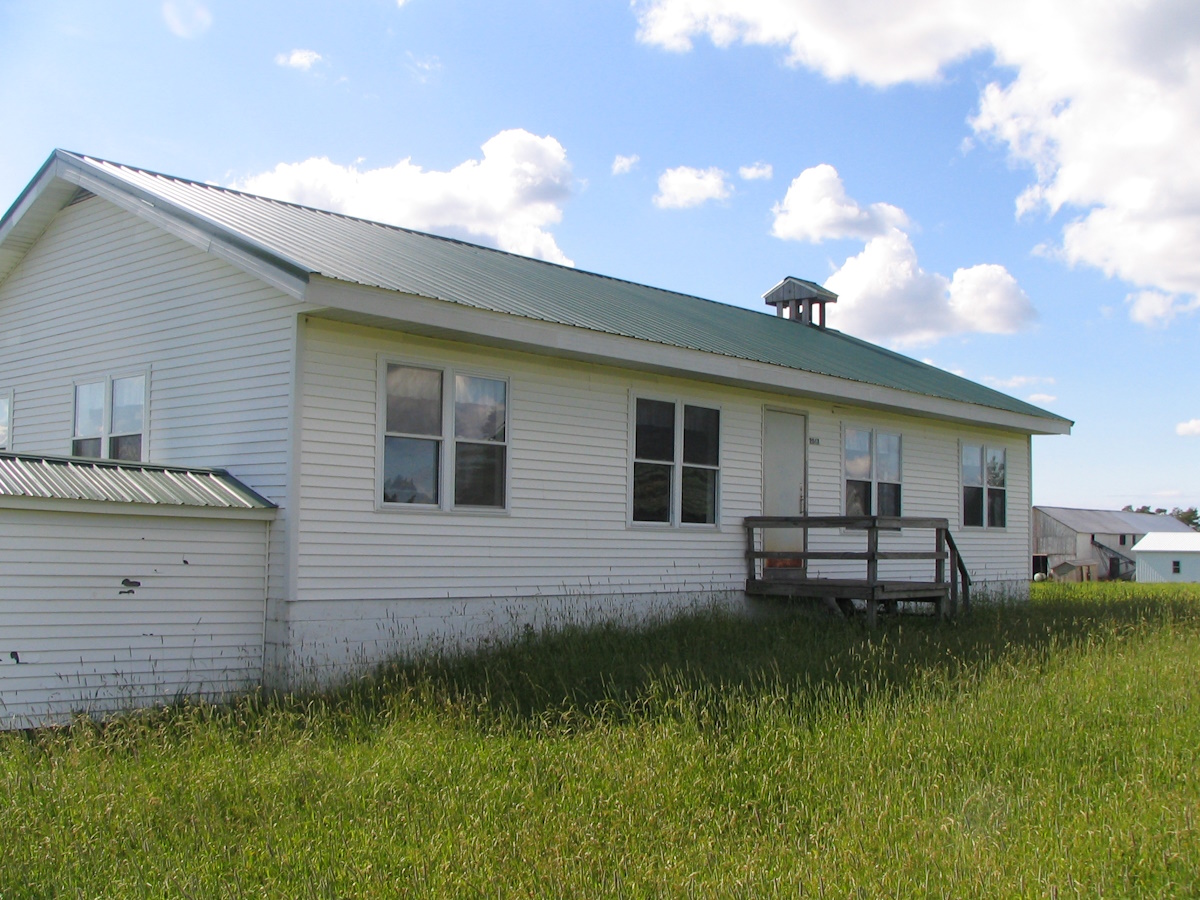
The schools and several parents sued. After losing at the district court and the Second Circuit, they petitioned the Supreme Court in summer 2025, which vacated the ruling in December 2025 and sent it back for reconsideration.
This year in June, the same panel ruled against them again, essentially finding the law applies to everyone equally, and does not single out religion.
Their lawyers say the petition will be filed next month. And they have the federal government on their side this time: a spokesperson for the Department of Health and Human Services told the Post that the administration’s recent executive order reaffirmed their “commitment to parental choice and religious freedom when it comes to childhood vaccination.”
On the other side of the issue, the New York Department of Health told the Post its job is to protect public health and enforce the law fairly, and that the school immunization requirements are based in science.
The Scope Is Larger Than Three Schools
I don’t believe I’ve really pointed this out before, but it’s worth noting that the three communities listed span the state – Clymer in the west, Canajoharie (Fort Plain area) in east-central New York, and Heuvelton in the north near the Canadian border.
New York itself is home to around 60 Amish communities and over 25,000 Amish people – the fifth-largest Amish population of any state.
The fact that the schools are from across the state brings home that this is not just a case in an isolated area, but that this could impact Amish across the state. Not all Amish are going to have the same objections to vaccination, but many probably will.
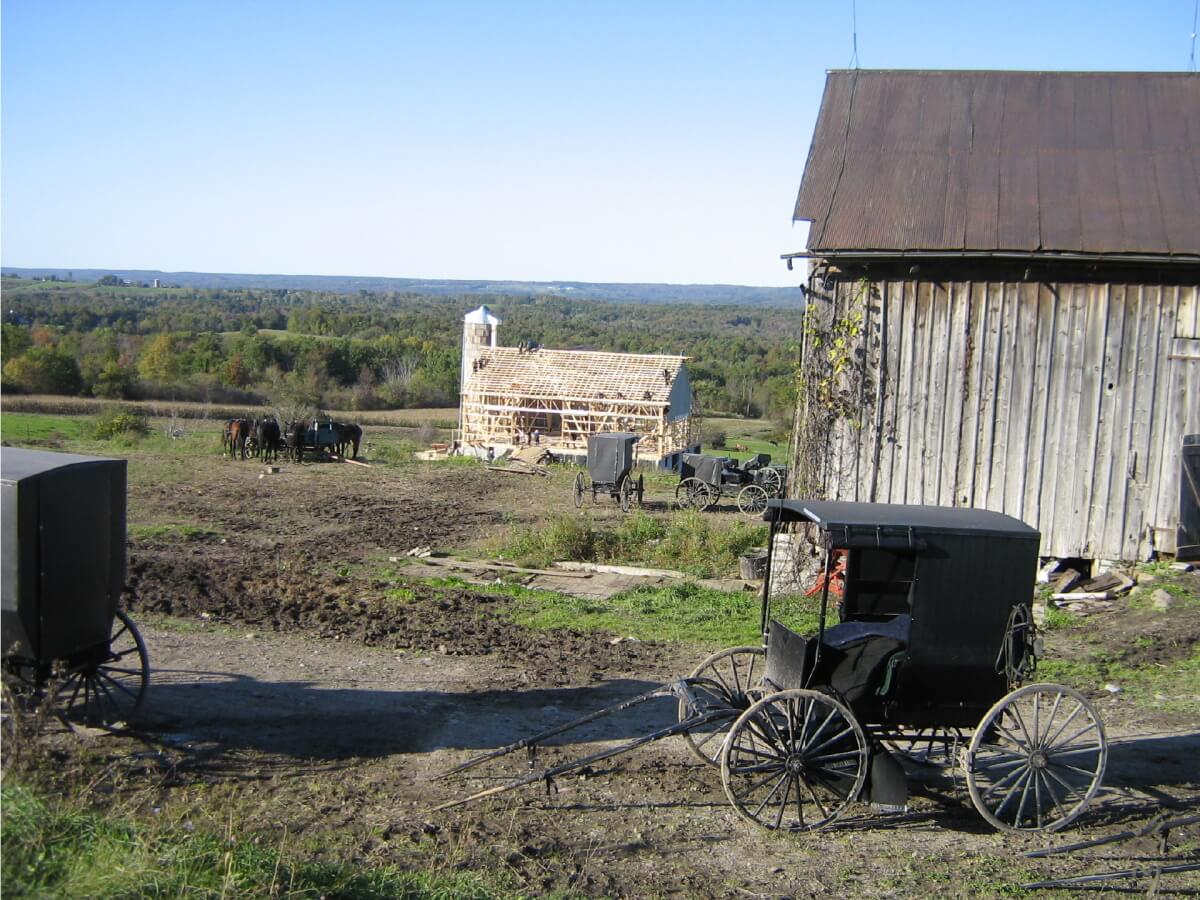
And attorneys for the plaintiffs are pointing this out too – that every Amish school in New York is in the same position as the three named in the suit. Wayne State University law professor Christopher Lund made a version of the same point to the Post, from the state’s side:
“The state isn’t just thinking about the Amish, it’s thinking about everyone together. I think the Amish are probably a very sympathetic set of plaintiffs, but the state is thinking more widely.”
Aaron Siri, one of the attorneys for the plaintiffs, described to the Post how the community views being in court at all:
“The Amish really don’t want to be in this position. They don’t want to be engaging in this lawsuit in any way at all. But they’ve been left with no choice.”
Siri also told the paper the only way the penalties could actually be paid would be for the state to take the families’ land.
What The Amish Parents Told The State In 2022
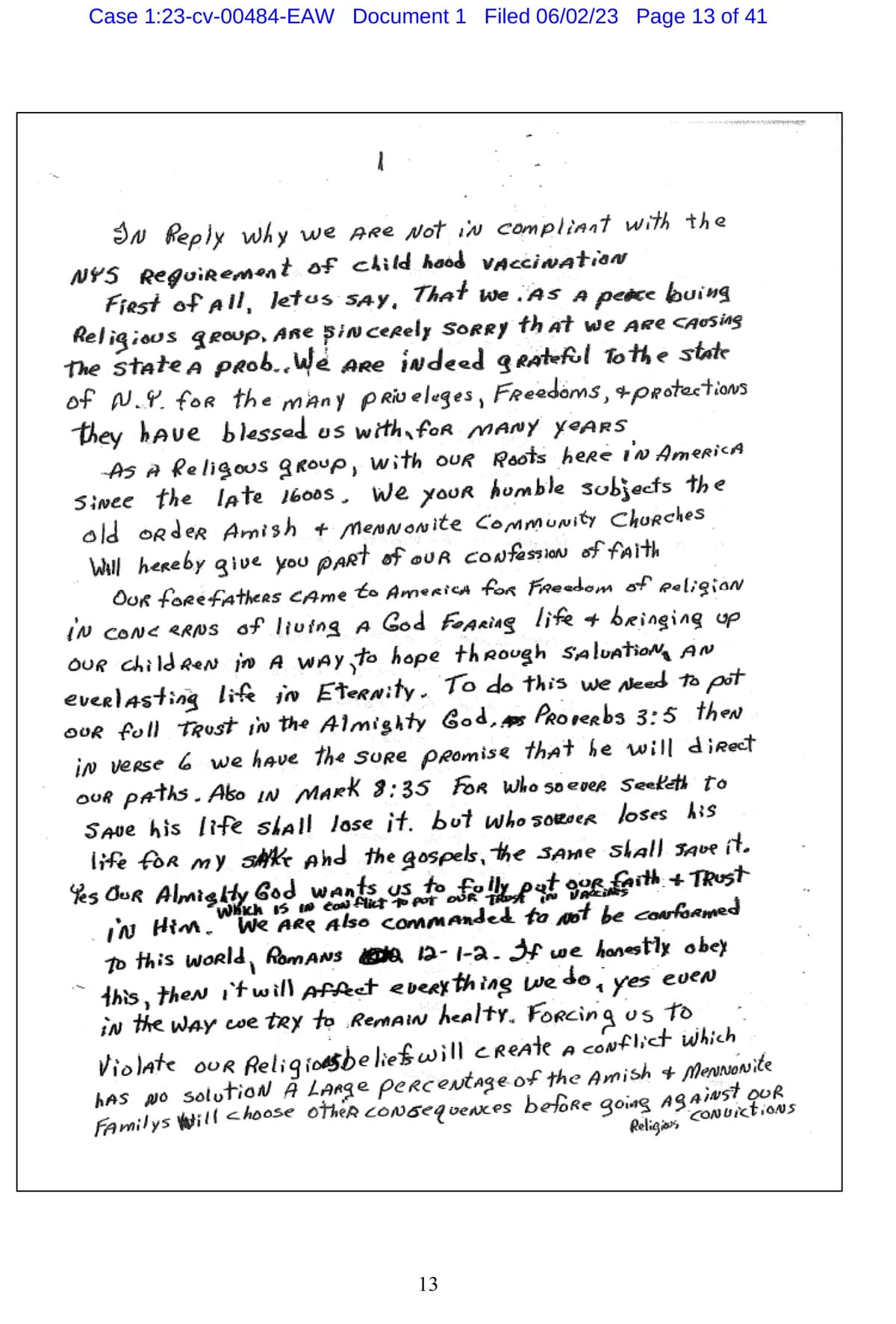
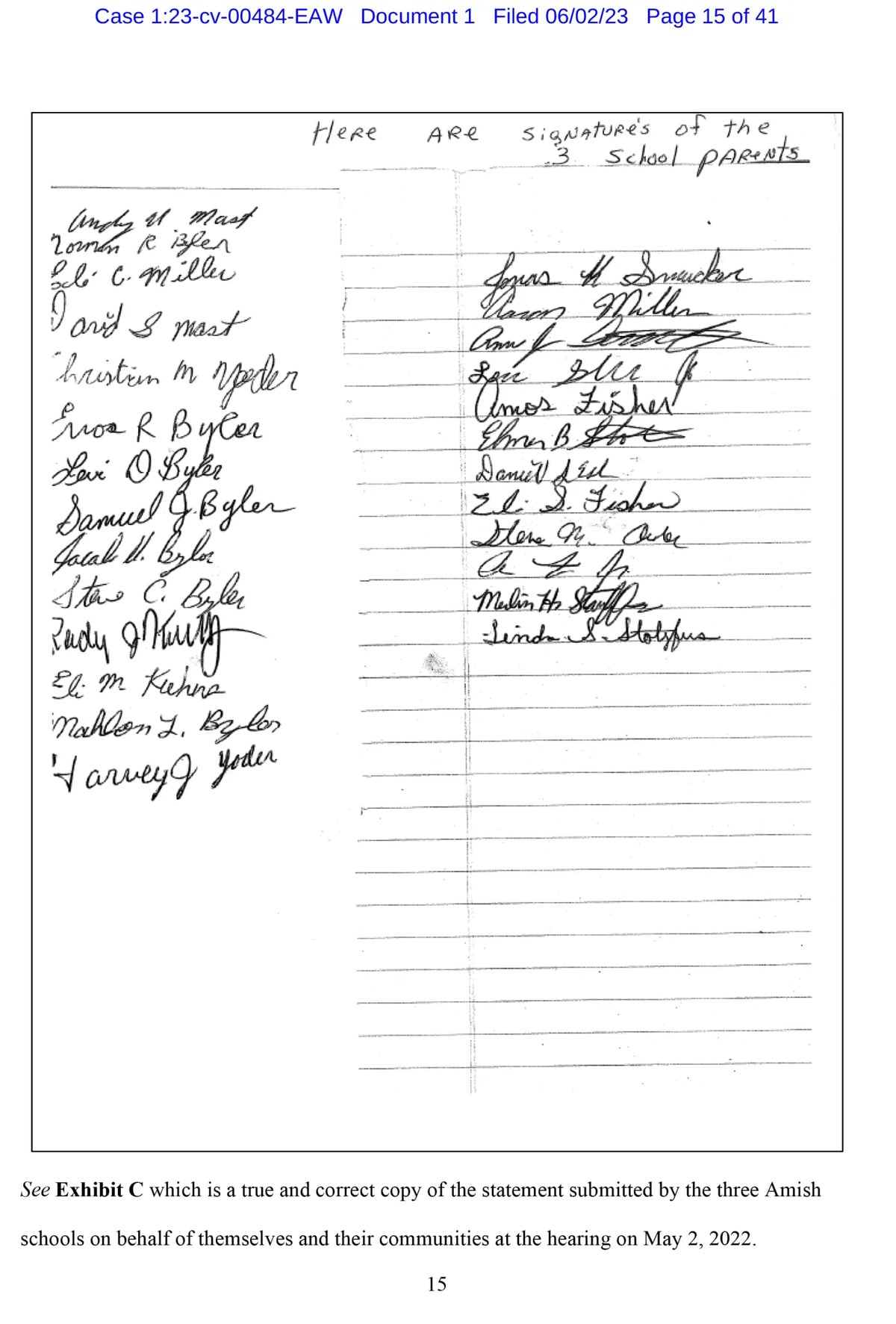
Before any of this reached a courtroom, the three schools submitted a handwritten statement to the state at a hearing in May 2022. It runs two pages and closes with 26 signatures of the Amish parents. It was later filed as Exhibit C to the June 2023 complaint, and the Post has shared it in their new report.
It is worth reading in full. Spelling and punctuation below are as written.
The letter is headed “In Reply why we are not in compliant with the NYS requirement of child hood vaccination,” and opens with an apology:
First of all, let us say, that we, as a peace loving Religious group, are sincerely sorry that we are causing the state a prob.. We are indeed grateful to the state of N.Y. for the many priveleges, Freedoms, & protections they have blessed us with, for many years
As a religous group, with our roots here in America since the late 1600s. We your humble subjects the Old Order Amish & Mennonite Community Churches Will hereby give you part of our confession of faith
This open reflects Amish humility and also is a nod to Two Kingdoms beliefs, which appears more directly a bit further down in the letter. The Amish try to obey the rules of Man (Earthly Kingdom), but the rules of the Heavenly Kingdom take precedence.
Next they share four scripture citations which they offer as guiding their beliefs:
Our forefathers came to America for Freedom of religion in concerns of living a God Fearing life & bringing up our children in a way, to hope through salvation, an everlasting life in Eternity. To do this we need to put our full trust in the Almighty God. as Proverbs 3:5 then in verse 6 we have the sure promise that he will direct our paths. Also in Mark 8:35 For whosoever seeketh to save his life shall lose it. but whosoever loses his life for my sake and the gospels, the same shall save it.
Yes Our Almighty God wants us to fully put our faith & trust in Him. which is in conflict to put our trust in vaccines. We are also commanded to not be conformed to this world, Romans 12-1-2. If we honestly obey this, then it will affect everything we do, yes even in the way we try to remain healty.
Then, a summary of the conflict at core:
Forcing us to violate our Religious beliefs will create a conflict which has no solution. A large percentage of the Amish & Mennonite familys will choose other consequences before going against our Religious convictions.
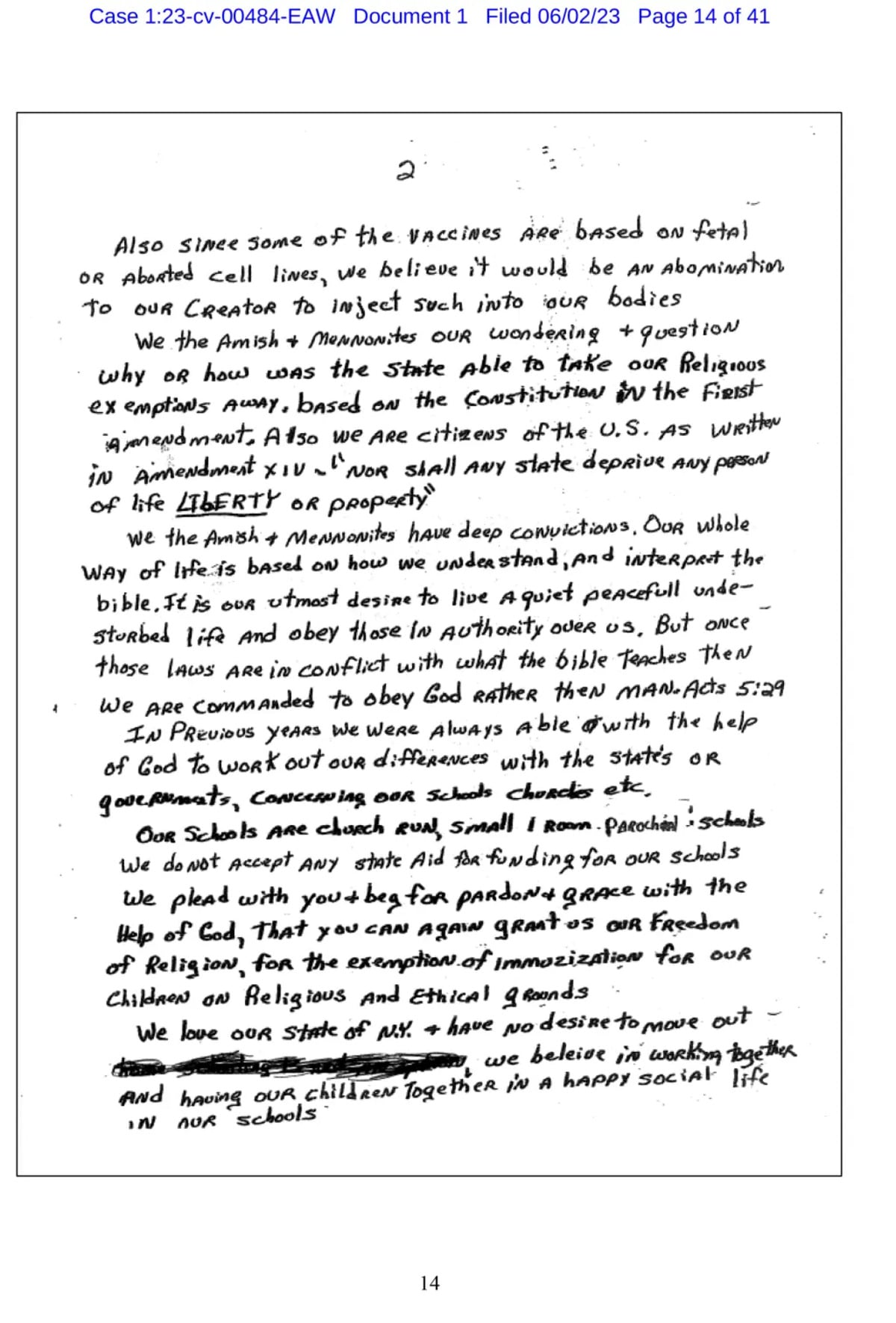
The second page opens with the specific objection, which I feel hasn’t really been covered that much:
Also since some of the vaccines are based on fetal or aborted cell lines, we believe it would be an abomination to our Creator to inject such into our bodies
The Amish are a pro-life people, and the belief that some vaccines were developed using fetal cell lines – whether or not that’s accurate – is something they find deeply objectionable.
Next they tap the Constitution to make a point in this part:
We the Amish & Mennonites our wondering & question why or how was the state able to take our Religious exemptions away. based on the Constitution in the First amendment. Also we are citizens of the U.S. As written in Amendment XIV — “nor shall any state deprive any person of life LIBERTY or property”
And here, back to Two Kingdoms beliefs, they summarize the crux of it – Laws of God vs. the Laws of Man:
We the Amish & Mennonites have deep convictions. Our whole way of life is based on how we understand, and interpret the bible. It is our utmost desire to live a quiet peacefull undesturbed life and obey those in authority over us. But once those laws are in conflict with what the bible teaches then we are commanded to obey God rather then man. Acts 5:29
In previous years we were always able with the help of God to work out our differences with the state’s or governments, concerning our schools churches etc.
Our schools are church run, small 1 room, parochial schools. We do not accept any state aid for funding for our schools
It ends with a simple ask:
We plead with you & beg for pardon & grace with the help of God, That you can again grant us our Freedom of Religion, for the exemption of immunization for our children on Religious and Ethical grounds
We love our state of N.Y. & have no desire to move out. we beleive in working together and having our children together in a happy social life in our schools
That all seems to me to be pretty plainly stated, and written in earnest. They do not want to leave – they love their home of New York – but if they have to, I think this letter clearly states why that will be.
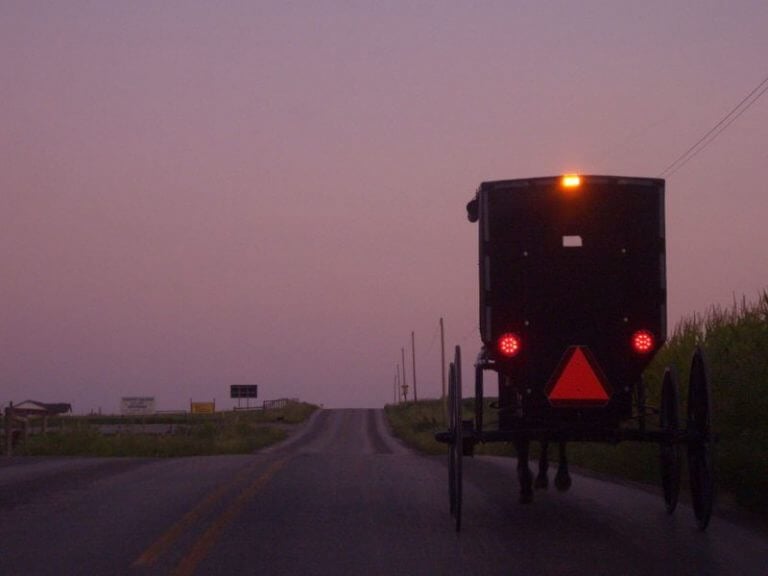
Leaving Is A Real – And Often Used – Option
The threat to move is being reported as an ultimatum. For the Amish, it happens often enough when conditions where they live no longer suit them – whether that is a change in a law, economics, or otherwise.
There is an entire book (The Amish in America: Settlements That Failed) giving the histories of such communities; you can read about some of them in our “Settlements That Failed” posts.
Strictly speaking as it relates to a change in the law, we have a recent example that fits within that general mold, though having to do not with schools, but waste disposal.
Two months ago we covered an Amish family in Crook County, Wyoming that sold out and moved to Iowa over an outhouse permit dispute. In that case, the ones leaving were limited to a relatively small group, because others in the community did not view waste disposal as something they couldn’t adapt around.
In this New York case, it sounds like families are going to be more resolute. And if they do leave, odds are it will be quite a few more than just a couple of families.
Though the three schools named in the suit are from some of the state’s longest-running Amish settlements, New York also has many young communities, many founded by Amish families arriving from outside the state in the past decade or two.
So they have an established history of moving. A lot have done it at least once already, in coming to the state. And it’s just as possible for them to return to Pennsylvania, Ohio, or head off to a new state altogether.
There’s one big open question I will end with here. The source story at the New York Post is framed as “Amish threaten mass exodus from New York over vaccine fight.”
But we don’t have a quote from the Amish saying that in this piece – it comes from their lawyers. That’s not to say it’s not true. We might at the least assume they’ve heard that from their clients in the three communities they represent.
But if these families do lose, just how many of the state’s 25,000+ Amish would in fact move out of the state?
New York knows the Amish can not pay those fines.
So the only way New York can collect is to take the Amish land……
And just like that, you now have land that can be used for data centers or,….
that land can be seized by New York, then sold, really cheap(to benefit the profit margins of developers), to developers for another parking lot, shopping center, etc,..
Forcing the Amish to assimilate one step at a time and using vaccines as one of many different ways to take their land.
Developers and gov’t have plans decades in advance that slowly plays out over time.
Constitution over ruled
Do States have the right to bypass the U.S. Constitution?
NY State knows by challenging the religious beliefs of the Amish they can not accept the state mandates . Either the Amish sell their land to pay the fines or the state seizes the land . Win/Win for NY State and a Lose/Lose situation for the Amish . May God bless the Amish peoples in their quest for those rights guaranteed under the US Constitution.
https://medium.com/@waqaskhd/10-best-u-s-states-for-preppers-and-outdoor-survivalists-32ad63890121
10 Best U.S. States for Preppers and Outdoor Survivalists.
Homeschool?
As popular as homeschooling is, why don’t they just do it and avoid this situation all together?
N.Y.
You live in one of the most liberal states in the country…..this is what happens. Live by Queen Kathy’s rules or else.
NY govt doesn’t like the Indians or the Amish. If Amish leave look for toxic solar farms unlimited