
8 Amish Parenting Habits That Raise Grounded, Hardworking Children

To generalize for a moment: Amish children tend to leave a positive impression. Visitors come away remarking how well-behaved they are, how respectful they are when around adults, even how they can seem older than they actually are.
The explanation you often hear is strictness. There’s something to that. Amish parents use traditional forms of discipline. But that’s not the whole story.
There are other cultural values, and child-rearing habits that go into it. Besides general behavior, Amish parents also bring up their children to be hard workers.
There is the usual caveat that Amish communities vary a good bit. What holds in one community might not so much in another. And like non-Amish families, Amish ones can vary a good bit too. Not all Amish families are perfect – some definitely have their problems.
That said, here are eight common patterns you’ll generally find across Amish society, which contribute to Amish children’s upbringing.
1. Chores Start Young

Amish children get real work early. By four or five a child might be filling the wood box, gathering eggs, drying off dishes, or sweeping up before meal time. One Amish mother describes giving each child a job according to their ability – filling water jugs for the shop, gathering quail eggs, having the littler ones pick up the number of toys that matches their age.
By nine or ten, a girl may be helping with canning and laundry, a boy handling animals or helping in his father’s workshop. These aren’t tasks invented just to build character. They’re actual jobs that contribute to the good of the household, and the children understand that.
2. They Work Alongside Their Parents

Amish children aren’t off by themselves while the adults work. They tend to be right there next to mom and dad in the shop, the barn, the kitchen.
Amish father Daniel Yoder, writing in the Amish Cook column, described his children coming out to his furniture shop – sitting next to him while he worked, asking questions about what he was building, telling him they’d build furniture and drive forklifts when they grew up.
They pick up not only an understanding of how to do a particular job, but a desire to do so – just being around their parents and wanting to do what mom and dad are doing.
3. Older Children Help Raise The Younger Ones

With six or eight or even ten-plus children in a household, older ones necessarily take on some minding of the younger ones. John Hostetler, who was raised Amish himself, described the arrangement writing decades ago in Amish Society:
Although the younger children must obey the older ones, the older children may not make arbitrary demands on the younger. The four-year-old is expected to hand over his toy to a younger child if he cries for it, but in the absence of the parents the younger one must obey the older.
I’ve written before that this is one that gives me some pause. That’s because children qualify as “older” at quite a young age. You’ll sometimes see, say, a six-year-old looking after a two-year-old.
In other words – as a non-Amish person – I don’t know that I’d be comfortable with every situation I’ve seen children left in. Though, that may also say as much about how safety-minded the rest of us have gotten as it does about the Amish.
4. Regular Outdoor Play
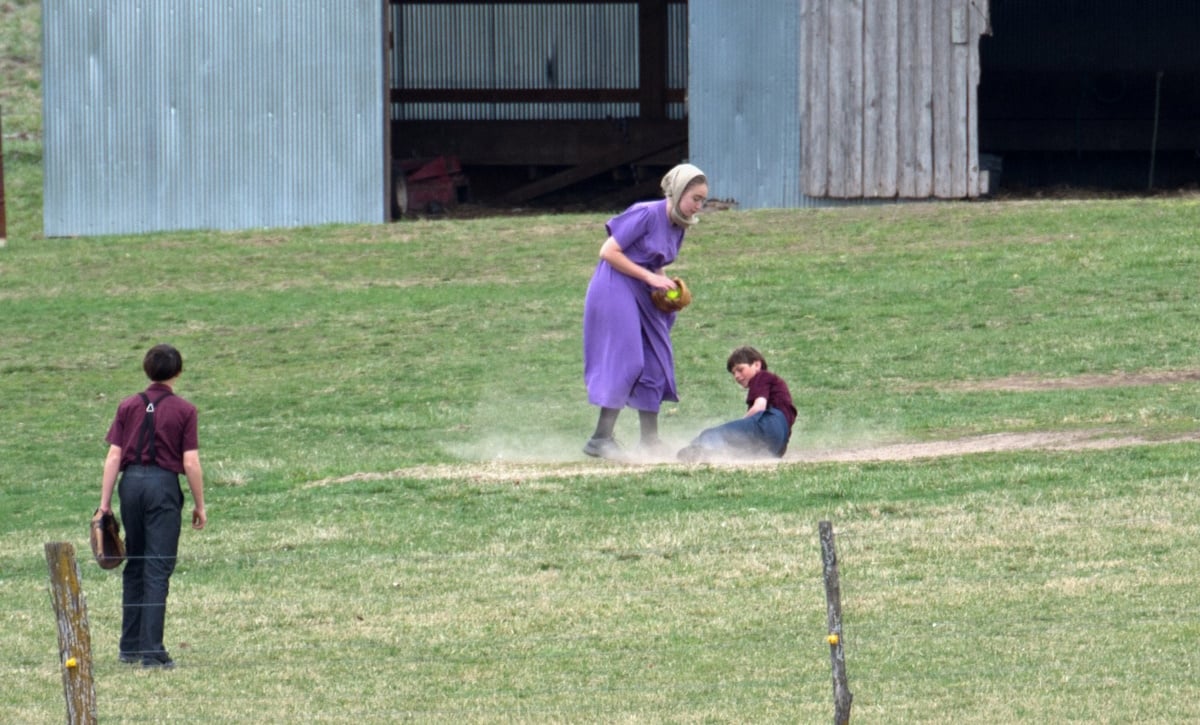
In sharp contrast with the direction of non-Amish society, Amish children have little to no exposure to screens – phones, computers, televisions. That alone means they spend a lot of time outdoors – playing “real world” games and not digital ones.
At school there’s recess, and games like softball. Games aren’t about winning, especially at school. Everyone plays – boys and girls, of all ages. At home there’s whatever they come up with – which might take some creativity. That’s another benefit in addition to the exercise and fresh air.
5. Children Get Included In Nearly Everything

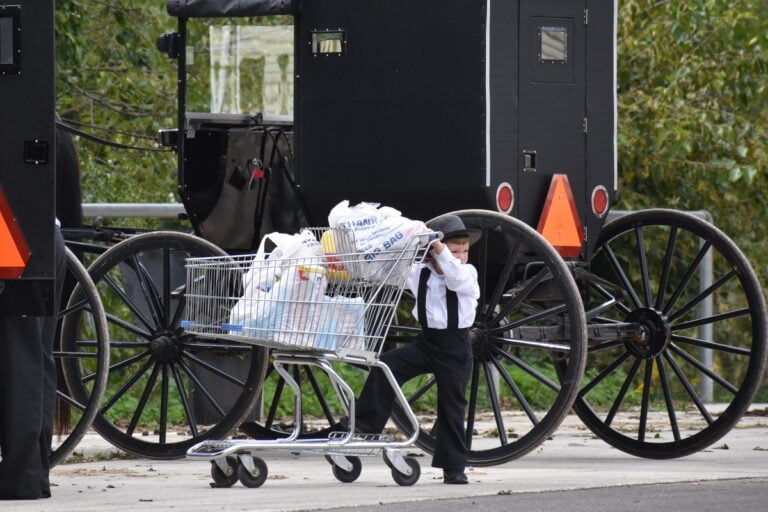
One thing you’ll notice if you go to any Amish event, or even visit an Amish-run store: Amish children go where their parents go. Church, weddings, funerals, work frolics, auctions, visiting on a Sunday afternoon. They aren’t left with a sitter while the adults handle the serious stuff. It’s important to Amish parents that the children are included. It’s one way they absorb the values of the culture.
It also means Amish children see a good deal of adult life early, including the hard parts, like funerals, which tend to be large gatherings of hundreds of people. They’re also there when the community comes together to rebuild a burnt-down barn or for other “frolics” (Amish term for a community work gathering).
6. Obedience Is Taught As A Religious Value
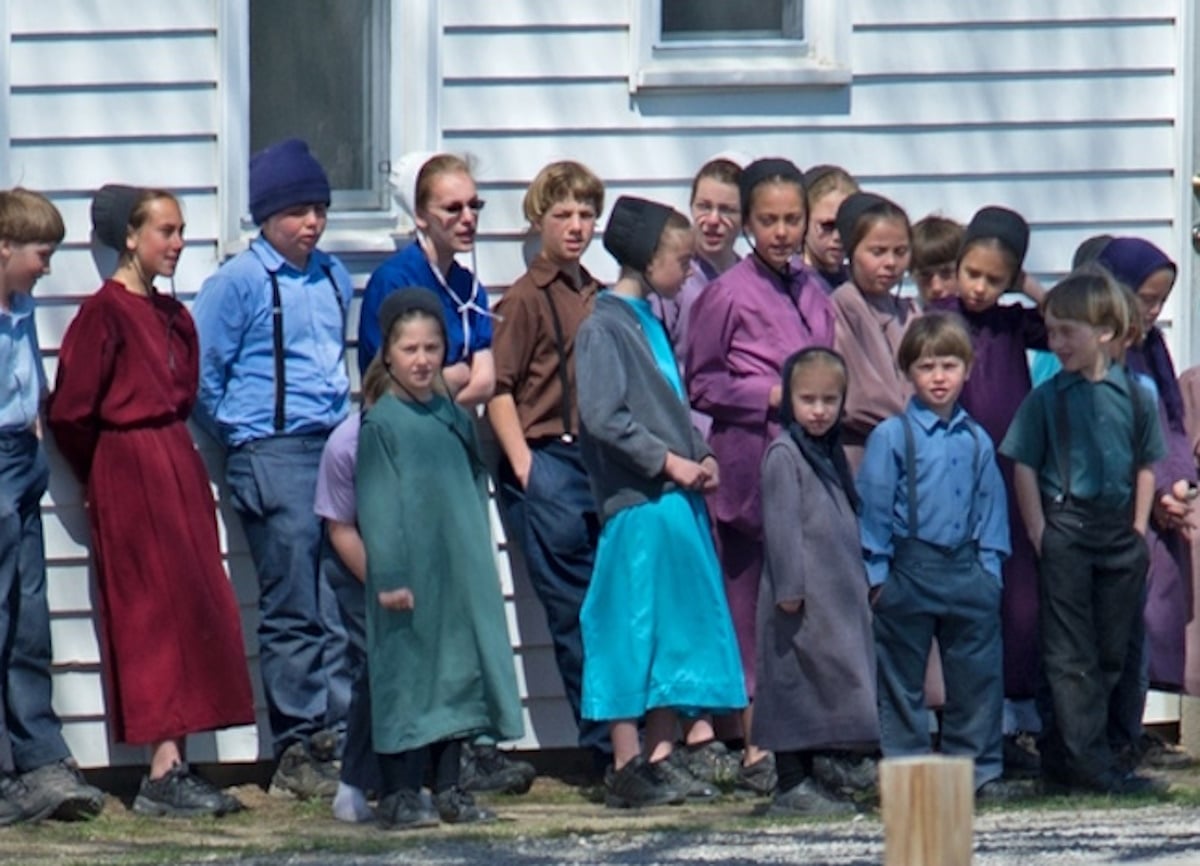
Gelassenheit is a concept that Amish children absorb just by growing up in the culture. It’s a German term that, as the Young Center at Elizabethtown College describes it, “carries many meanings – self-surrender, submission, yielding to the will of God and to others, contentment, and a calm spirit.”
It’s a key belief or value within Amish society – and as they put it, “the point where Amish society diverges most significantly from contemporary culture.”
So the value of obedience – loosely speaking – is not just something that Amish children are taught by their parents. It’s something that permeates the culture, and is seen when Amish adults obey church rules that they agreed to honor when they chose baptism.
An Amish child learns to yield to his parents first. Later he’ll be asked to yield to the church and the Ordnung (church rules and standards). So teaching a child obedience is not only about good behavior in the home; it’s a sort of training for something the child will need later as a church member.
7. After Eighth Grade They Shift To Hands-On Learning
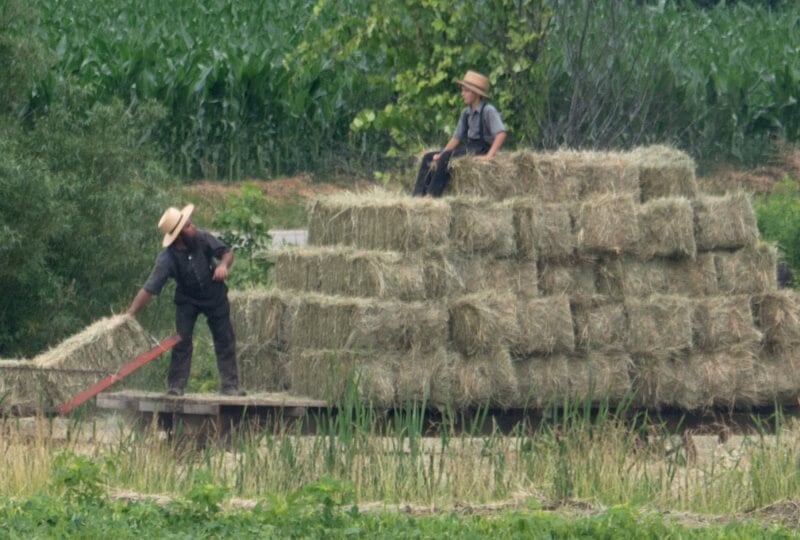
Amish formal schooling ends at eighth grade (for the most part, anyway). The landmark Supreme Court decision in Wisconsin v. Yoder (1972) found that requiring Amish children to attend high school violated their parents’ free exercise of religion.
At the time, the Court also saw evidence that the Amish provide continuing informal vocational education designed to prepare children for life in the rural Amish community. So while formal schooling ends, education does not. It continues in a practical, hands-on form.
At fourteen or fifteen a boy goes to work with his father on the farm, or in a relative’s work shop, or gets hired out. A girl works at home, or in a store or bakery. Of course, this isn’t the first time they’ve been helping out, as we’ve seen. It just becomes more full-time at this point.
By the time they’re 18, Amish children have accumulated hundreds if not thousands of practical work hours; working is just second nature by that point.
8. The Community Reinforces What Parents Teach

All this doesn’t just happen in a vacuum. Living among other families in a like-minded community means the values stay consistent, and are reinforced in different contexts and settings. An Amish child generally doesn’t get a different standard at the neighbor’s house.
Amish church districts (congregations) are kept deliberately small – just twenty-five to thirty-five families. They divide when they grow too big. In practice, everyone in a district can know everyone else’s children.
Other adults can and will correct a child. Teachers can discipline children, and are given the authority to do so by the parents and school board. Amish parents aren’t doing it alone. That consistency only helps these values to stick.
You Don’t Have To Be Amish – Though Yes, It Helps
As has been said before, these ideas do not require being Amish to work. Admittedly, some are easier when you’re living in a community of people who see things the same way, as the Amish are.
But on a household level at the least, any parent can hand a five-year-old a broom or a set of freshly-washed dishes and a dry rag. Anyone can bring the children along instead of finding a sitter, or shut down their screen time to get them outdoors.
Yes, an Amish parent has a church district, a school, and a couple hundred neighbors aligned in the same direction. That helps, a lot. But lacking that, it’s not impossible to adopt these ideas on your own, or with the support of other like-minded parents.
You might also like:
- 7 Ways Amish Families Keep Grocery Bills Low — Even With 8 Kids
- 7 Ways the Amish Harness Tech – for More Peace and a Happier Life
- 9 Time-Tested Skills Amish Women Still Use…That Are Making A Comeback





Worry
I love the Amish way of living, and the Amish people, but I worry the world out there has gone wild and wicked.
The Way It Was
We used to have a system in this country where children would learn certain values at home and then all the institutions on society would reinforce those values. (Don’t lie cheat or steal, be honest, respect people and their property, have compassion for those in need, etc.). The entertainment media, the schools, the government responded with support for these values. Now, children who are fortunate to have families that still teach these once shared sense of values are confronted with opposition from these institutions. Maybe someday society will wake up but I’m not hopeful.
No TV is good
Also, there is no “direct bad influences”, like TV, rock music, ….. modern entertainments.
Great Read
Thank you for posting this. So interesting. The Eight Parenting Habits of the Moms and Dads was very enlightening. I really enjoyed the pictures with it. Especially #2 and #3. That brought a smile or 2. Smiling at the beginning of your day makes the start of a good day.
Alberta
Gladly Alberta, happy you liked it. I think we’ll have some more posts in a similar vein.
Answer to Education Question
I get a lot of questions here at the Geauga Amish History Center and one of the most frequent one is on our education system. This article answers beautifully to the education question as well as the ‘grounded and hardworking’ bit.
Sometimes it is a bit difficult to illustrate the integrated system of our culture in a limited time frame with our visitors. We have a different value system than mainstream America (formal education not being top priority) and I recognize and can even understand the difficulty some folks have at grasping this concept.
This is a wonderful article to reference for our visitors, thank you!