
“I’m Truly Sorry”: Man Sentenced To Time Served & House Arrest for Amish Store Burglaries — and Burning Down a Church

This past summer we learned that a man who had gone on a burglary spree, targeting several Amish businesses in Mercer County, Pennsylvania, had been caught a year after the crimes were committed.
Along with three Amish stores, Harley Richard Redmond had broken into several non-Amish churches, burning one down in the process – and causing hundreds of thousands of dollars in damage. Now comes news of his sentence, via the Sharon Herald:
Mercer County Common Pleas Judge D. Neil McEwen followed the plea deal set up by the district attorney’s office and sentenced Redmond to 180 days to 2 years less 1 day in Mercer County Jail followed by 3 years probation, $300 restitution to Ben Byler of Fredonia and $300 restitution to M&M Grocery Store.
Since Redmond had already served 107 days in jail, McEwen ordered Redmond to serve the remaining 73 days on house arrest.
Essentially, this amounts to a few months’ time served plus two-and-a-half months of house arrest. I suspect most would find that to be a pretty light sentence.*
Ben Byler and M & M Grocery Store refer to two of the Amish businesses.
Did Far More Damage At A Non-Amish Church
But these Amish businesses were not the only places Redmond hit. Non-Amish churches were targeted – and he did far more destruction there. More from the Sharon Herald:
Harley Richard Redmond, 30, Mercer, pleaded guilty to burglary charges. He originally incurred 19 charges by state police including burglary, arson, theft, criminal mischief and institutional vandalism of a place of worship.
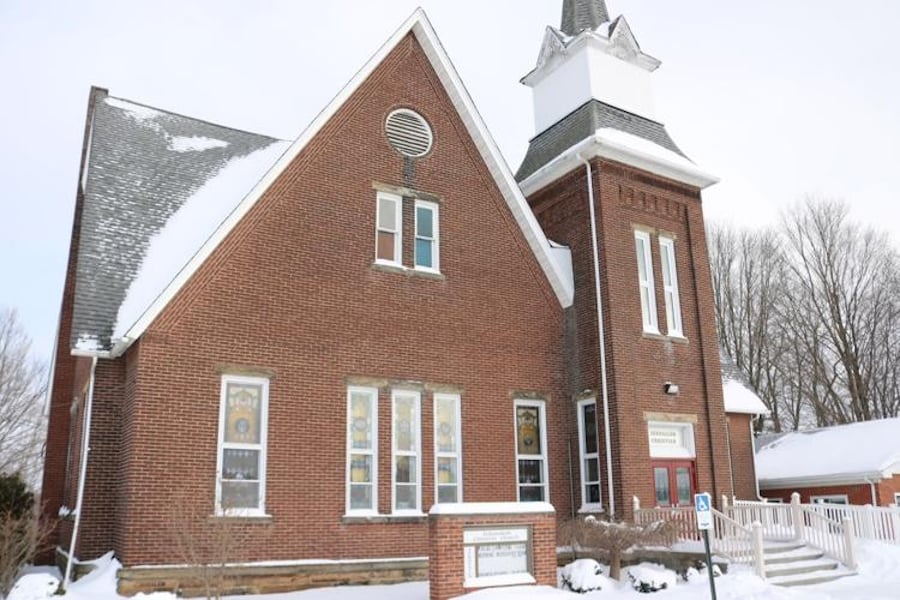
State police said he started multiple fires in Jerusalem Christian Church, 560 Donation Road, Otter Creek Township. The church is said to have spent $300,000 rebuilding, but they were not seeking restitution.
Instead, Pastor Jerry McCloskey, who spoke at Redmond’s sentence hearing Thursday, said the congregation has been praying for Redmond.
Looking at the terms of the punishment, plus going by what was said by the church’s pastor – not to mention the judge – it sounds like Redmond has really gotten off easy here.
And that may be in no small part due to the response of the church. More on that below.
Redmond Brought To Tears By Church’s Statement
Pastor McCloskey reportedly read a statement in court which brought Redmond to tears. More from the Sharon Herald:
McCloskey read from a prepared statement, making Redmond cry.
As part of the statement, McCloskey said the church lost its auditorium, kitchen and classrooms.
“It cost a lot of money and effort to fix our church,” McCloskey said. “In a matter of an hour, a lot of things happened to our little church.”
But the congregation proceeded and never missed a single Sunday during which time they gutted and rebuilt the church.
The congregation has responded in a way that can be fairly described as Christ-like:
The congregation prayed for Redmond, McCloskey said.
“You caused a lot of heartache,” McCloskey said. “You were used as a pawn by the devil, but it backfired because a lot of good things came out of that.”
McCloskey said Jesus tells him to forgive.
“Our church forgives you,” McCloskey said. “We’ve been praying diligently for you since we found out who you were. We’re willing to help you where we can.”
McCloskey asked the judge to use the sentencing to give Redmond hope. Hope that life can change.
“Hope that life can change,” McCloskey said. “Work to fix that part of your life and you submit your life to Jesus Christ.”

Redmond, for his part, apologized:
Redmond said his tears were happy tears. He said he doesn’t know where to begin with an apology. He said he has been battling addiction.
“I wouldn’t have done it if I were sober,” Redmond said. “It’s been a long road of trials and tribulations.”
He said it took a lot for him to get down on both knees last year and surrender his life to Christ.
“I’m tired of fighting this battle,” Redmond said. “I’m truly sorry.”
I can understand a person desperate for a fix of drugs seeking valuables or cash during a robbery. I just don’t get what then motivates someone to burn a church down. Anger?
Regardless, it seems Redmond has found himself in a very fortunate position, given the extent of what he had done. Presumably the church could have sought restitution for some or all of the $300,000, but chose not too (on looking further into it, it sounds like insurance covered costs).
Judge D. Neil McEwen did not mince words, however. And reading between the lines, it seems he would have imposed a harsher punishment if not for the benevolence extended by the church congregation (and perhaps, other of the victims): “The people you harmed didn’t deserve what you did. This agreement – you don’t deserve. If you come back in front of me again, you will get what you deserve.”
The church’s example here is powerful, and commendable. If Redmond faced repayment of the full damage he caused, it would be quite the burden in addition to the other terms of his punishment. He would do well to take the opportunity he’s been given to turn things around.
Mercer County’s Criminals Should Be Getting The Message By Now
To return to the Amish aspect of this story, this area has seen criminals repeatedly target the Amish for robbery and burglary.

In addition to Redmond’s crimes, early in 2025, a man was arrested for armed robberies of Amish buggies in Mercer County. He was later charged along with his wife for a scheme of passing bad checks at Amish businesses.
Previously, five teenagers, allegedly part of a burglary ring, were arrested for a series of over 20 break-ins at Amish properties in Mercer County in 2021 and 2022.
Publicizing these cases will hopefully do something to make it better known that the Amish are not the easy targets that some seem to think.
Especially in Mercer County, PA…this being at least the third case of criminals trying to rob the Amish there, and ultimately failing to get away with it.
*Terms of punishment were updated shortly after publication with more details.





Man Sentenced.
Anger?? No. I’m more inclined to believe he burned the church to “cover his tracks” and to try to destroy evidence. He’s lucky. Most people, even members of a church, would have him sit behind bars a while longer to cool his heels. The judge was right: he doesn’t deserve the slap on the wrist he received. I’m soooo sick of, “If I hadn’t had a drug problem . . . “ as a so-called excuse. He wouldn’t have been so lucky had he landed in my courtroom!
Addiction is a very difficult moral problem
I think as Redmond seems to be repentant and the victims want leniency, a light punishment and a second chance is a good response – I really do hope and pray he’s able to turn his life around. While I strongly defend the concept of retributive punishment not exceeding talion for real crimes where the offence can be proved (if we as the community behave as if it doesn’t matter, we make ourselves complicit) I am deeply frustrated by the fact that it often seems that the punishment actually puts the person in a worse rather than a better position to do rightly in future, and is therefore often serving as a temptation rather than as a correction. And that’s definitely not in the theory.
Excuse and justification aren’t the same thing: justification is where the circumstances of an act change the nature of it (such as a policeman shooting someone in the actual process of committing murders dead when they can’t reasonably be stopped any other way), whereas excuse is something that compromises the agency of the agent. I am not aware of any situation in which drug abuse is a justification, but it may be an valid excuse. From the point of view of moral responsibility, addiction is an absolutely maddening problem. It does seem to involve things having gone wrong in the brain – what depends on the chemical – that is, it does seem to be a real sickness once developed. But if people take the drug voluntarily and wrongfully the first time? If they haven’t? How responsible is someone in any case for understanding and resisting the norms their own culture? (Historically, one usually considers if people are doing rightly according to what they could have known. If it’s correct to do that, the same principle probably has to be applied microcosmically).
I haven’t been in this specific sort of mess, but I am also a sinner, and I do find the whole excuse problem annoying in my attempts to correct my own (non-judicial) faults. In my experience, it doesn’t help to ignore excuses entirely because if you do, you tend to be trying to solve the wrong problem – if there are real excuses they need to be taken into account to actually develop the virtue that’s lacking – but it is also too easy to allow excuse to go too far on the wrong things, and to excuse other people too little if their difficulties are different and therefore not easy to imagine. Trying to understand one’s own mind is a rather different thing from where one is necessarily sitting in judgement on a crime, but I think some of the problems of growing in everyday virtue do offer sidelights that need to be taken into account in judicial matters for the sake of trying to be as just as possible.
I think the main point I’m trying to make is that while people can be wrongfully or inconsistently lenient on the basis of certain excuses, treating these things as complicated and considering the commission of justice very carefully is important.
As I said, I think that to ignore crime is to be complicit in it, but I would add that it also seems to me that to punish unjustly through negligence is to be guilty of the same crime as the punishment is when not punishment (it’s not punishment if unjust, and is therefore whatever it would be outside that system). By the measure that we mete, so shall we be judged.
The Lord's Way
This story is a beautiful, albeit painful, reminder of what true forgiveness looks like. Watching this congregation extend grace to Harley Redmond immediately brings to mind the Amish response to the 2006 Nickel Mines tragedy. In a world that demands ‘an eye for an eye,’ the Amish consistently choose to ‘forgive and forget instead of resent and remember.’
They live by the conviction that vengeance belongs to the Lord, not to us. By refusing to seek restitution or harbor bitterness, they aren’t saying the crime didn’t matter; they are simply refusing to let someone else’s sin poison their own souls. They recognize that we are all flawed humans, and that while it’s God’s job to judge, it is our job to love and offer a path toward redemption.
Whether it’s a church being rebuilt or an Amish shopkeeper moving forward without a grudge, the message is the same: Grace is a far more powerful tool for change than a prison cell ever could be. I hope Mr. Redmond realizes just how much of a miracle this second chance really is.