
Dozens Of Amish Train For Rural Emergencies In This Pennsylvania Community
We often hear and read about accidents in Amish settings – whether on the farm, in recreational settings like hunting, or on the road. The Lewistown Sentinel reports on how one community has tried to address a gap in emergency skills in rural Amish-heavy areas.
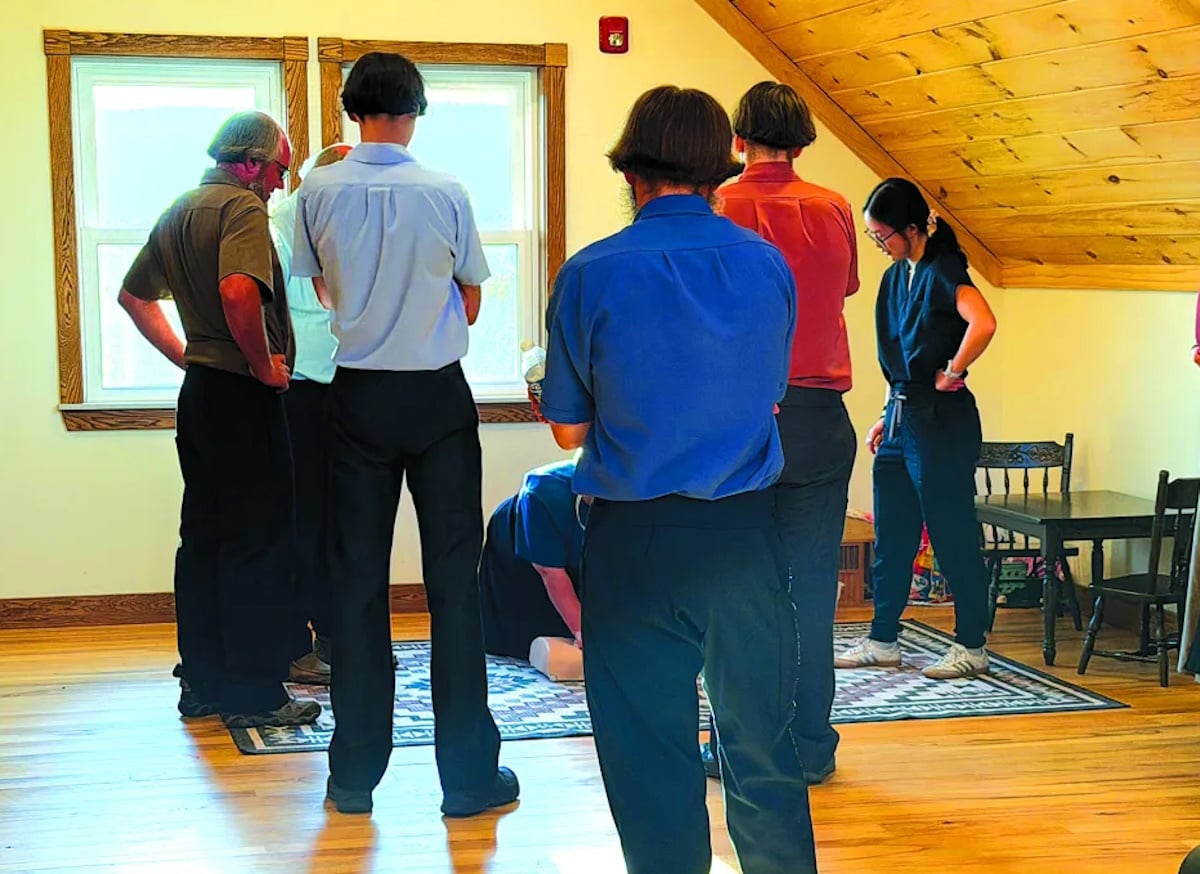
Forty-two people turned out for a free Rural Response and Rescuer Training program at the Central Pennsylvania Clinic for Special Needs Children and Adults in Belleville, Pennsylvania. By the photos included it appears that many if not most were Amish.
The attendees were mainly from Juniata County, home to a sizable Amish settlement, rather than the Big Valley settlement which Belleville lies at the heart of.
What The Training Covered
The training wasn’t just watching – it was hands-on – and the attendees responded:
“I was actually pleased and surprised that they were willing to do, like, the CPR training, you know, get on the floor and do the hands-on part,” said [Louise] Yoder, executive director of the clinic.
“I didn’t know how the community would respond to that, but they were very, very engaged and very willing to participate.”
Participants had a chance to learn and practice a range of skills:
Participants rotated through stations covering CPR, AED use, Stop the Bleed techniques, choking, anaphylaxis response, and opioid overdoses.
Volunteer EMTs, physicians, residents, and medical students provided the instruction.
The program was created by a medical student – Isaac Weitzman, of Geisinger Commonwealth School of Medicine – along with Mandy Maneval, an MD and PhD. Weitzman told the Sentinel the training starts with recognition:
“If somebody has a broken arm, that’s not urgent,” Weitzman said. “That’s not something that they’re going to die from within minutes.”
Severe bleeding, stopped breathing, or the loss of a pulse are different. A person nearby may have only a short window to act.
That is where the training becomes less about memorizing medical information and more about giving people the confidence to act.
Weitzman said the biggest problem is people not having any idea where to start.
Why This Training
The Sentinel notes that farms, sawmills, hunting, and outdoor work in the area can produce serious injuries (tragically we just saw an example of that Friday in another corner of the state), and that professional help has farther to travel in rural areas.
Weitzman built the program with Maneval after hearing about accidents in rural communities and talking with residents affected by them.
There’s a second layer to it in some, even many, Amish and Mennonite communities. Yoder said some Plain families treat health care providers as a last resort, and that part of the clinic’s appeal is not having to travel to scattered locations for different services:
“The more they’re in here, the more they look for cohesiveness,” Yoder said. “They don’t want to have to go over the mountain for this and, you know, down the valley for that.”
Receiving more services in a place families already know can help build trust, Yoder said.
The clinic already has a standing relationship with Plain families in the area, so it was an obvious good choice to host this event.
Next Steps
And after what looks to have been a successful first run, to take things further, organizers want to bring the training to other rural communities in Mifflin and Juniata counties, and possibly beyond.
They would also like to make it annual, and expand it to more situations, like getting injured people out of hard-to-reach places – a type of situation we saw in a hunting accident which claimed an Amishman’s life last December in Juniata County.
Awareness in Plain communities of tragic stories like that one no doubt drives interest in programs like this. People want to be as ready as they can, and when you are in a rural area, often without a phone at hand, it can make you feel more vulnerable. This type of program is helping people in those situations feel more prepared and ready if and when an emergency does happen. Good for them.



Emergencies
What a brilliant idea!! Too bad this can’t happen across all Plain communities in America. But perhaps someday it will?? I learned all of the techniques described back in high school and often brush up on my skill set. It’s great to know all of these things b/c one never knows when they might be faced with an emergency. Thanks, Erik, for bringing us this story.
Gladly KD and it was neat to see this. Other communities do safety-focused events, sometimes on a much bigger scale. It was good to see the hands-on aspect of this training and that it was not just men taking part.
Emergency training
I live in Belleville and have to wonder why most attendees were from Juniata County. Did you have trouble reaching people here? I hope you will bring this training back to our area. I would be willing to help get the word out. I am 68 don’t work anymore, but I do drive. I would also advise not having it on a Wednesday, as that is the weekly Sale Barn day and a lot of Amish here are selling there or looking to buy and sell animals at the auction.