
For The First Time In A Century, The Amish Now Live In This Southern State
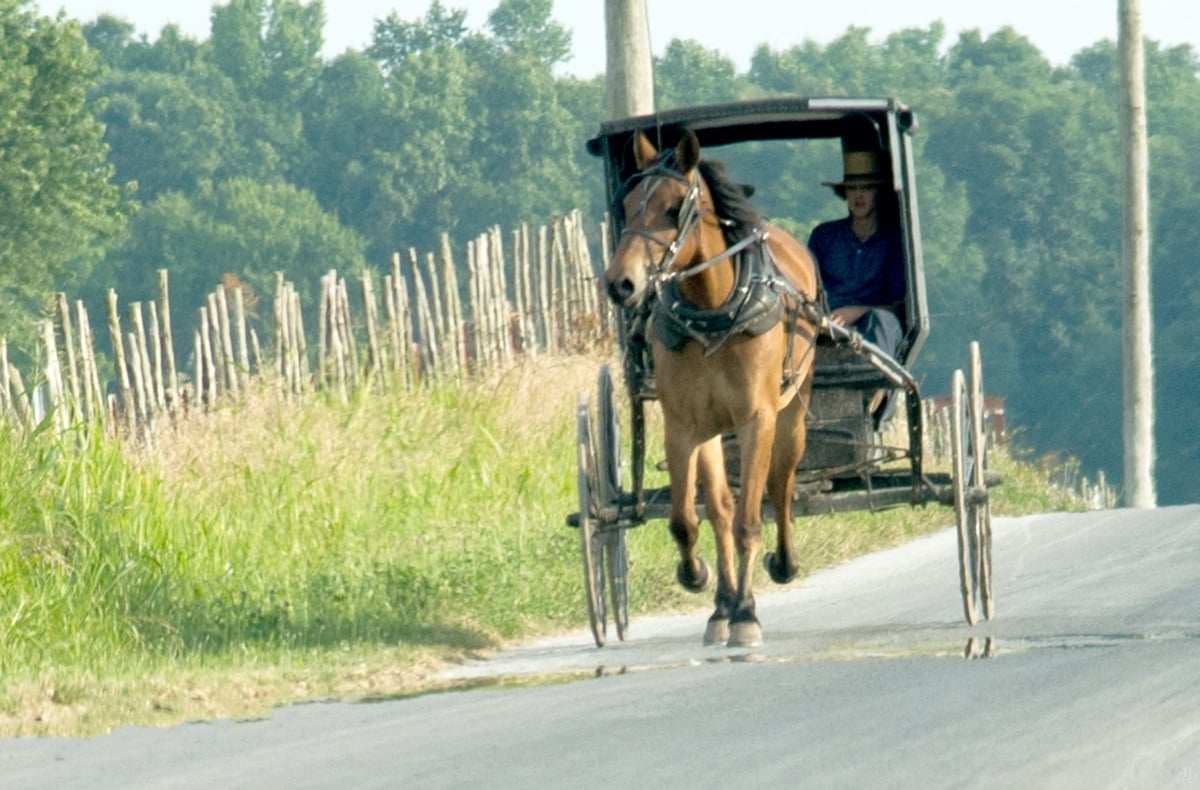
We often think of the Amish as living in the Midwest, and states like Pennsylvania. But Amish communities in the South are nothing new.
States like Virginia, Kentucky, and Tennessee have seen their Amish populations grow robustly in recent decades.
However, there’s one part of the South that the Amish have (for whatever reason) not settled — the “Deep South”.
The Deep South is most strictly defined as five states — Louisiana, Mississippi, Alabama, Georgia, and South Carolina (other, looser definitions include parts of bordering states such as Arkansas and Florida).
Outside of a short-lived settlement in Georgia in the 1990s, and a still-existing community in Mississippi, there has been no other Amish presence in the region in decades.
Until now, that is.
Welcome To Alabama
Joe Donnermeyer of the Journal of Plain Anabaptist Communities reports that there is now a new Amish community in Alabama, and shares supporting correspondence from the Amish “scribe” newspaper Die Botschaft.
Based on the correspondence, as of last year, the Amish have begun settling in central Alabama in Chilton County, in the area of Clanton.
Die Botschaft and other newspapers like it publish letters from members of Amish communities around the country, providing updates and other news.
They are one way to get a handle on whether an Amish community might be coming to an end — or where a new one might be starting up.
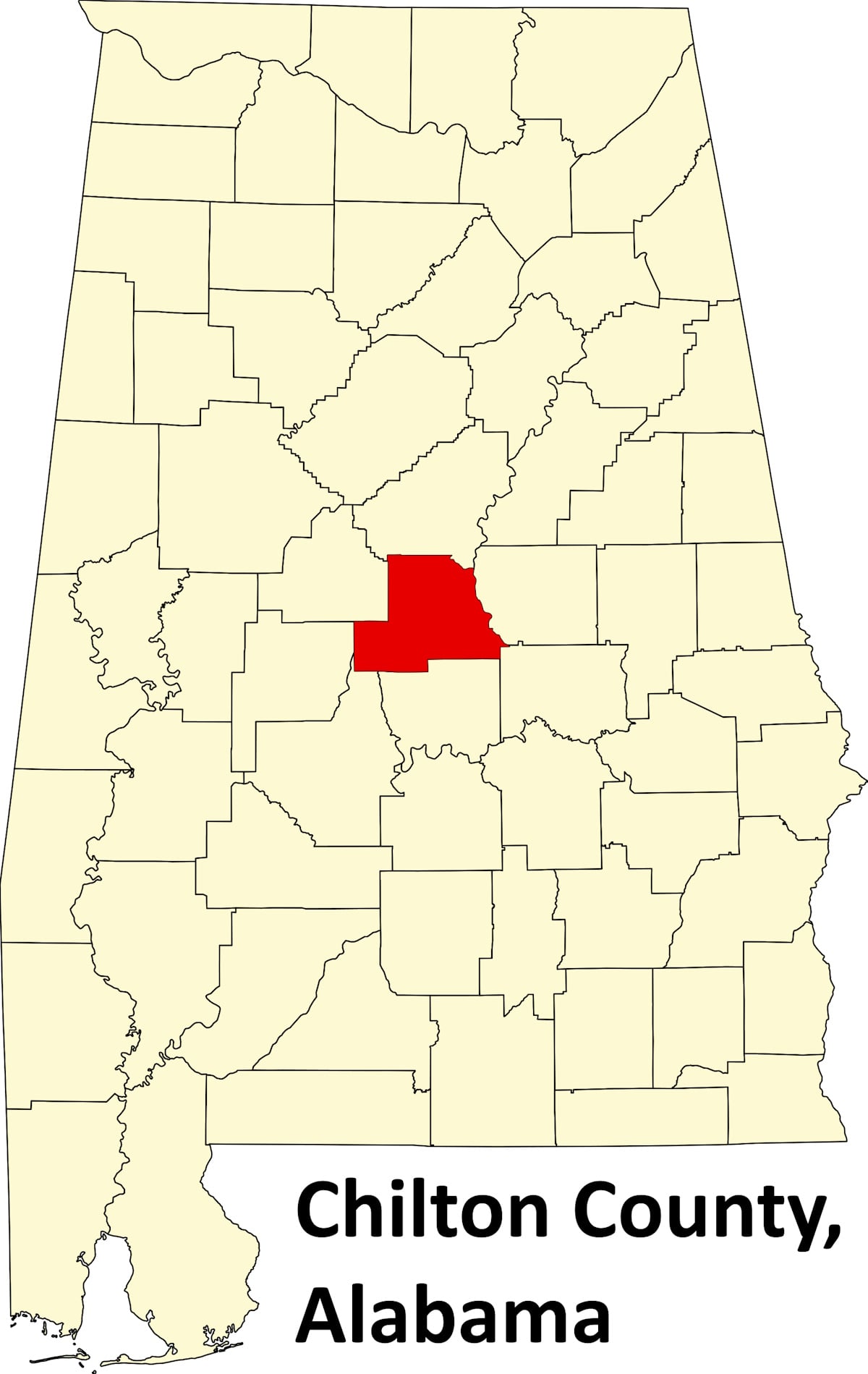
Joe shares this report from the paper from early last year — telling of plans of Amish families in Mississippi and Tennessee to move to the new location in Alabama:
NEW IN ALABAMA – Clanton (spelled Clenton by the Die Botschaft scribe from Randoph) is in Chilton County, and appears to be about halfway between Birmingham and Montgomery.
Die Botschaft (2/23/25, p 41), scribe from Randolph, MS (which a S-group), Mahlon and Millie Yoder, write: “Yesterday we were at Noah S. Hostetlers for dinner. They plan to move to Clenton, Alabama in the future, starting a new settlement. Hoping to move by fall if not before then. A few families from Ethridge plan to join them. They need to start up with new buildings.” Ethridge is in Tennessee and is one of the largest Swartzentruber communities.
As Joe notes, these are Swartzentruber Amish, generally considered the plainest significant Amish group. Joe follows that up with this report from the new community in February of this year:
CLANTON, ALABAMA – this community is located in Chilton County, and Chilton is located in the center of the state of Alabama. The community is about halfway between Birmingham and Montgomery, that is, about 30 miles from either city.
Clanton is about 180 miles from Randolph, MS and about 200 miles from Ethridge, TN. Die Botschaft (2/6/2026, p 1) – “Gideon and the three out of school boys went to take a greenhouse down that we are getting and hope to get it up to use it this Spring yet.”
And, this one from just a little over a week ago:
They also report that several days ago, the low temperature was about 14 F. DB (4/3/2026, p 1) – the Clanton scribe is Gideon and Ida Gingerich. They write about the weather, first a hard freeze and then a high of 84.
Then they write: “Noah’s shop now has the roof on and boys are digging some more for our basement….Then on Saturday I, Lena, and Gideon Jr. have plans to be to Ethridge, TN and come back home Wednesday.”
No word on how many families have settled there by now – probably not a ton, but assuming there are at least a handful of households there.
The last time we added a state to the Amish list was when New Mexico joined the club several years ago. Let’s hope this Alabama group takes firm hold, so that the number of “Amish states” stays fast at 33 and counting.
The Amish Lived In Alabama Once Before
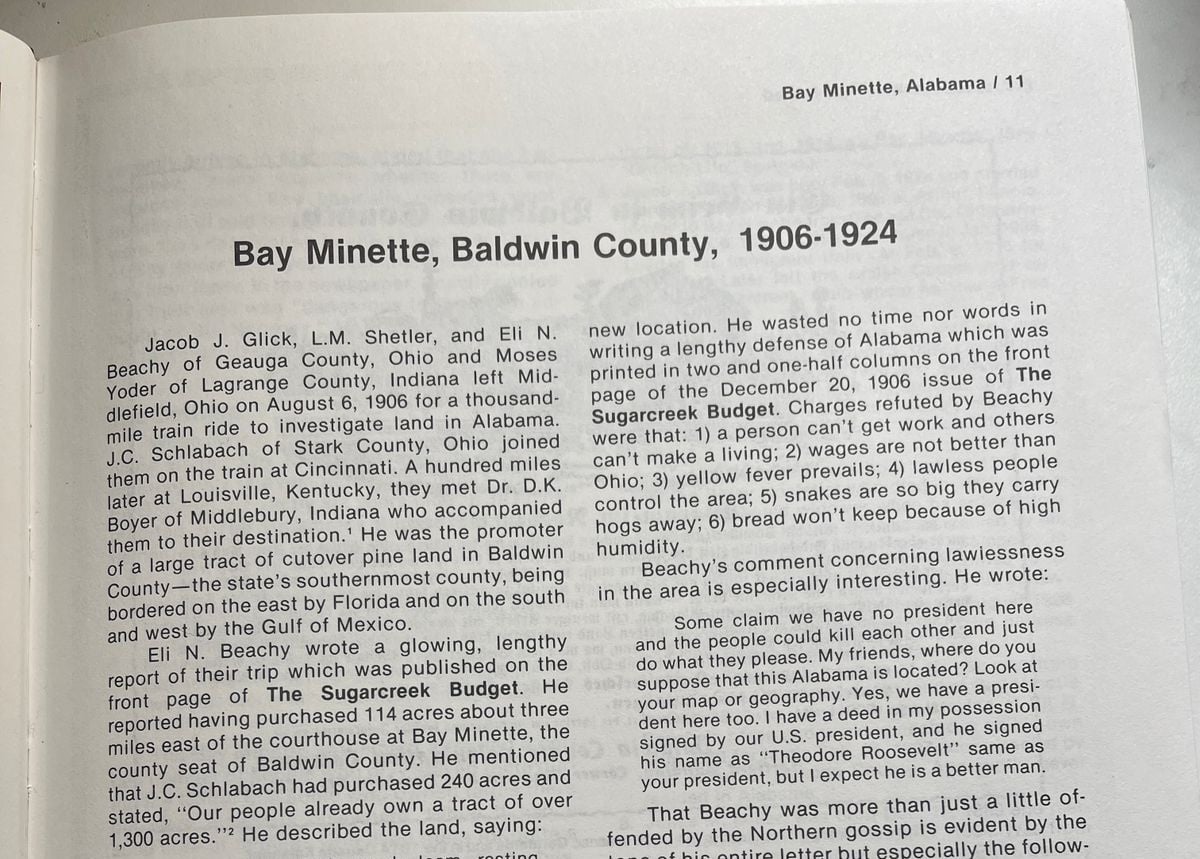
This isn’t the first time the Amish have tried Alabama. Over a century ago, a small community took shape in Bay Minette, in Baldwin County — the state’s southernmost county, bordering the Gulf of Mexico and Florida.
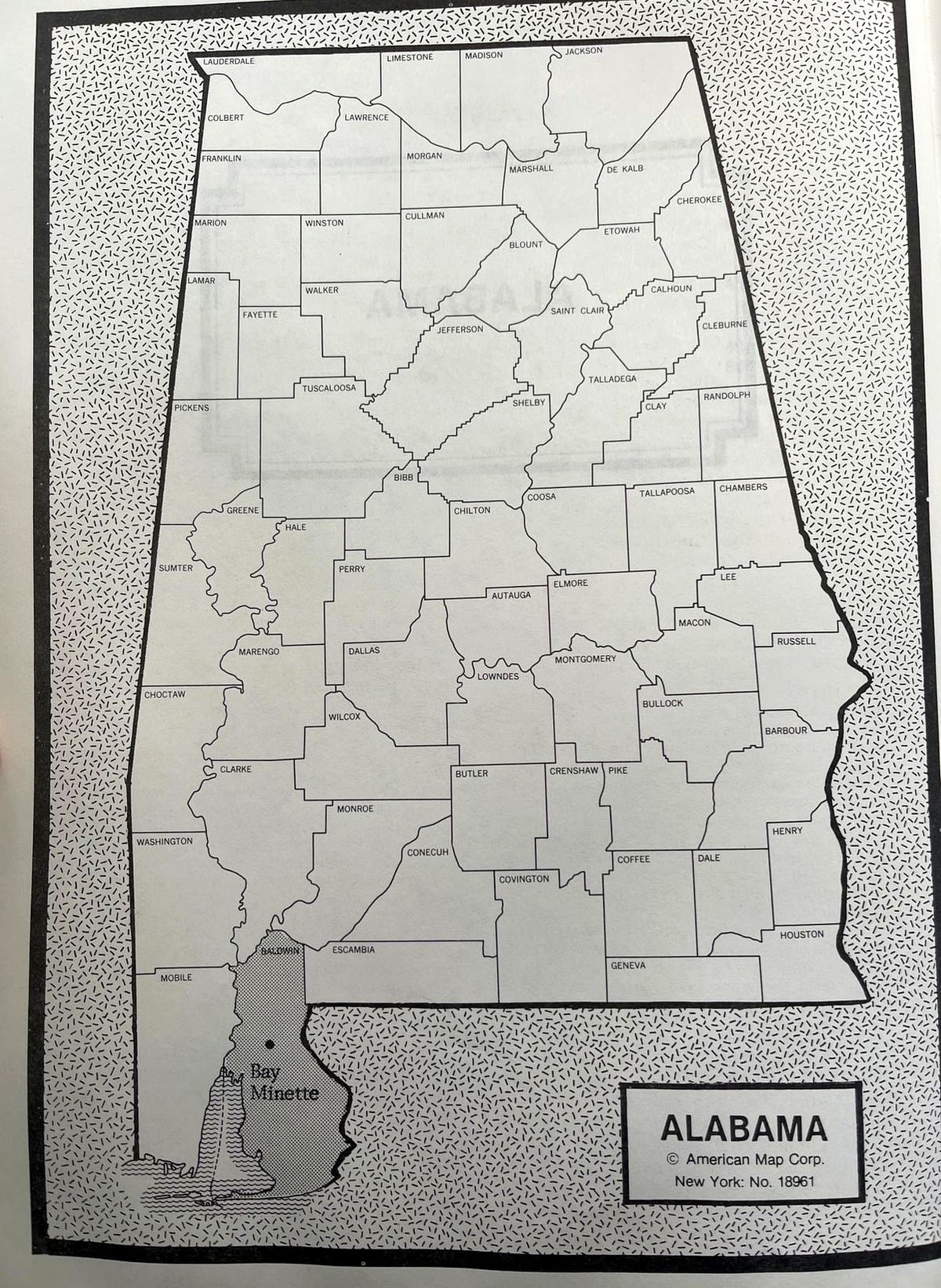
I recently took note of this settlement in a look back at an unusual Amish community in early-1900s Arizona.
In that Arizona group’s strange and winding story, some of their members ended up moving across the country to settle in the area of this Bay Minette community — and crossing paths with members of this group, as they were in decline.
As Joe Donnermeyer notes in his overview of extinct Amish settlements, the Bay Minette community was the only other Amish settlement in the state, lasting nearly two decades (1906 to 1924).
That makes the new Clanton community something of genuine note: the first Amish settlement in Alabama in over 100 years, and only the second in the state’s history.
It’s also only the second Amish community in the “Deep South” – joining the previously-mentioned settlement in Pontotoc County, Mississippi.
Swartzentruber Amish Leaving Another Southern Community?
New Amish communities start up — while others come to an end. And while the Amish are forming a new settlement in one Southern state, they are apparently leaving a community in another.
Namely, it appears that the Ellenboro, North Carolina community – also a Swartzentruber settlement – may be coming to an end.
A commenter at the Amish America YouTube channel left this about two weeks ago:
Unfortunately, the Ellenboro community is leaving. They are splitting up. Half are going to Kentucky and some are going to Mississippi.
Previously there had been talk of the settlement, which was founded in 2015, dwindling a bit. After my last visit there in 2022, I reported that the settlement had in fact grown, up to 22 families from 14 several years earlier.
On the other hand, we have seen at least one Amish home in this community up for sale online. Joe Donnermeyer also shares this entry from the Ellenboro scribe to Die Botschaft from last November:
Scribe in Ellenboro (J.D. Gingerich) writes of moving with a December closing date on their property, and looking to move to Dexter, KY or Kilgore, OH, but neither seemed suitable.
So while I can’t 100% confirm it, it appears as if this community might be at least dwindling, if not coming to a close. As an NC native, that would be sad news for me.
Whether or not they leave, the Tar Heel State should stay on the “Amish map” regardless, due to the well-entrenched Union Grove settlement, which just turned 40 last year.


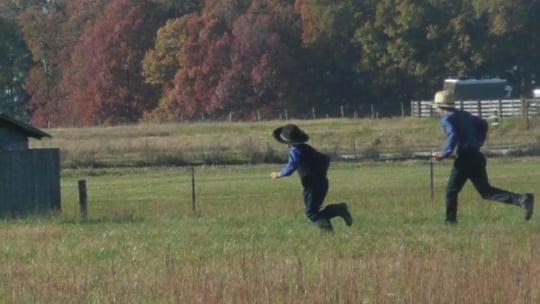

There they go!
LOVE this! In 2021, I drove a load of Amish from northwest Missouri to Huntsville, Alabama for doctoring. The rule in Amishland (at least in my parts) is: the farther away the doctor, the better the care.
This particular doctor was English and practiced alternative medicine. Word had gotten around that some folks had good results, and once that happens… well, the Amish grapevine does the rest. Next thing you know, they’re packing bags and heading south to “check it out.”
And now, with a community there, I imagine future trips will be a little more convenient—and a lot more affordable—with built-in places to stay.
How do they choose?
Any idea on why they pick a certain area for a settlement? And why would the settlement fail? With the high birthrate among the Amish and high retention rate, you would think the settlements would only grow, not fail. Can you or any of your readers with insider knowledge give us any insights?
One of the biggest reasons they pick an area for a new settlement is available land. They have to find an area with multiple available properties, that are affordable and suitable for their needs within buggy driving distance of each other. Sometimes multiple Amish families will purchase a large piece of property then split it up between the families. At least a couple of settlements out west were started by multiple Amish families coming together to purchase a ranch then subdividing it. Proximity to the home settlement or other Amish settlements might also be a consideration. This new Alabama settlement is relatively close to Pontotoc, Mississippi and Ethridge, Tennessee where the Amish probably still have friends and family residing. The Amish also have to be relatively confident that they can earn a living in a new location.
Settlements can fail for multiple reasons. Some examples are a settlement not attracting enough families, no ministry in the settlement, problems within the church, conflict with governments and schools, economic problems. Often times it’s a combination of multiple factors.
Amish in North Dakota
Hi Erik,
With Alabama, I think the number of US states with Amish populations would now be 32. There are reports from last year of a community near Rugby, ND, that was not captured in the Young Center statistics: https://www.amish365.com/where-are-the-amish-in-north-dakota/.
Cheers,
Mark
correction
**34**
Apparently this community in North Dakota was started by 25 families. There doesn’t seem to be much information about it online outside of the article that you shared, also this community is not listed in the 2026 Rabers Almanac.
Hi Mark, thanks for the note. Yea, this is a tricky one. Unfortunately, I have reason to believe that the original source for the North Dakota Amish story was what we might call an “incorrect report”.
I think that some other websites, like the link you share here, then picked it up. That can happen, especially in this day and age.
I myself seem to recall seeing this last year, and getting excited about a “new Amish state”, until I learned more.
And what I believe to be the original source of this ND story was actually cited in a news report recently, as also being the source for a story about an Amish food business that turned out to not actually exist. Not to get too in the weeds about it here, but I can fill you in more if you like.
Hi Erik,
Interesting! Thanks for the information. I know some WI families who have relatives who recently migrated to South Dakota (and Wyoming). I will ask if they’ve heard anything about ND.
worlds deliberately hardest to read articles
Amish medicine
Looking for diets and medicines used by the Amish. Some of the natural ingredients used could fight many conditions.
Diet and health
Hi Bertram,
Erik shared an article on the topic of the Amish diet here: https://amishamerica.com/what-do-amish-eat/ and another one on their health care practices here: https://amishamerica.com/5-unconventional-amish-health-practices/
Yes, many believe in healing naturally first, then if that doesn’t work, turning to modern allopathic medicine. Amish stores sell many such natural healing books.