
This Amish Buggy For Disabled Riders Has A Solar-Powered Lift
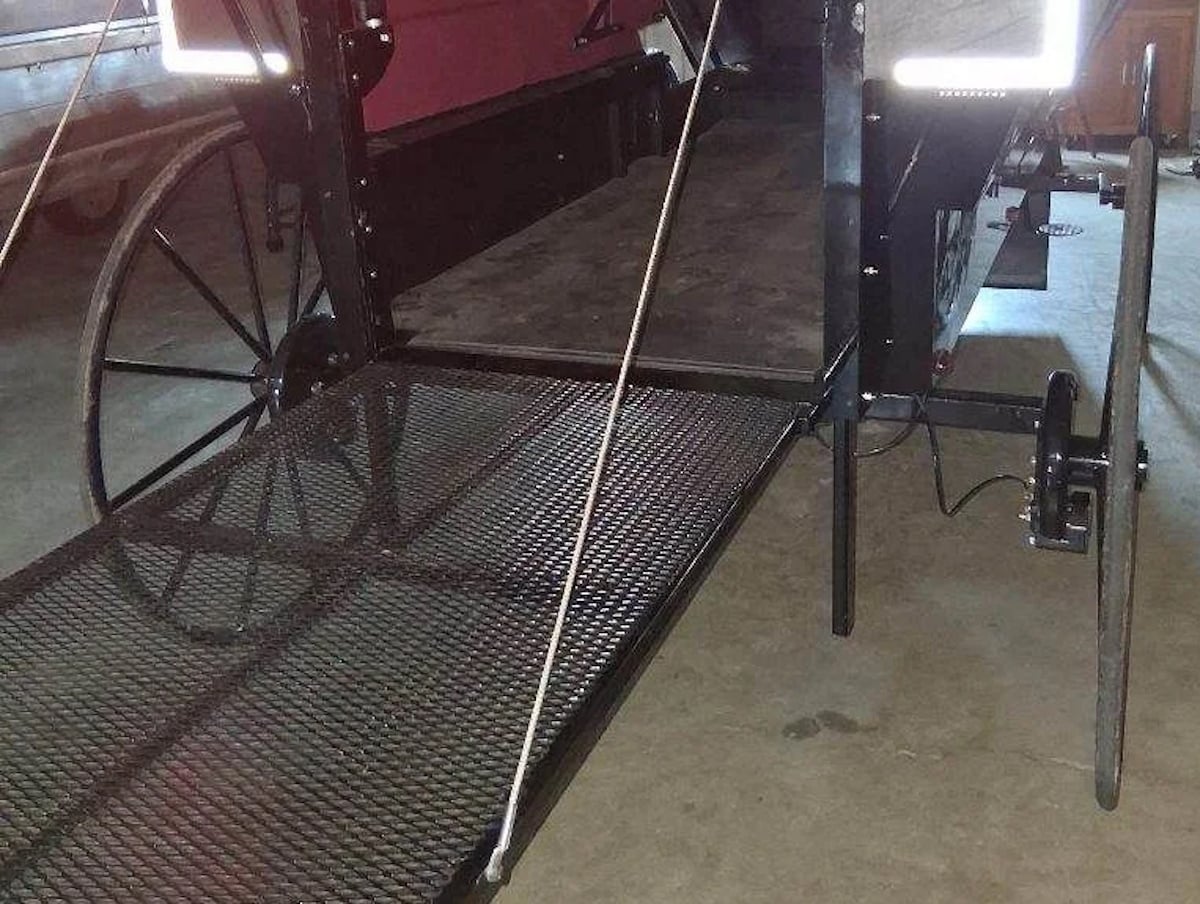
Sixteen months after starting the process, Amish Kitchen columnist Lovina Eicher’s youngest son Kevin finally has his handicap-accessible buggy. This week, Lovina shares a closer look with readers of her column.
Kevin, age 20, has muscular dystrophy. He gets around on a mobility scooter (see photo further down). But at about 6’4″ and 230 pounds, getting him in and out of a standard buggy has meant depending on his brother Benjamin to do the lifting. No small task, and as Lovina explains, not always possible when Benjamin has other plans.
Several of Kevin’s siblings live with the same condition, and his older sister Loretta and her husband Dustin already have a lift-equipped buggy that Kevin’s was modeled after.
How The Buggy Lift Works
Here’s Lovina describing the mechanics in her latest column:
“The buggy has a lift in the back that folds down and, with a remote, can be taken to ground level. Kevin can drive onto it with his mobility scooter and be lifted to the buggy so he can drive in.”
“The passenger seat up front folds up if he wants to sit beside the person driving. Otherwise, the back side seat also folds up, and he can sit behind the driver and passenger seats.”
“The lift is run from a solar panel on top of the buggy, charging a lithium battery under the buggy. This also runs the lights, turning signals, etc.”
This is a good example of how Amish churches permit technology that helps members in special situations live better lives. And as has been mentioned more than once, the Amish don’t think tech is “bad”.
There is nothing really threatening to family or community stability by a solar-powered battery-operated lift fitted onto someone’s buggy. It simply helps a person in the community who needs it to live a fuller life – an indisputably good thing.
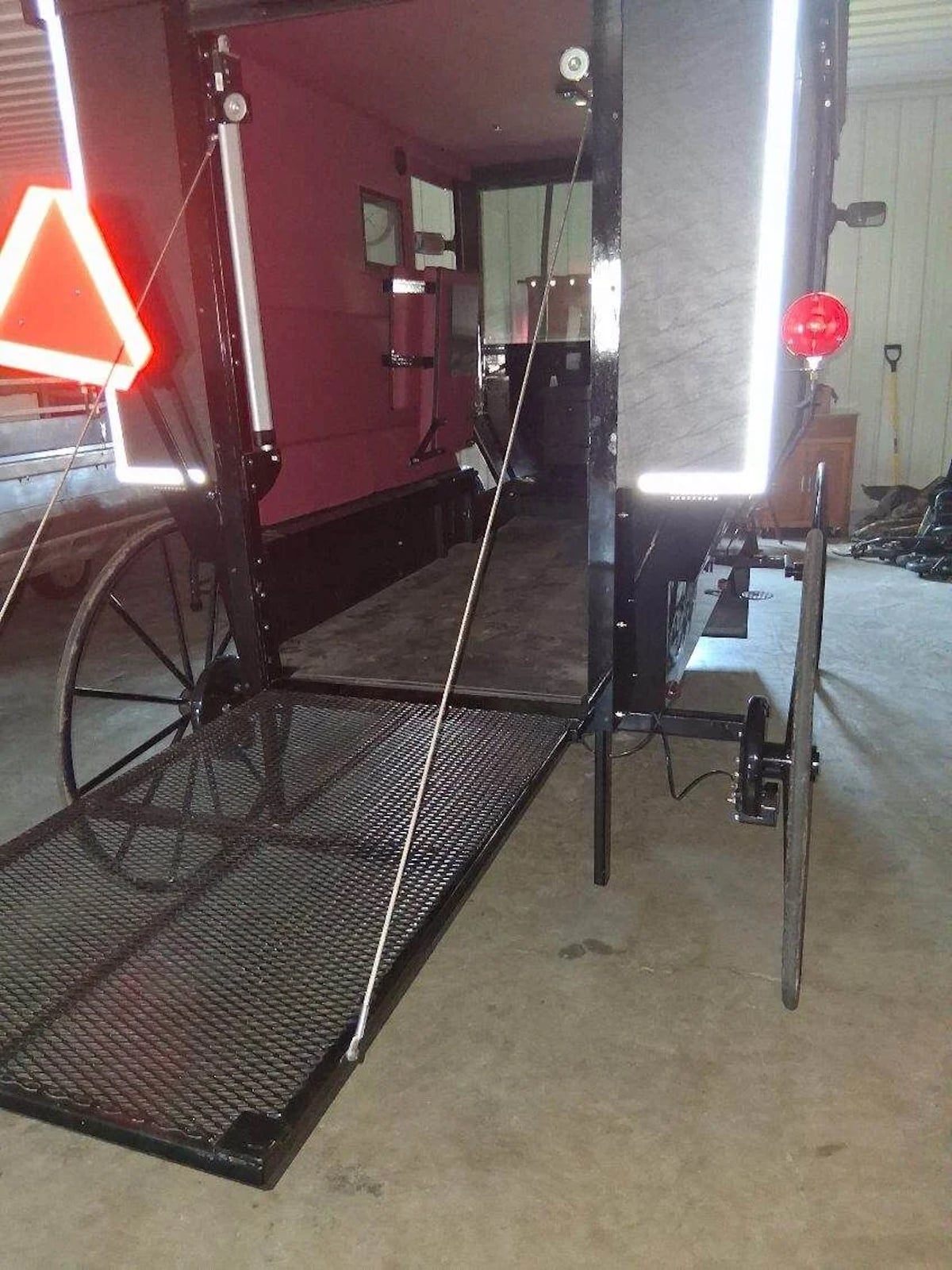
Kevin drives his scooter onto the platform at ground level, hits the remote, and gets a lift up into the buggy. It’s an elegant solution that gives a person a true feeling of independence, with no lifting required from anyone.
Sixteen Months — And a lot of help
Getting to this point took real community effort. The Eichers kicked things off back in April 2025 with a benefit barbecue chicken drive alongside a garage sale, and support kept coming in various ways after that.
Kevin himself wrote a delightful guest column in September 2025 thanking readers who had donated toward his buggy. At that point they were still saving up.
In that column, Kevin wrote “Every time my brother picks me up, I’m saying ‘Don’t drop me,’ over and over, and luckily, he hasn’t yet.” So nixing that risk was another good motivation to get this buggy.
Lovina’s note this week:
“A big thank you from Kevin and us to all who so generously helped in any way. May God bless you for your kindness. This buggy makes life easier for Kevin and the caregivers. It is appreciated more than you know.”
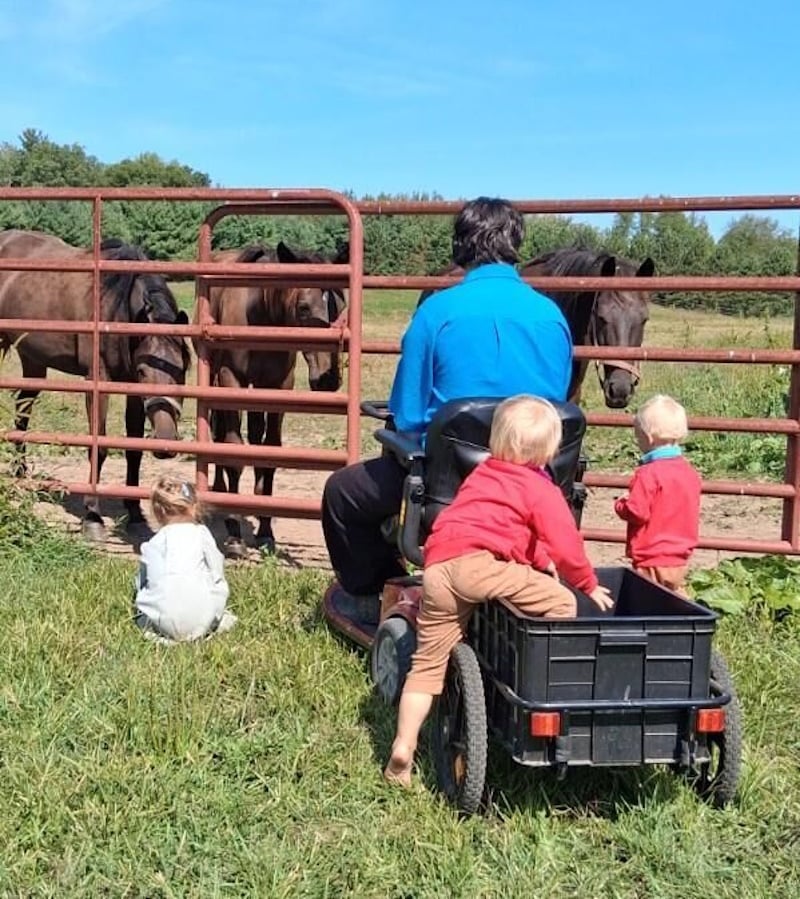
Lovina adds one nice human detail in the column. Kevin isn’t quite comfortable with the lift yet:
“Kevin needs to get used to the lift, especially when he backs out onto the lift to get out of it. I understand that heights look a little scarier when you can’t jump off if something happens. He’s still working on trusting the lift and that it actually will pick him up.”
I trust he’ll learn to trust it well soon enough. Very nice to learn this news in Lovina’s latest column, and bravo to those who helped make this happen.
We’ve seen versions of this before
Handicap-accessible buggies aren’t brand new. But they’re not something you usually get this good a look at.
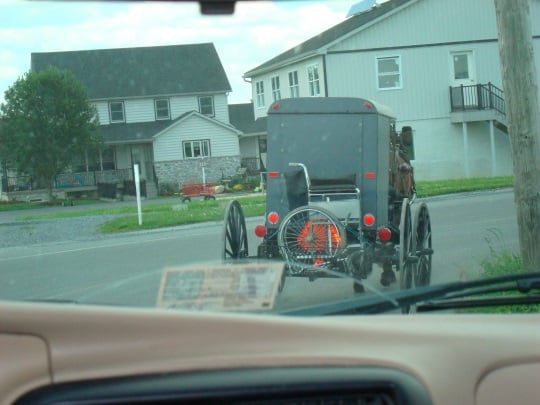
Back in 2018, we covered a Michigan family who received state funds toward a custom-built buggy with wheelchair access for two children with special needs.
Years earlier, readers speculated about an unusual wide-body surrey that appeared to be wheelchair-modified.
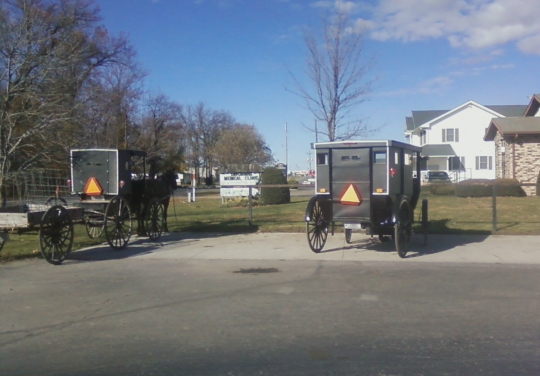
And in the comments on this 2013 post, reader Jodi described a community where two adults with Huntington’s Disease used a modified buggy.
It was particularly noteworthy because in the community in question (Adams County, Indiana), buggies are traditionally all open-top (though that has changed in recent years somewhat). Jodi explained how it works:
I know one of the Amish families in Berne who have this buggy. They have two adults with Huntington’s Disease who are in wheelchairs and can not be exposed to the cold (or get up into the regular buggy).
They have a piece of wood that works as a ramp up into the compartment in the back, but the rest of the family still rides in the front, exposed to the elements. The wheelchairs are secured to the floor inside the buggy compartment.
Those examples noted, this buggy equipped with a solar-powered scooter lift is the “highest-tech” and most convenient version I’ve come across.
You can read Lovina’s full column at the Daily News-Record here.






Interesting and clever invention.
And Kevin’s article that he wrote was also a good read.
Happiness is...
I’m so happy Kevin received his buggy lift. What a difference that will make in his and his family’s life. I’m sure everyone who contributed to reaching this goal will be pleased. I always enjoy following the Eicher family happenings.