
“Legal War on the Amish”: Attorney Fights For Breeder Who Killed 4 Unsold Puppies
After last week’s animal cruelty case, I really wasn’t looking to write more on Amish-owned dogs coming to harm. But here we are.
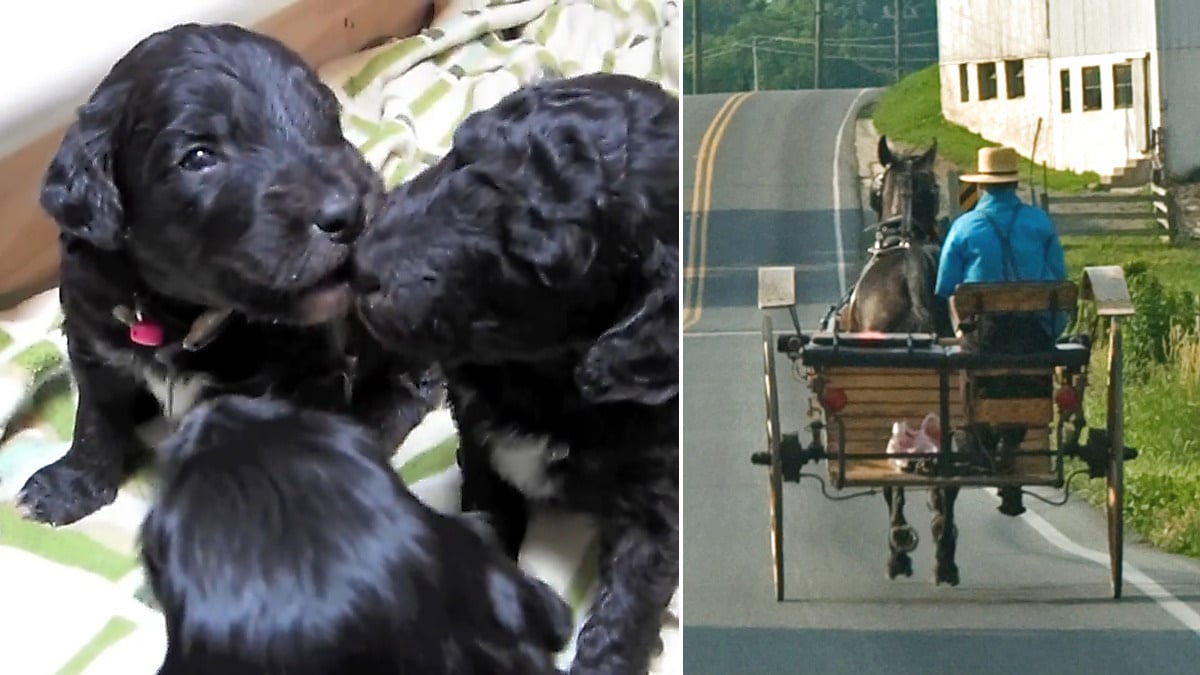
Today we see a report on an Amish dog breeder named John S. Stoltzfus Jr. The Lancaster County resident got himself into trouble after it was learned that, in late 2023, he had killed four Sheepadoodle puppies which weren’t selling.
From the report at Lancaster Online:
Stoltzfus, 48, a New Holland dog breeder, is facing four felony aggravated cruelty to animals charges for killing Tammy, Terry, Todd and Tom. He later laid their bodies in a compost pile on his property, police said.
“Black puppies are not selling…” Stoltzfus told two witnesses, saying he “put them to sleep,” according to police.
Stoltzfus’ attorney told PennLive: “The idea that the Amish would be mean to their animals is ridiculous,” Robert Barnes said. “That they’re mean, cruel or violent is preposterous.”
The attorney working for the defendant is Robert Barnes, who seems to specialize lately in handling high-profile Amish cases in Pennsylvania.
You might recognize Barnes as the same lawyer who took up the case of Amish raw milk products seller Amos Miller against the Pennsylvania Department of Agriculture, and who later defended Reuben King, the Lancaster County Amishman charged with selling firearms without a federal license.
Stoltzfus’ attorneys have twice tried to get him into a diversionary court program, an alternate judicial route, “to resolve the charges without serious consequences.” The Lancaster County District Attorney has twice said no.
What Happened in 2023
John S. Stoltzfus Jr., now 48, was breeding Sheepadoodles, a Poodle-Old English Sheepdog cross, and putting them up for sale online. Specialty breeds are often quite profitable, and breeders, Amish and non-Amish alike, are drawn to them for this reason.
On October 30, 2023, Stoltzfus called an employee of the puppy listing site handling his dogs and asked to have four of them removed.
When asked why, he reportedly said the dogs were black, and “black puppies are not selling.” In fact, he’d already “put them to sleep” himself, without involving a vet. At the time, the dogs were reportedly 16 to 20 weeks old, weighing about 25 pounds each.
Police came two days later, after the website manager reported it. Stoltzfus told them, according to charging documents, that “We have a way of doing it. We took good care of them.”
Neither the prosecution nor the defense has publicly stated exactly how the puppies were killed, though his lawyers say, as it’s reported in the piece, that “Stoltzfus humanely, painlessly and instantaneously euthanized the puppies in a manner consistent with Pennsylvania law.”
“Tradition For Centuries”
Under Pennsylvania law, small domestic animals can only be euthanized by a licensed veterinarian or a licensed technician using an approved injectable solution. At commercial kennels, a licensed veterinarian must be present.
That didn’t happen here. Barnes argues the manner in which Stoltzfus put the puppies down was humane, painless, and instantaneous. And that the real issue is the missing vet, not the killing itself.
More of a technical matter, it sounds. And by treating it as a criminal act, they’re encouraging more crime? That’s what this sounds like:
Stoltzfus put the puppies down in his own backyard by himself, and the district attorney’s office is treating the case like a crime. But all that serves to do is teach the Amish not to call the local veterinarian or police, Barnes said.
“Don’t call anyone because they’ll try to get you imprisoned,” Barnes said. “It’s exactly the wrong message you should be sending.”
I’m a little confused by what’s being argued here, maybe I’m just slow, or something was left out. I think if Stoltzfus had called the vet beforehand, there wouldn’t be a legal problem here. That seems easy enough to comprehend. There was also this eye-raising bit:
“Its an increasing concern in the Amish community,” Barnes said. “They don’t know any given day whether something that’s been their tradition for centuries is something that might get them thrown into prison.”
That “tradition for centuries” language is interesting. By using that language, Barnes is re-framing this as a bigger discussion over “Amish ways”, things that run deep in a traditional culture — one that has a lot of positive to speak for it.
But is Barnes suggesting that convenience-killing Sheepadoodles, a 20th-century designer dog, has been Amish “tradition for centuries”?
Or, is it just killing any commercially-bred puppies that the market doesn’t want “tradition for centuries”?
Or is “tradition for centuries” more about traditional ways of treating and disposing of livestock, which, despite what some Amish breeders still seem to think, puppies and dogs decidedly aren’t.
Barnes also says that “The idea that the Amish would be mean to their animals is ridiculous. That they’re mean, cruel or violent is preposterous.”
I guess that is what you want your lawyer to say in a situation like this, but I’d be wary of making a blanket claim like that. Just like I wouldn’t make a similar sweeping positive claim about “the Amish” as a whole. There are bad apples in every bunch, and granting a group categorical guilt or innocence is not the way to go.
Stoltzfus Was Rejected Twice From the Program
The program Stoltzfus’s attorneys have been trying to get him into is called Accelerated Rehabilitative Disposition, or ARD. It’s a form of what’s known as diversionary court – a track that steers first-time, non-violent offenders away from a standard prosecution.
In a nutshell, if you complete the requirements, the charges are typically withdrawn. For Stoltzfus, ARD would mean avoiding a felony record.
It would also make a big difference on his potential for breeding dogs in future. ARD can only legally give a two-year ban on owning dogs; a felony conviction can be seven years per count.
Stoltzfus applied in August 2025. The DA’s office rejected him in October. His attorneys asked for reconsideration and were turned down again this February.
District Attorney Heather Adams reasons that “This longer period is best for ensuring the behavior does not occur again.”
For his part, Barnes disputes that a conviction is even likely. He told PennLive there’s “a very high chance of acquittal” if the case goes to trial. He’s also planning to file motions to dismiss based on religious discrimination.
A Special Court For The Amish?
There’s another piece of the story worth noting. Barnes and his co-counsel Bradford Geyer are floating the idea of a diversionary court specifically for Amish defendants. Such courts exist across Pennsylvania to address various issues and groups. Here’s more on that:
Diversionary court programs vary across Pennsylvania. Some counties offer mental health court, drug court, and some, like Dauphin County, offer diversionary veteran’s court to address county-specific needs.
So why can’t Lancaster County, which has the biggest per-capita population of Amish than anywhere else in America, have an Amish diversionary court? It’s a question Barnes raises.
ARD isn’t the perfect vehicle to further outreach efforts into the Amish community, Adams said. She applauded the idea but said there is no way for the probation department to supervise and enforce the requirements of the program.
I wasn’t aware such courts even existed, but maybe there’s something to this. However this shouldn’t be a way for Amish people to dodge following laws they don’t like, using (read: abusing) the religious freedom argument where it doesn’t really apply, for instance.
To their credit, Stoltzfus’ defense team expresses a desire to help educate communities about the legal issues involved in such matters:
Barnes and Geyer are pushing for a “global solution” that educates insular pockets within the Amish community on what the law says about euthanasia. They’re suggesting the district attorney’s office collaborate with them on outreach.
That leaves aside of course the question of whether killing unsold puppies is good for anyone involved in the breeding business (more on that below).
“Legal War on the Amish”?
In his statements to the press, Barnes has taken the framing well beyond just this case, telling PennLive:
“The Lancaster County DA’s office is waging a legal war on the Amish. They’re unwilling to extend to the Amish things they extend to those accused of real crimes.”
“Legal war on the Amish” are strong words. But I am not surprised he is casting it that way, as he appears to have become the lawyer of choice for Amish in the county who end up on the wrong side of the law in their business practices.
It probably starts to seem that way if you’re repeatedly defending Amish from the same community, and using the consistent narrative of Amish “traditional ways of life” being under threat — as was a part of the messaging around the Amos Miller raw milk case. I guess we’ll see if he succeeds in making this a bigger issue than just this individual case.
Adams, for her part, is standing by the charges, saying that “This case is particularly troubling as Lancaster County sees a lot of animal abuse surrounding the sale of dogs.”
Lancaster County has been dealing with issues around dog breeders, largely the Amish, for decades now. Leaving aside the technical question of whether a vet is present for euthanization or not, in my view, reputable breeders among the Amish should really come out against the practice of killing puppies that don’t sell.
Even from a cold business perspective, one Amish breeder doing this is going to (and already has) taint the reputation of all Amish breeders, as it is portrayed as an “Amish problem”.
So that means allowing the puppies you don’t sell to live – and doing something humane with them. And yes, that will eat into profitability. Maybe that means some people need to find a new sideline.
So if you have to kill puppies that don’t sell as quickly as you’d like, maybe you shouldn’t be in this business. Again, Amish aren’t the only ones who do this, I’m sure. But it has potential to make all Amish breeders look bad, because the Amish are an easily-identifiable group.
This works in their favor in some cases – e.g. Amish furniture makers’ reputation helps all Amish furniture makers – and against them in others, such as this one. So those in the community who don’t support this practice should speak against it, privately in their circles, if not publicly.




I’m pretty sure that the report’s claim that Lancaster County has the highest ‘per-capita’ Amish population in the US is incorrect. While Lancaster’s probably still the county with the highest absolute number of Amish, Holmes County, Ohio has a much lower overall population, and therefore the proportion of that population who are Amish is much higher – close to 50%, or maybe even over it, compared to Lancaster, where the Amish make up only around 5% or so of the population.
The legal issue is that the Amish person put the dogs down himself instead of paying a licensed vet or licensed tech to do it.
Either way, the dogs are still put down.
Even the state offered no proof that the dogs were put down in a inhumane way. So those charges, at this time, are odd.
Seems like a pressure tactic to force the Amish to comply and pay up.
According to Pennsylvania’s own website, the state of PA charges about $35 to get a license and $360 every 2 yrs to renew it.
So far there is no proof that the dogs were put down in a inhumane way.
So being put into the ARD program is the proper way to go.
from what I read, the killing method was horrific
I encountered some people who might possibly have been family members related to this person, and they, the family members, also committed some crimes against animals, but I won’t get into that story. From what I read about this guy, he actually killed them by: 1. trapping them in some kind of a grate in the floor, and 2. drowning them in liquid manure. It was not just a ‘quick and humane’ death. I actually believe it, because of the horrible things that the family members did to my own animals and some neighbors animals in the incident that I had with them. They were horrible, sick, and abusive.
How it was done..?
I can only hope not. Don’t even want to imagine that or how someone could decide to do that.
They are using words like “instantaneous” which clearly would not apply there.
Why?
I am confused. If a dog breeder (Amish or English) has puppies that they can’t sell is it acceptable that they just kill them? Why don’t they drop them off at a shelter or local animal control? Or drop the price? Or give them away to a good home? Is the bottom line always money? Had a veterinarian been involved I would hope the vet would have intervened and rescued the puppies.
I absolutely agree…
with you, Kelley. This whole thing has a bad aroma about it.
One more thing…
Right or wrong, good or bad, we generally hold the Amish to a high standard. Mostly because we think they live up to our expectations. That’s why we pay big bucks for their furniture and crafted items. We love their home-cooked meals, pies, cookies and pastries. We devour their popcorn. How I wish their same high standard for everything else pertained to their care for the animals that serve them, especially dogs and horses.
I get the whole “animals do not have a soul” discussion. Yet, these animals trust humans, their owners, to care for them. I wish the Amish would take the lead in animal care with the same high standard they show us in other things. I’m sure some do. Unfortunately, this Amish man did not.
Well said Kelley. I know a lot of you left thoughtful comments on this one, but after doing the post I had to leave the topic alone for a bit before chiming back in.
Sadly, shelters put the animals down because they can’t find a home for them, don’t have the funding to take care of them, health issues, violent/behavior issues, and lack space.
Online search results say about 320,000 dogs are put down in shelters each year. That’s about 10%. But I suspect the number is higher due to what I have seen. Especially in cities. The number of dogs that are put down seem to be way higher than that.
Shelters can be sad and depressing because there are so many dogs that need a home and just not enough people willing to adopt them.
Dog breeding is a business I am not a fan of and seeing so many people not take care of their pets properly makes me blame pet owners more and more, as they are enabling the dog breeding business.
Good points to keep in mind J.O.B., thanks. That side of it is really sad too. People understandably envision having a certain type of pet, and so we have specialty breeders to provide those “premium” dogs. But then there’s the downside of one shelter pet not finding a home and being put down. Though, as I understand not all shelters do that.
Most animal abuse cases are obviously not Amish. Stereotypes can lead to pointing fingers in one direction when the problem is everywhere. Here are 2 non-Amish examples. Sadly, it is more common than some think.
https://www.nbcphiladelphia.com/news/local/police-woman-who-abandoned-bucks-co-farm-leaving-animals-to-die-captured-in-belize/4273361/
https://www.nbcphiladelphia.com/news/local/pets-and-wildlife-sanctuaries-mark-ptomey-charged-with-animal-cruelty-delaware/4278855/
Amish Puppy Breeder
1st, I am a driver. I’m not expert on the Amish, but I know more than most English.
While I think it’s awful that that man killed his puppies because they didn’t sell, at least he didn’t dump them in a ditch or off a bridge like some non-amish breeders do. I think making this a felony is wrong.
Now, what’s really my shorts in a knot is someone saying Amish are not cruel to their animals. YES THEY ARE!!! They don’t care. I’ve changed the attitudes of several in the community I drive for. They think animals don’t have soul & don’t deserve compassion.
Marketing
There are many ways to disperse of unwanted puppies. This is a supply and demand issue. Here we seem to have a man that was dependent on one form of selling his pups. 8-10 weeks is a common age to find them homes. After that the value drops, and many breeders have newer stock to move. It’s a very narrow window, and I imagine this happens more than one would expect.
Business as Usual
This happens all the time. If Amish animals don’t make money they don’t get fed or they die. Amish would rather destroy an animal then to give them away free or to a rescue.
I wish they would get of the puppymill business. The poor quality and genetic health problems they create are criminal. Defective puppies cost the buyer thousands or require the dog to be abandoned. Stop supporting pet store pet purchases.
Puppy killer
Maybe the breeder needs to be put down the same way that he said he “humanely “
put down the puppies. And why is a criminal such as this person allowed to sell puppies or anything else. They should be in a real state or Federal prison especially if these puppies are transported across state lines such as NJ or another state.
His crimes and trial should be in a regular court in PA and not an Amish county court.
If you live in any state you deserve no special treatment even if you choose to live differently than most citizens of PA.
I love visiting Lancaster and shopping but after reading things like crimes against animals, women or children makes me disgusted. Puppy mills should be outlawed and put these criminals in prison and throw away the key. Or use the Bible as punishment as in an eye for an eye.
Animals should be treated with warmth, kindness and love.
Amish dog breeders
If there was a way for me to educate the Amish on breeding issues I would be happy to help. I am a retired humane law enforcement officer and certified national animal cruelty investigator. I have worked with the Amish during my time and always had positive feedback. The problem is people don’t respect the Amish I do. I know I’m English but I don’t think of it that way. I am willing to help if accepted. I am 66 years old and own 4 dogs that are designer breeds. Please let’s try I’m looking to get help for the communities and would welcome meeting with the respected religious community leaders.
Dogs that Didn't Sell
In the future, if an animal doesn’t sell, arrange through a different party to help find homes!
I once bought two Budgies: slightly larger than a usual “Parakeet,” they were bred for showing but lacked the proper perching stance, of all things. I got them at discount, since they did not fetch the show-bird going rate. Their colors were beautiful.
Why on earth kill dogs that could make a family’s joy increase, just because they “Don’t sell?!” That is, von meiner Warte aus, die brennende Frage!
Dogs are just livestock to the Amish. Yes, some are very good and have them as outside pets, and let them live to be old, but to others they are just $$. The females are bred until they are worn out and also discarded. Same with horses and mules, some take good care of them, and others just use them until they are worn out and off to the slaughter pipeline they go. Some Amish are “horsemen, and to others, they are just a tool they are required to use. I will compare them to English farmers and their tractors. Some use and abuse and don’t do any maintenance and leave in the weather, and some do the opposite, regular maintenance and stored in the dry. People are people and some not so nice.
Upsetting on Different Levels
I’m a bit late on responding to this post, but well stated, Erik, on calling for reputable Amish breeders to speak up. Speaking up would help protect their reputation but even better would be them speaking up simply because it would be the right thing to do.
“Whoever is righteous has regard for the life of his beast, but the mercy of the wicked is cruel” Proverbs 12:10
There are times when the community goes too far in staying silent in order to ‘keep the peace’.
The lawyer’s schtick of ‘Tradition for Centuries’ leaves a bad taste in my mouth. Framing cruelty as a value system of a spiritual heritage?
I would also oppose any support for a diversionary court for ‘first time offenders’ of these matters. Especially in black and white issues of morality. We are not above the law and the greasy attempt at escaping consequences angers me almost as much as the abuse.
The Amish Card
DA Heather Adams is well within reason to persue prosecution of the puppymill operator. The Amish must adhere to the law like any other citizen. All to often the Amish pull their “Amish Persecution Card”. The puppymill operator could have easily surrendered the almost 5 month old puppies to a rescue or humane organization. In my opinion, the operator was angry he couldn’t make a profit by giving them away. He elected to kill the pups without following the law requiring a veterinarian present.
The Amish know the law. They don’t need “education”. The Amish chose to defy the law and then insist on special considerations simply because they are Amish. Nothing “kind and gentle” about their calculated intentions.
I hope DA Heather Adams is successful in prosecuting the puppymill operator to the fullest extent of the law.
Attorney Barnes stop pulling the “Amish Persecution Card”. Nobody is buying it.
Re the euthanized puppies
I agree, the Amish already have a very bad reputation in re to their treatment of animals: abuse, neglect and mistreatment! The Social Media is full of such negative posts and comments whenever the Amish are mentioned!
Such accusations colour the whole Amish community, gives them a very bad reputation nationally and abroad! The Amish need to read those posts, not that they would, as many of them aren’t allowed social media and smart phones, except for business! The Amish need to know that there are many angry people out there, angry with the Amish, precisely about the animal issues!
I am actually surprised to hear that there may be some reputable Amish breeders!
The Amish farmer in the news story did NOT have to euthanize the puppies! He chose to! He could have just as easily gave them away for free or surrendered them to a humane animal society’s shelter! He chose not to!
The question is why?
Because the Amish have a tendency not to view their animals as sentient beings! That’s the crux of the issue!
He could have chosen to respect the lives of these puppies, but instead he chose to treat them as a property, dispensable! Along the lines of: if I don’t want them, can’t make any profit, then no one can have them! It is decidedly cold!