
JPAC Volume 6, Issue 2 Released: Holmes County Demographics, Remarriage Among The Amish, And More
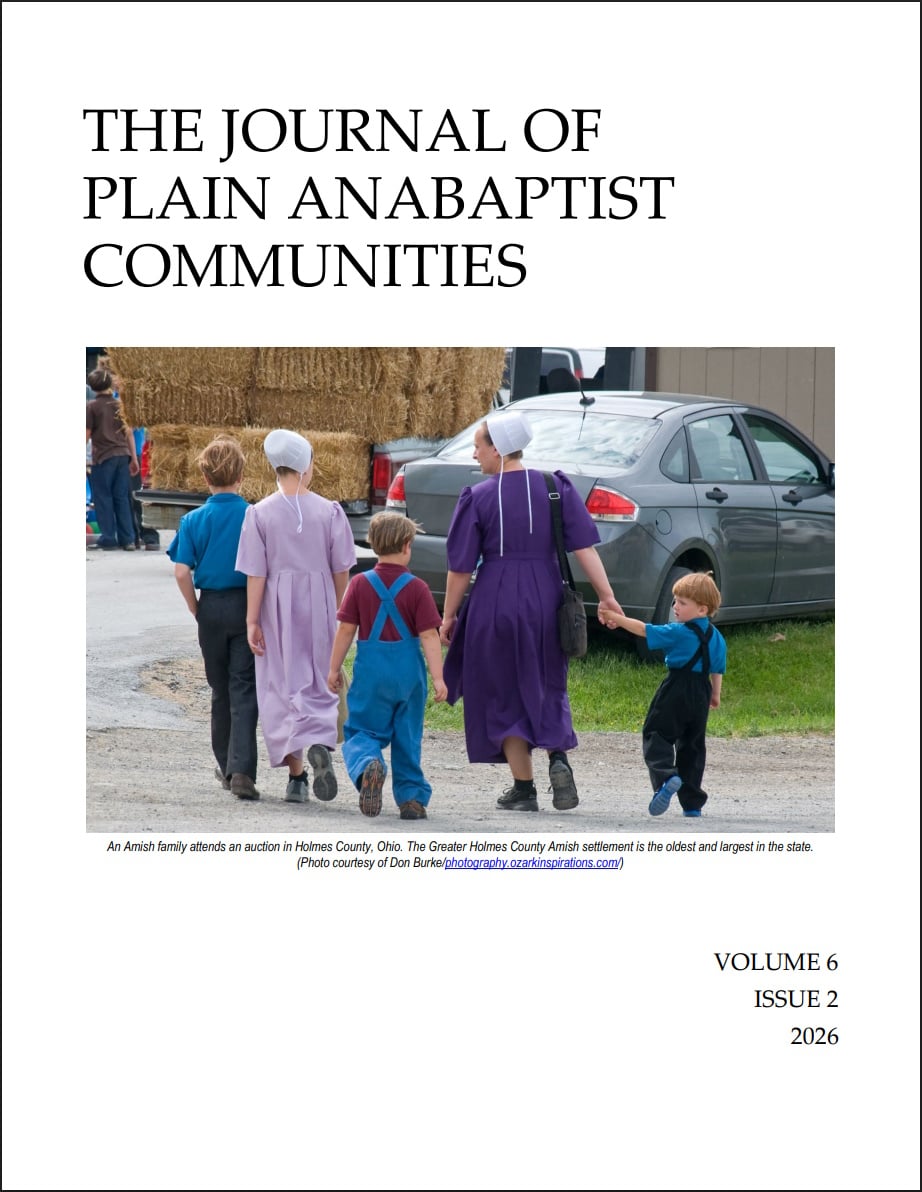
The Journal of Plain Anabaptist Communities (JPAC) is dedicated to publishing a variety of articles about the Amish, Mennonites, Hutterites and other plain Anabaptist groups. The recently released Volume 6, Issue 2 is no exception.
Holmes County Amish Demographics
The lead article is a demographic profile of the Greater Holmes County Amish settlement. Located in northeast Ohio, it is the second largest Amish community.
Previously, population profiles of three of the four largest settlements were featured in JPAC: (1) the Greater Lancaster County, Pennsylvania community (Volume 3, Issue 2), which is the largest; (2) the third largest community, which is the Old Order settlement of Elkhart-LaGrange in northern Indiana (Volume 3, issue 1); and (3) an article on population growth and fertility patterns for the fourth largest settlement, the Greater Geauga County, Ohio community, located to the east of Cleveland (see Volume 1, Issue 2).
All four studies used data compiled in directories of families for each of these settlements, which account for nearly 36% of the total Amish population in North America, based on available statistics from the Young Center for Anabaptist and Pietist Studies.
An index of all articles and book reviews is found in Volume 5, Issue 2. In addition to demographic profiles, it lists a variety of JPAC articles on specific population traits, from twinning and population pyramids to doubling time and marriage patterns.
The population profile of the Greater Holmes County settlement reports on a number of demographic characteristics, including age of men’s ordinations, men’s occupations, marriage patterns, widowhood and remarriage, birth intervals, population pyramids (broken down by major fellowships within this settlement), and twinning.
Wherever possible, comparisons are made with information about the other three large Amish settlements. For example, the percentage of men who are farmers varies from slightly less than 11.5% in the Greater Holmes County community to nearly 41% in the Greater Lancaster County settlement, with the Elkhart-LaGrange settlement much closer to the Greater Holmes County settlement with 15% of men in farming. This characteristic was not part of the Geauga County article, however, the percent of men in farming there is now only about 5%.
Remarriage Patterns Among The Amish
A second article in this new issue of JPAC also uses data from two Amish directories, in this case, from the directory of nearly all settlements in the state of Minnesota and the directory from the large Daviess-Martin County community located in southwestern Indiana, which is the seventh largest.
This study zeroed on remarriage patterns, a topic seldom the subject of demographic research, even though information on widowers and widows is often part of various population profiles. In this JPAC article, the authors found that remarriage for men is far more likely when their average age was in the early 50s when the spouse died.

However, the average age for women who remarry was significantly younger, that is, the late 30s when their spouse died. Furthermore, widowers were more likely to remarry than widows, despite this age difference.
The authors conclude that these differences are related to the size of the “marriage market”, in part because women live longer and in part because in many Amish communities, especially more traditionally minded settlements, women tend to marry men who are older than them.
How Mennonite Parents View Children’s Health Care
The third article focuses on parental views of children’s healthcare in an Old Order Mennonite community located in south-central Kentucky. This community is one of the most conservative of all Anabaptist groups in terms of the adoption of technology.
The researchers used a modified Child Health Conditions Survey plus a survey they themselves developed. Quantitative analysis of the information from the first survey was accompanied by a qualitative analysis called Thematic Data Analysis from the second survey.
The researchers found that parents generally viewed their children as healthy, with the most frequently reported health issues associated with dental concern, and digestive problems such as frequent vomiting, constipation and reflux.
They also found a preference for home remedies over modern pediatric services, and a preference for seeking out advice from other community members. Nonetheless, the vast majority were satisfied with pediatric care, especially specialized medical services, when they were used.
Amish Youth & Illicit Substances
Noting that trajectories for involvement with illicit substances are different when comparing Amish and mainstream youth, the authors of the fourth article in Volume 6, Issue 2 of JPAC examine the efficacy of using assessment instruments and programs designed for the mainstream.
They asked: how might they be modified, if at all, to be more effective for Amish youth, based on experiences with development of an intervention program in the Elkhart-LaGrange, Indiana community. After a careful statistical analysis of the assessments, the authors conclude that a more grounded approach to substance misuse is to understand the distinctive trajectories of Amish drug use, including their perception for why they would use illicit drugs.
Book Reviews & More
Volume 6, Issue 2 also includes three interesting book reviews. These are: (1) “Giving and Receiving Counsel: Mutual Admonition and Life Together in the Hutterite Tradition” by Jesse D. Hofer; (2) “Beechdale Road: Where Mercy is More Powerful than Murder: A True Story”, by Megan Shertzer and Tim Rogers; and (3) “Justice and Mercy: Distinctive Teachings of the Plain People”, by Donald Martin.
You can access Volume 6, Issue 2 for free online, here. The next issue of JPAC (Volume 7, Issue 1) is scheduled for release in late 2026. It will include the second installment of the article on assessment and treatment of substance use among the Amish, plus additional profiles of Amish populations and much more.
To subscribe to JPAC, simply go to the journal’s web page (https://plainanabaptistjournal.org/). On the upper right side, go to register and follow the directions. Only 5-10 minutes are required to sign up. Also, there is a “JPAC listserv.” To join it and receive occasional announcements, contact Joe Donnermeyer (donnermeyer.1@gmail.com).

A driver's observations
Interesting article. In eight years of driving Amish families, I’ve personally never known of a case where an Amish couple divorced and remarried, though I’m sure there are exceptions. In the communities I know, marriage is taken very seriously. They often point to Mark 10:11-12 and Matthew 19:6, believing that remarriage after divorce while a spouse is still living is adultery.
I have, however, seen several widows and widowers remarry after losing a spouse. It’s always heartwarming to see older folks find companionship again.
One thing I enjoy about JPAC and Amish America is that they continue to shine a light on aspects of Amish life that many of us wouldn’t otherwise think about. There are always new things to learn. – Thank you Erik and Don!