
Amish & Mennonite Investors Lose Big Yet Again – This Time, In Alleged $770 Million ATM Ponzi Scheme

It’s looking like Amish and Mennonite investors are once again victims in a big investment fraud case.
It was reported last week that Lancaster County, PA businessman Daryl Heller is being charged by the US Department of Justice with multiple counts of fraud – for his role in an ATM investment operation being described as a Ponzi scheme.
From the report at Reuters:
A Pennsylvania man has been charged with tricking people into investing money he claimed would be used to buy thousands of automated teller machines, causing more than $400 million of investor losses, U.S. authorities said on Wednesday.
Daryl Heller, 55, of Lititz, Pennsylvania, was charged by the U.S. Department of Justice with one count of securities fraud and four counts of wire fraud. The Securities and Exchange Commission filed related civil charges.
Authorities said Heller falsely promised investors in his Prestige and WF Velocity funds they would receive 25% returns based on revenue generated by ATMs purchased by his company Paramount Management Group.
According to court papers, many of the machines didn’t exist, or were old, broken-down and stored in warehouses.

The numbers involved here are massive – dwarfing previous financial scandals which have claimed Amish and Mennonites as victims (more on that below).
I should say this is not a “new” story, outside of the news of the federal charges against Heller.
It’s been reported on since at least August of 2024, when investors sued Heller Capital Group after the company ceased making required monthly fee payments the prior April.
Heller’s group was allegedly able to collect about $770 million from investors over a mere 7.5 year span (from January 2017 to June 2024). In other words, over three-quarters of a billion dollars.
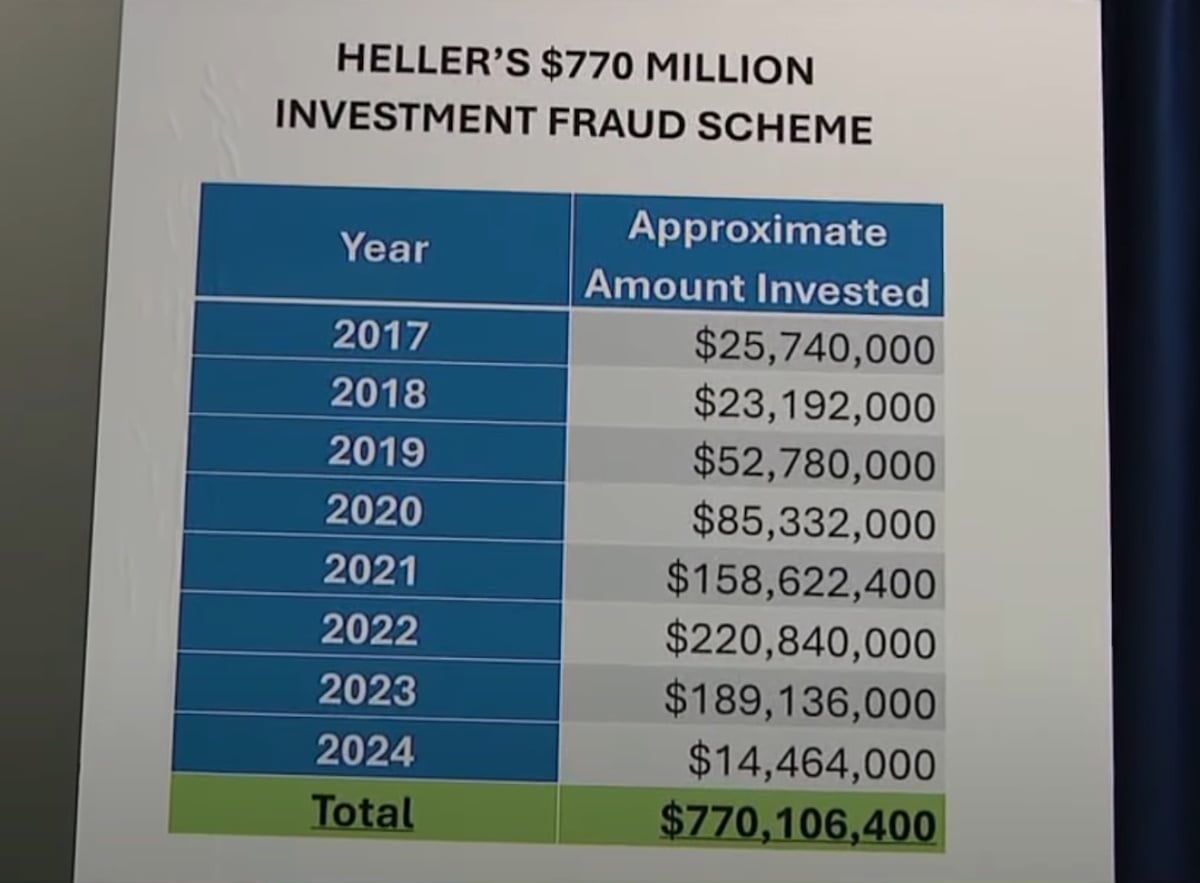
And the SEC is saying that Heller took $185 million of that money for his own gain. This report at WITF goes into extensive detail on Heller’s operations, based on SEC allegations.
Now, not all of the investors were from the Plain community. But according to the reporting, “many” of the roughly 2,700 investors were Amish or Mennonite.
That gives you a sense of both the wealth in the area, and also the power of local networks built on affinity and inherent trust.
It’s a trust often granted, essentially, automatically when people come from the same or similar close-knit religious and cultural backgrounds. Heller’s father and grandfather were pastors in a Mennonite church in the rural Lititz, PA area.
So where did all that money (allegedly) go?
Heller allegedly used new money to make Ponzi-like payments to earlier investors, while misappropriating $185 million for other companies including two cannabis-related businesses, and personal expenses including a New Jersey beach house.
The defendant also paid millions of dollars to fund managers to recruit new investors, authorities said.
According to the indictment, after new money dried up in April 2024, Heller stopped making distributions and promised investors “a complete buyout to get everyone’s capital back,” but this never happened.
Heller was arrested on Wednesday morning in Lancaster County, the U.S. Attorney’s office in Philadelphia said.
There are other more conventional investment vehicles where these Plain investors could park their millions – stock market or plain mutual funds for one (and of course, many do just that).

But whether it’s the promise of better returns, the comfort of investing with a trusted “local”, something else (or some combination of those), it seems we are seeing some version of the old story replaying.
That story is the one where Plain investors go in with the old comfortable ways – trusting someone adjacent to, or within their culture, to turn their money into a lot more money – and are left holding the bag.
Hardly the first time for the Plain communities
The Plain communities have been no stranger to such happenings, often enough falling prey to operators using close connections and Plain backgrounds to gain trust and promote offerings which haven’t always been on-the-level.
And it keeps happening, as – sadly – I rather expected it to. Why?
A less-charitable interpretation might mention things like “greed” and “when something sounds too good to be true…maybe it is”.
And, I have little doubt that those two factors were operating to some extent in this, and other cases. Heller’s group apparently promised 25%(!) returns (people, come on).
At the same time, the victims and losses are legitimate, even if maybe some should have known better.

Back in 2019, I put together a simple post summarizing fraud cases involving Amish & Mennonite investors: “Amish & Mennonites Victims of 4 Major Financial Schemes Since 2008“. You can see that post for more, but briefly, they were:
- Earl D. Miller, a man with “Amish heritage” who ran an investment fund scheme losing investors over $4 million (sentenced to 8 years in prison in 2023)
- John M. Sensenig, a Lancaster County Old Order Mennonite man who settled federal charges in 2013 that he cheated 1,500 Mennonite and Amish investors out of at least $45 million
- Monroe L. Beachy, Amish investment fund manager who defrauded 2,700 people, many Amish, out of $16.8 million (sentenced to 6.5 years in prison in 2012)
- Arlan Galbraith, who ran the “Pigeon King” scam leading to an estimated $20 million in losses, with a large share of its investors being Amish and Mennonite (sentenced to 7 years in prison in 2014)
Additionally, since then, there was at least one more big one:
- Philip D. Riehl, an excommunicated Mennonite man who ran a $60 million Ponzi scheme defrauding Mennonites & Amish (sentenced to 10 years in prison in 2020)
To their credit, there is a lot of success in Amish and Mennonite communities, and particularly in places like the Lancaster County area. Likewise, there is quite a good share of well-off and wealthy people among the Amish and Mennonites.

Naturally – and I certainly don’t blame them – they look to invest their hard-earned money to secure future gains for themselves and their families.
But this sort of thing keeps happening. And I’m not going to act like I have the solution, other than maybe turning up the “common sense” dial and doing a bit more due diligence. Even if that erodes the automatic trust mode a bit.
It’s just a sad thing that the inherent trust built into these communities, which can lead to a lot of good, keeps getting betrayed.
Social capital exploited
It’s the flipside to the benefits that Amish and Mennonites get from their large stores of social capital, which, when working properly, can be leveraged to promote a prospering and growing business environment (among other positive benefits).
But if someone from within the community decides to exploit that, you can end up with devastating frauds and scandals like these.
And the sad reality is that these types of people are present in every community of size. And if they are skilled and motivated enough, they can do a lot of damage.

Based on this track record, there’s probably at least one more big investment fraud of some sort going on right now in Plain communities. And it is going to generate similar headlines soon enough, maybe not far down the line.
So I’m still wondering when Plain communities are going to stop getting entangled in these things. After seeing this happen repeatedly for the better part of two decades now, I’m not holding my breath.
If you’re a member of a Plain community reading this, I’m sorry if that sounds rude, but it is what it is. I’m sad to read these stories because your strong communities can be such a force for good.
And these fraud schemes do untold damage – not just financial, but emotional, health-related, as well as damage to relationships – and to those same community ties that enable them to happen.
Lawsuit Against Heller’s Partners
Heller had help in his operations, specifically from four managers who are named in a $700 million class-action lawsuit.
This article at WITF profiles the four, which include an Old Order Amish-born person (who from what I can tell, was raised Amish, has Amish relatives, but is not Amish now himself):
Four of Lancaster County businessman Daryl Heller’s partners in his ATM investment network are named as defendants in a class-action lawsuit filed Wednesday on behalf of 2,700 investors.
Batman Investments LLC claims in the suit that the men — Jerry Hostetter, Randall Leaman, Dave Zook and Mir Jafer Ali “Buck” Joffrey — helped carry out a $700 million Ponzi scheme by using cash infusions from new investors to pay previous investors.
While Heller is not named as a defendant, the suit said Paramount Management Group, which managed the ATMs, and the Prestige Funds that recruited investors “were riddled with conflicts of interest stemming from common ownership and control by Defendants and by non-party Daryl Heller, who collectively grossly mismanaged the Prestige Funds and misappropriated investor monies for themselves.”
It sounds like Heller’s legal team might be planning to cast these managers as the culprits. One of Heller’s lawyers, Christopher Adams, had this to say:
Adams says his team will mount a vigorous defense of Heller and appeared to cast aspersions on the managers of the ATM funds who were involved in the recruiting process.
“We are prepared for and look forward to rebutting all the false allegations and speculation in open court,” Adams says. “Those portfolio managers who are desperately trying to portray themselves as victims will soon have the light shone on their actions—the truth will definitely come to light,” he adds, declining to comment on how he intends to portray the fund managers’ role in the operation in court.
Heller Released on Bail
In the latest news, Daryl Heller, having been arrested last Wednesday, was released on bail Friday. If convicted, Heller faces up to 100 years in prison.






WOW
Hey, buddy you just got your name changed to Darryl “Monroe” Beachy Congrats! I knew you were shady! God knew, hope you had fun in that beach house on Jersey Shore! How are people that unaware! We live in the age of technology and surveillance and you’re gonna get caught! Did Grossdaadi not teach you in his sermons that ‘Thou shall not steal?’
Alleged $770 Million Ponzi Scheme
Batman Investments LLC . . . ?? That alone should tell ya something. Not trying to rub salt in anyone’s wounds here, but as my grandfather used to say, “Best way to double your money is to fold it in half and stick it back in your pocket.” One curious thing: the other stories shared on this site, the guilty parties received very light sentences, yet this other fella faces 100 years if convicted on all charges?? I’ll believe THAT when I see it. If the Plain folks are a “protected minority” I think sentences should be doubled. Clearly these fraudsters are counting on these investors not knowing what they might actually be getting themselves into. And that’s just plain WRONG in and of itself.
Well there’s also often a difference between potential sentence if convicted, and what someone actually gets.
Also I can only speculate (not a lawyer) but perhaps it reflects to some degree the greater sums involved. If losses were over $400 million, that is 6 to 8 times larger than the largest of the other cases.
Again?
You hear about these sorts of frauds ALL THE TIME. If people would just think, if someone could generate this type of huge return (25%!!!) annually, why are they promoting this to average ordinary people when they could market it to a small group of wealthy investors, get all the capital they needed and deal few far fewer customers?
Amish and Greed
25% return on your money through an “Amish” connection with nothing but trust shows that greed conquers smarts.
A culture of victim blaming?
//So I’m still wondering when Plain communities are going to stop getting entangled in these things.//
I think a culture shift away from seeing fraud as inevitable and saying that the victim should have had more sense, towards saying that the less sense or capacity to defend themselves the victim had, the more guilty the fraud is for taking advantage of a weaker party would be of great advantage to everyone.
The guilt lies with the people who cheat, not the people who trust. It’s not for the plain communities not to get entangled, it’s for people to stop trying to cheat them.
Of course, I’d recommend getting clear paperwork, but that’s a good idea for totally other reasons – to make things easy to sort out in the case of, e.g. unexpected deaths.