
One Month After an Amish Man Was Killed on an E-Bike, Holmes County Faces a Problem With No Easy Fix
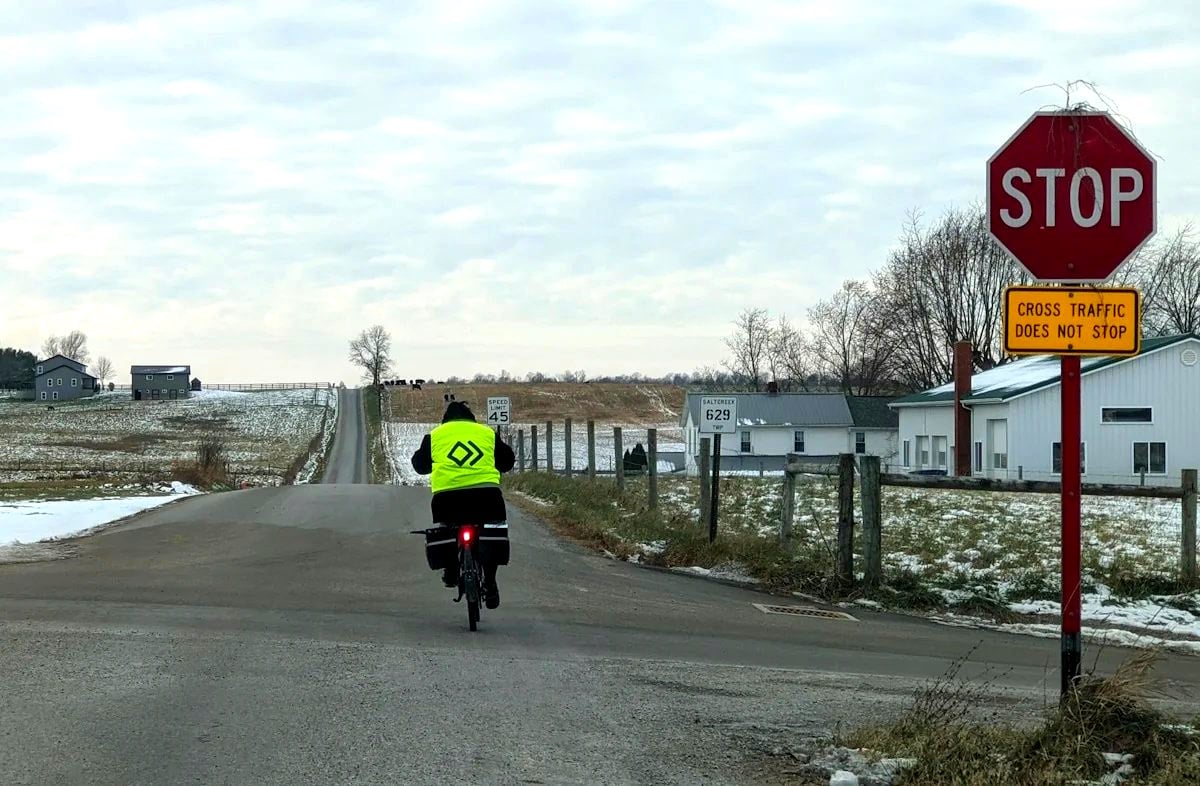
In early March, an Amish man named Jason Yoder, age 30, was killed in a chain-reaction crash on a Holmes County, Ohio highway while riding an e-bike. The accident – which also left a Good Samaritan in critical condition – has put the spotlight back on safety concerns over the e-bike.
As we’ve covered before, e-bikes have skyrocketed in popularity among Amish in the Holmes County community, arguably more so than in any other Amish community. Yoder’s death was not the first serious accident, as the Amish have been using e-bikes in this community – home to tens of thousands of Amish people – for years now.
It’s a diverse Amish settlement, so a significant segment of the Amish population reject e-bikes. But it’s still probably fair to say they are “heavily used” in this community. As I mentioned in the prior post, on a visit to Holmes County last December, I saw more e-bikes on the road than buggies.
Growing Concern
On April 6, Ohio State Rep. Mark Hiner sat down with the Holmes County Commissioners to make clear that the conversation sparked by that tragedy is not going away, as reported in a new article by Dave Mast at Your Ohio News.
Hiner articulated concerns. “We’re getting more and more calls about that,” he said, referring to constituents communicating to him regarding e-bike safety. Additionally:
“There is growing tension about this, and we are going to have to come up with a solution,” Hiner said. “I hope we can do it through education and management.”
Commissioner Joe Miller articulated what sounds to me like a “pro-e-biker” perspective, for lack of a better term. In a nutshell, he said safety is not only on the e-bikers, and that the e-bike is embedded in the community now and here to stay:
Commissioner Joe Miller said e-bike safety and education isn’t just for those traveling on e-bikes, but for travelers in vehicles who must take on some of the burden of creating a safer travel space for e-bikes.
Miller said e-bikes are a part of life in Holmes County, and with half of the county’s population being Amish, e-bikes aren’t going to go away any time soon.
“E-bikes are fine. We need to tell people to slow down, be careful and watch for them,” Miller said. “(E-bikes) are part of our community. These people are the heart of our community. They live here. They go to work.”
Complaints against e-bikers, for that matter, include not properly using signals, to riding side-by-side.
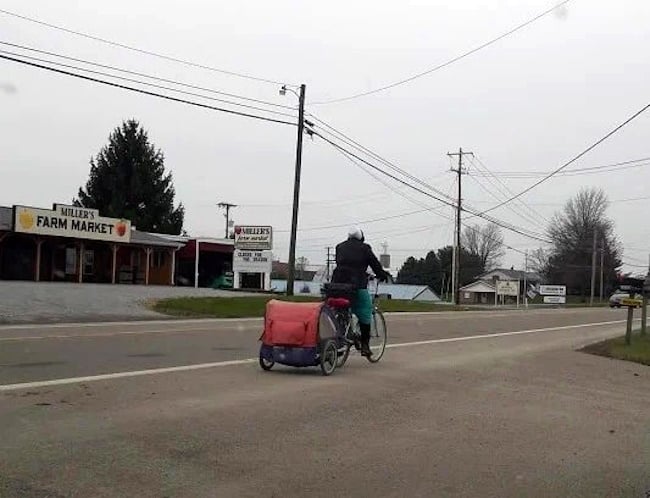
Though past Amish transport safety issues have been addressed by changes to statewide law (see the controversial buggy lighting requirement), Hiner appears to be taking a more targeted and collaborative approach.
He emphasized that he doesn’t want to go the way of making a new law to address the matter: “I hope we can do it without writing a law or changing the law. People have a right to travel; it doesn’t matter who you are or what you do.”
Possible Solutions
Several solutions – or call them safety enhancements – were discussed. One of those would be improved technology – namely, adding signals to the bikes themselves:
While those using e-bikes have been using hand signals to denote their direction and plans to turn into adjoining roads or driveways, Miller said new e-bikes are being built with signals as part of the construct of the bike.
Hiner asked Miller if that new technology would be accepted by the Amish community, and Miller said he believes it will be embraced.
I would agree with that – if you’re already using an e-bike, adding a turning light is essentially irrelevant from the perspective of the question “is this too much tech?” That is nothing like adding an electric light to an ultra-plain Swartzentruber buggy, for example. This is already “advanced tech” in some sense.

Another idea was one often proposed when it comes to buggy safety – widening roads:
Commissioner Dave Hall said while education is a must, another key will be finding funding to create wider roads where e-bike travel is popular, including along state routes like 83 and 557.
Hiner said in his discussion with Young that creating bicycle lanes is much less costly than adding buggy lanes because it doesn’t require as much space for bicycles.
Finally, someone also suggested the idea of an e-bike safety course similar to a hunting safety course, which would presumably be a requirement for e-bike operation. It seems to me that might require some sort of legislation to enforce, however.
Concerns Over Tourists
Interestingly, they also brought up tourists among their concerns. And I think that is wise. People come to Amish Country expecting to see, and watch out for, the horse-and-buggy. A bicycle – or rather, many bicycles – going at abnormal speeds up and down the area’s many hills is another thing.
The group then discussed another issue. While educating local people about e-bike and automobile harmony is one thing, with Holmes County being such a large travel destination from the tourism perspective, educating tourists is a completely different story.
He said people who live here understand the components of the two types of travel coexisting and are more aware of the dangers and challenges involved while tourists are less likely to understand how fast e-bikes can move and how one could be around every hill or turn.
It almost seems like this needs to become part of the tourist marketing efforts. People who are only familiar with other Amish settlements will be surprised by what they find in the area. Be aware of Amish buggies, yes, but in Holmes County you need to be just as aware of Amish e-bikers…

A Unique Situation In The State
Holmes County is unlike any other county in Ohio. With roughly half of its population being Amish, and with e-bikes having become the dominant form of transportation for a significant part of the Amish population, the roads there present a set of challenges that no other county in the state faces quite the same way.
In approaching that challenge, you get the sense from this article that Hiner is coming to the county to attempt to solve this without having to go the legislative route – but not ruling that out as a possibility if things aren’t improved. “We need to identify the problems and come up with solutions. We’ve got to find a way to make it work,” he said.
So, following this meeting, I’d expect the efforts at improving e-bike safety in a more methodical and comprehensive way to gain some momentum. I imagine both sides would like to avoid going the legislative route if possible. It will be interesting to see what they come up with.


I am an Amish Taxi driver. The Amish that I take to work and home 5 days a week complain more than I do about the E-bikes.
The problem I see everyday is that the Amish E-bikers DO NOT FOLLOW THE LAWS! They don’t stop at stop signs, they don’t use hand signals nor have turn signals. More than half try to race an automobile down a hill. When a line of cars are stopping at a stop light they proceed to go straight to the front and try and beat you through the light and cut you off and then turn in front of you!
Joe Miller is saying it’s the English people’s fault for the problems with the E-bikes is not true! Yes everyone needs to be aware when driving!! That includes the Amish. I see them on their phones and riding with no hands! I tried to pass a E-bike on County Road 329 and I was going 40 MPH. That bike was going way faster than 40. I could not pass him/her until I sped up to 50. This is not a E-bike it’s a moped or a small motorcycle! They need to take a test like the English do for a car permit and then a driving test!
I got the impression – only based on the limited info presented in the original article – that Joe Miller was representing or advocating on behalf of the e-bike riders, which we can assume here are majority Amish.
But based on your experience shared here it sounds like e-biker behavior is worse than suggested or alluded to in the article.
Solving a problem takes accurately identifying its causes first. Hopefully those in charge have a clear and accurate picture of things.
E-bikes
I do think e-bikes present a unique problem. I spend a lot of time in a biking-friendly community with separate trails specifically designed for pedestrians and bikes. Suddenly, e-bikes enter the scene and they actually create a dangerous situation for regular bikers and walkers. Those on e-bikes do not want to slow down and follow the normal rules of the trails. E-bikes can allow riders to reach vehicle speeds, but they do tend to act less cautious than a normal biker. There’s something interesting psychologically happening there. I do think that any vehicle, motorized or electric, that can obtain certain speeds (say over 40 mph) should potentially require licensure or can at least be ticketed for erratic driving.
That being said, many American drivers really struggle to slow down for anyone attempting to share the road. There is a sort of anonymity that takes place in a car and a feeling that cars take precedence over everything. Bikes, buggies, pedestrians, motorcyclists, slower motor vehicles, even RVs—all are often treated like second-class citizens who should get out of the way or dodge the vehicle that wants to race along. I think it really comes down to impatience, the constant feeling of rush, and lack of courtesy. As a driver, I have decided I just need to always leave extra time so I can wave people in, take road work in stride, smile and wave at the slow-moving farm equipment, etc. I got tired of always being stressed when driving. We can all just take a deep breath, slow down, and treat everyone else on the road like we would want to be treated.
End of my small lecture. Haha.
The article and quotes from Your Ohio News allude to some involvement with Amish residents in addressing the problem and a collaborative approach. For lasting improvements to take place, planning needs to actively involve planning “with” Amish residents (not merely planning “for” Amish residents). I’m wondering about the thoughts of the Amish ministry about the problem. Could compliance with good cycling safety standards be part of the Ordnung? I was also wondering if there are yellow road signs that alert drivers to bicycle traffic, just as there are road signs that alert drivers to buggy traffic.
,
Good thoughts Al…I’m assuming that Amish will be/are involved in this on some level, though it did seem like we heard mainly or only from “officials” in this piece. Some interesting ideas there also – prominent e-bike signage seems like a no-brainer for one.
Love for the Amish
I absolutely believe safety comes before every form of transportation.
As a walker here in Wooster sidewalks have become dangerous because of all types of bikes.
They speed down them and do not acknowledge their presents.
Sarasota is for...
Around here (northern Indiana), young people go to Sarasota, especially as a honeymoon kind of thing – some time the first year of marriage. So the saying here is that “Sarasota is for the newly-weds and the nearly-deads.” ha!
Holmes County E-Bike Problems
Maybe I missed it. Did officials determine who was at fault?? If so, were charges filed against the motor vehicle driver?? Must admit I scanned the article quickly which isn’t normal for me. Thanks everybody!