
Before Phoenix Was A Major City, A Breakaway Amish Group Made It Their Home – Then Came To A Strange End

“A very unlikely place for Amish farmers to settle, yet they did.”
That’s how David Luthy introduces one of the unlikeliest settlements in Amish history in his book The Amish in America: Settlements That Failed, 1840-1960.
Today, Phoenix, Arizona is one of the largest cities in the United States — a sprawling desert metropolis with a population of over five million people in its greater area.
But well over a century ago, a small group of Amish families — driven to achieve a more devout community — quietly settled on a patch of irrigated land northwest of town and tried to build a new life in the desert sun.
It did not work out the way they had hoped.
An Unlikely Place For The Amish
The origins of this group trace to Kansas, where a minister named Noah T. Schrock had grown deeply frustrated with the Amish community around him.
His issues? He felt that the church people were not keeping Sunday holy – “too much laughing and playing”, that young people’s courtship practices were “wrong”, and that the people had grown too focused on material things.
He made the decision, as Luthy puts it, “to separate from the Amish Church”. Others followed him, including his brothers, sons and son-in-law Moses C. Amstutz. They sought a fresh location to start anew.
And somehow, they settled on Arizona. This was an odd choice for an Amish community, given its agrarian nature.
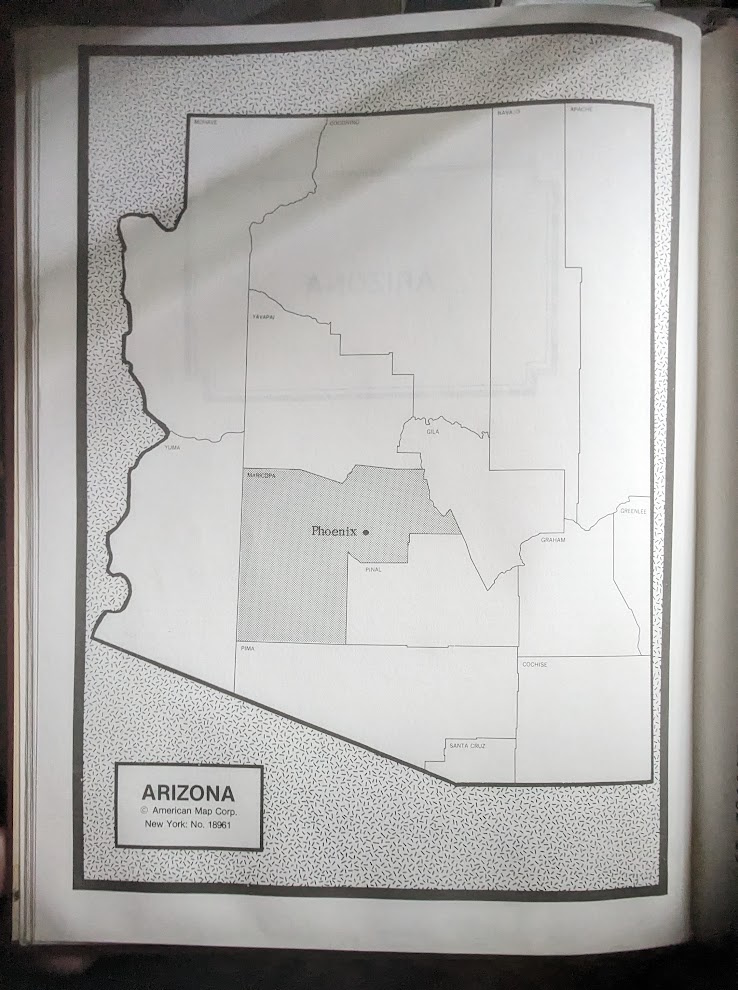
Only one-eighth of Arizona’s soil was suitable for farming. A full three-quarters of its land was either owned or controlled by the government. And statehood was still several years away. Indeed, Luthy writes that “it was not known why the group chose Arizona as their new location.”
Perhaps the draws included the region’s warm climate, irrigation canals, and a ready market in nearby Phoenix.
When Amish first planted roots in the area, the Phoenix of that time would have been largely unrecognizable compared to the sprawling metropolis of today. The city’s population numbered less than 20,000. But that could still make a nice-sized market for produce and other crops.
Whatever spurred the move, Moses C. Amstutz arrived first, in November 1908. He reported in Amish correspondence paper The Sugarcreek Budget that he had rented a house and planned to plant five acres of sugar beets and potatoes. He was working for a neighbor at $40 a month and living rent free.

Soon others followed. By early 1909, more than a dozen families had transplanted themselves, most connected by blood or marriage. They settled along what was then called Route 4, in an area between Phoenix and Glendale, about nine miles northwest of Phoenix along the Santa Fe Railroad.
Making A Living In The Desert
The farming, at least, showed real promise. The warm climate allowed for six or seven cuttings of hay per year. Alfalfa grew so well that one grower told of a stalk reaching 30 inches in length in just two months.
Settlers raised barley, potatoes, sugar beets, cabbage, lettuce, and corn, and the area proved well suited to fruit trees — oranges, peaches, pears, plums, and grapes were all commonly grown. Livestock could graze year round.

The land itself, though, was expensive. At $150 to $200 per acre, it cost far more than comparable land elsewhere — at the same time, Amish settlers in Michigan were paying just $10 an acre. Additionally, farming did not cover all the group’s financial needs. Some worked supplemental jobs, for instance in carpentry, and one man even ran a milk route in Phoenix.
Economic opportunities are often what attract Amish settlers to a new area. And at the same time, economics are often what help lead to a given community’s end, when those opportunities don’t pan out. But for this group, it was not economics that would prove their undoing.
Odd Church Happenings And Disunity
Luthy writes that this group was quite critical of what he terms the “Amish Church”, and which I’d take to mean the Old Order Amish beliefs and ways in general.
In fact, they did not fellowship with any other churches, and did ordinations without other Amish ministry present. Cementing their isolation, they even wrote back to their home community in Reno County, Kansas, condemning the community’s Bishop and the whole church.
The oddities went further. Noah Schrock’s brother John soon claimed to have experienced visions, and “that God was calling him to the ministry”. Those two alone are very odd for an Amish person to claim.
It grew stranger yet. Perhaps in line with his wishes, John Schrock was ordained a minister in early 1910, “by council of the group”. Furthermore, he was “considered by them a prophet.” Not long after, he was ordained a bishop.
No bishop was present for this ordination either, which would also be considered unorthodox, and reflecting the nature of this group as “breakaway”.

As noted, the Arizona group had criticisms for their home community in Kansas. But a critical nature can be infectious. Luthy outlines the outbreak of strife within the group as well:
It was not long before disunity appeared in the group. Noah T. Schrock and three other family heads began doubting the validity of their Amish baptism. They by now were so critical of the Amish Church that they felt their baptism had not been a true Christian baptism.
John T. Schrock and three others did not agree. They felt if John and Noah were to rebaptize each other and then rebaptize the rest of the group, as Noah had suggested, they still would not be any further ahead, since both of them had originally been baptized in the Amish Church.
Further internal disputes followed – with one faction feeling the group should keep the Law of Moses, and a further disagreement over an excommunication performed by John Schrock upon his brother Isaiah, for leaving the group.
They ended up seeking counsel from another breakaway faction in Adams County, Indiana, led by a man named David Schwartz. The group sent nearly two dozen letters in his direction over the next several years, carrying out a correspondence which only seemed to exacerbate matters.
The End Of The Arizona Settlement
In June 1913, Noah T. Schrock and his family left Arizona for good, heading to David Schwartz’s community in Indiana, along with several other families. That move did not work out either.
After years of searching, Noah eventually returned to the Old Order Amish, placed himself in the Bann, was received back into the church, and was eventually allowed to preach again. Luthy writes that:
It is said that after he returned to the Amish Church, he preached very moving sermons on “how the devil can cover people’s eyes after they get so selbstgerecht” (self-righteous)
One of Noah’s sons returned to the Amish as well, while two others went in different directions, one of whom ended up owning a pool room in Indiana, then leaving his wife and eventually returning to Arizona.
By summer of 1913, only a handful of families remained in Arizona. Luthy notes that those who stayed “became more radical as time passed.” This aspect apparently exacerbated their relations with local school authorities:
They felt it was wrong to laugh and told their children not to laugh or play at recess at the public school they attended. They also felt all pictures were wrong and either colored them over or tore them out of their children’s textbooks.
Since the books belonged to the school, the school board got after the parents. The situations deteriorated to the point where the officials were going to take the parents to court and take their children away.
The solution to this conflict with school authorities? John Schrock took the school-age children to Kansas and the other adults sold their property and prepared for a move to Alabama, “where school laws were either non-existent or not enforced.”
Not-So-Sweet Home Alabama
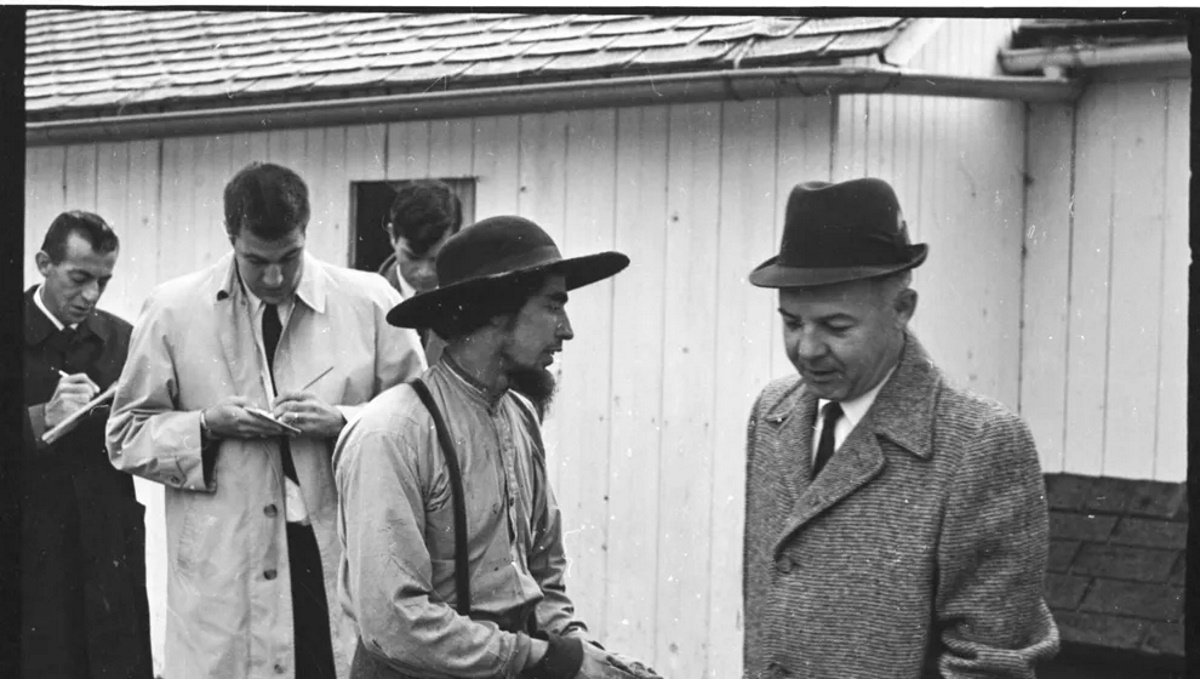
They ended up moving in 1916 to the area of Bay Minette, Alabama, near an existing Amish settlement that itself was in the process of going defunct. Interestingly, they were described by a correspondent in the Budget as “New Amish”.
And reflected in this name used by the correspondent, by the time of their arrival in Alabama – if it wasn’t evident before – it appears they had clearly become something that was not traditional Old Order Amish.
Illustrating that, I’ll quote another segment from Luthy, with several depictions of what you might fairly call a bizarre set of behaviors – at least for any group calling itself “Amish” [emphasis mine]:
A former resident of the Old Order Amish settlement at Bay Minette remembers the Arizona group and writes: “They had no Ordnung (rules), you might say, of clothing. The men wore long hair and had beard and mustache, and the women wore no head covering. And the saying was that they did not believe in washing their clothes, and by all appearance you could believe it.”
Another person remembers that they felt it was all right to work on Sunday: “They didn’t believe in wearing Sunday clothes, just went to church in everyday clothes. Went to church in the forenoon and in the afternoon just worked like any other day.”
A third person comments: “They would load their truck with grain, then go to church with it, and after church they’d take it to the grinder.” This same person remembers that the men greeted the women as well as the men with the holy kiss and that women wore brown, sack-like dresses and no head coverings.
Luthy writes that “the Alabama group never grew large and suffered from disunity,” with many of the children “rebell[ing] against the group’s exclusiveness.”
Over the years, some of the original Arizona group ended up re-joining Old Order Amish churches, while many children of those who ended up in this Alabama faction “drifted into the larger surrounding society.”
Luthy also notes the, shall we say “unsavory” detail, that “children who remained with the group married their first cousins or cousins one generation removed, known among the Amish as ‘Schwartz cousins.’ A check of the Family Record of Tobias Schrock, published in 1950, plainly shows this intermarriage.”
One Of The Strangest Amish Community Stories
After reading this account of the group, I’d have to say that top-to-bottom this is one of the strangest Amish community stories I’ve come across – from their unusual location in the desert West, to church leaders’ behavior while in Arizona, to dealings with the Kansas origin church and the David Schwartz group in Indiana, to what they ended up as in Alabama.
I suppose it goes to show that strong personalities and unorthodox ideas can lead groups of people in strange directions. It’s worth reading the full account if you can get your hands on a copy of Luthy’s book.
I’ll also note that these Arizona Amish did leave behind some remnants, as happens in even shorter-lived Amish settlements. Luthy includes one poignant note about an infant who died, a ten-day-old boy, and was buried in the settlement.
A man named Daniel Beachy recalled in a letter to the Budget, six decades after the Phoenix settlement had ended: “the writer has an infant brother buried in an orchard at that time which is all built over in city now. Only God will know where to find this little infant child.”



Great story
The great diversity of Amish experiences relative to places where they established settlements (that either failed or still exist today) make for great stories. This one is most interesting. I wonder if there is any evidence of an Amish presence from a century ago in the area between Phoenix and Glendale, even though development likely erased everything. If anyone knows anything about what might still be there, let readers know.
maybe some milk left in a jar or anything
Phoenix AZ Amish
I would have loved to have seen Phoenix AZ with its Amish community in 1910, way before I was born. As someone who vacations both in Lancaster PA and in Phoenix, I find this story very interesting.
Glad you liked it and I agree. It would be a fascinating “time machine” moment to see. The photo I found brings it to life. All things considered happy to live in the current era though 🙂
Sunday
Sunday sacredness was never ever ordained by God. He commanded the 7 th day. No reason to change it other than man himself did. “In vain they worship Me. Teaching for doctrine commands of men.” “They will THINK to change times and laws.” There it is in scripture. Nothing else fits but the true sabbath. Saturday.
Phoenix Amish.
Very Very interesting Eric! This history is something most people knew nothing about. You do such a great job. Keep up the good work.
regards Marty R.
Glad you thought so Marty! I enjoyed putting together this post. David Luthy did the real work on it though.
alot of work. thanks 🙂
The Bay Minette, Alabama Connection
My father, John H Miller, was born in Bay Minette, Alabama in 1915. My grandfather, Eli S Miller moved there with his family in 1914. He said it was poor farming country. Once a neighbor commented to Eli, That is one pitiful crop of corn,” to which my grandfather responded, “Oh, I’m just raising the stocks this year, but next year I’ll raise the ears.” My father had the book Amish Settlements That Failed by David Luthy. I also have a letter in my possession from David Luthy concerning my interest in calligraphy. David Luthy could rightly be called Dr. David Lucy. He held a doctorate and was educated at Notre Dame. But he would never tell you that. He later left general society; joining the Amish group in Aylmer Ontario Canada. He remained faithful Amish man until his recent death. He documented much Amish history.