
One Woman’s Journey from English to Amish to Jewish
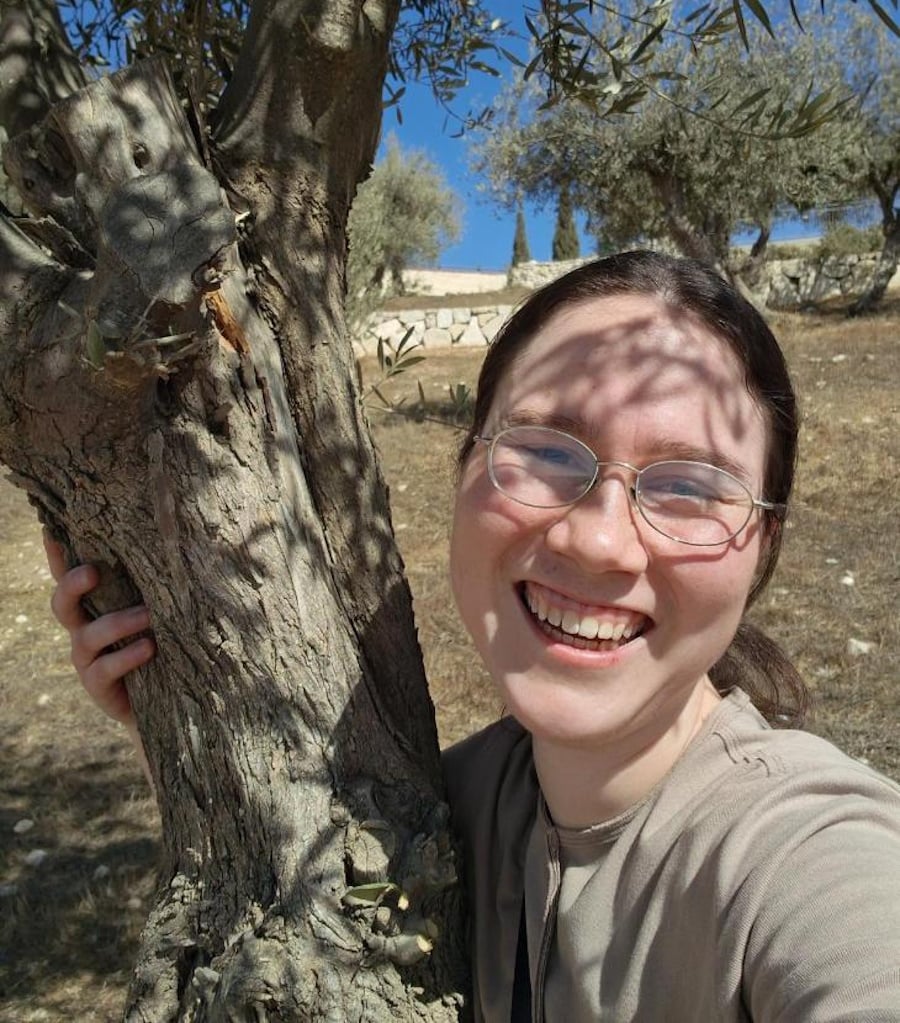
An interesting story appeared recently about a young woman who has made an unusual faith journey: from a non-Amish Christian family, to joining an Amish community, and most recently to Judaism.
Nechama Leapley grew up as Briana Leapley in a non-Amish (aka “English”) Christian home – though in an “Amish-sized” family: she was the oldest of seven children, described as “homeschooled and mostly isolated”.
Her parents are described as “devout Christians, strictly vegan, and wary of technology”, though her particular denomination is not given.
By the sound of it, the family seems to have spent years on a spiritual seeker journey together. On the one hand, as detailed in the story at aish.com, they were attracted to Jewish customs:
Despite having no connection to Judaism, her parents were drawn to Jewish holidays. “When I was seven, my parents started lighting Shabbat candles, having a Passover Seder, lighting Hanukkah candles, building a sukkah, and dressing up on Purim. Of course, they didn’t have the same kind of Passover Seder that an observant Jew does…but something about Jewish holidays spoke to them.”
Later, they felt a pull from the Amish:
When Nechama was 14, her family began spending time with a nearby Amish community. Drawn to its conservative values, simplicity, and family-friendly environment, her parents hoped it would provide a stable community.
They were well aware, however, that they could not keep Jewish customs if they wished to join fully. Wanting stability, the family decided to let go of their Jewish observances, and became Amish when Nechama was 16.
Nechama convinced herself she didn’t care. She wanted friends, a community, and she already disliked technology.
Nechama spent the next five years with the Amish, living a lifestyle many of today’s Amish people would consider austere. The community they joined isn’t given (it was in Kentucky), but it sounds like a pretty conservative one:
Her parents struggled more. Her father, who had worked in a nuclear power plant, suddenly found himself in a world without electricity. Clothing was plain and handmade, and life was labor-intensive.
Their community had no running water or plumbing. Laundry was washed by hand in basins and hung to dry. Water—whether for cooking, cleaning, or irrigating potato fields—had to be hauled manually.
They grew produce to sell, especially sweet potatoes. The entire family worked: planting, watering, harvesting. Inside the home, they preserved food for winter—drying fruit, canning vegetables, and preparing beans. “If you wanted hot water, you heated it on the stove.”
Some of those practices sound like they’re Swartzentruber-level, or maybe even plainer (I suppose it’s also possible this might have been a “para-Amish” group). Eventually, at the age of 21, Nechama decided that life wasn’t for her, and left the community, going to stay with relatives in North Carolina.
Becoming Jewish
As Nechama describes it, she maintained an attraction to Judaism even after joining the Amish community. But the events of October 7, 2023 served as a trigger to reignite her attraction to Judaism:
As she began adjusting to modern life, she still felt directionless—until October 7. After hearing about the war, she began to pray for Israel.
“Suddenly everything came rushing back—how much I love Israel, how much I want to be Jewish. I fell to the ground sobbing. I told myself: Never again. I’m not forgetting this. I’m going to find Jews. I’m going to go to Israel. I’m going to become Jewish.”
Eventually she found her way to Brooklyn, where she became the live-in help for an elderly Orthodox Jewish woman. Once there, she began attending synagogue, dove into the study of the Jewish faith, and eventually converted. As she explains:
“If you become Jewish, it’s because your soul was at Mount Sinai—it’s where you belong. That’s why I chose the name Nechama (comfort). My soul had come home, and I’m more deeply comforted than I’ve ever been in my life.”
It sounds like she has found her place. And if you read the full story, you’ll note her intense enthusiasm and emotion for having found her way to become Jewish.
One odd note
Nechama’s is an interesting story; one strange passage jumped out at me, however. It’s when she describes her experience upon leaving the Amish community for non-Amish society:
The culture shock was overwhelming. “It felt like moving from Earth to Mars. I didn’t know how to make a phone call or how to go into a store and pay for things.”
Everyday conveniences were astonishing. “Seeing a faucet turn on—wow. Getting into a car. Toilet flushing. Light switches. A washing machine—you just push a button!”
In another passage, she describes being mystified by an elevator. But it’s all a bit head-scratching, especially when you consider what’s been presented as her background.
Now, if you’ve read accounts of Amish-raised people leaving their communities for the “outside world”, you’ll know this sort of passage – a person encountering unknown tech for the first time – sounds familiar.
Some of them do effectively have to deal with modern conveniences and technologies for the very first time, leading to the culture shock described above.
But…this is a person who spent her first 16 years in the non-Amish world. So on first read at least, it all sounds like something said to be dramatic.
Perhaps she was in fact “isolated” before – as described in the story – in her family’s pre-Amish life. But, her father was in the navy, and the family is said to have moved frequently. At the start of the story she describes having the “choice between being on a computer or being outside with a book”.
Additionally, on joining the Amish, her father is described as “struggl[ing]”, having gone from working in a nuclear power plant, to “a world without electricity”.
So presumably, she had ridden in a car before, used flush toilets, turned on light switches, used something as basic as a water faucet, etc.
That is, unless the parents had previously silo’ed their children into a very austere low-tech lifestyle…while the father made use of some of the most modern of all technology, to make a living in his career in the navy, and in nuclear power plants.
Not impossible, I suppose…but quite unusual if so. And other details in the story suggest that was not the case.
Do Jewish & Amish culture share a similar attraction?
That odd detail notwithstanding, hopefully she has found her spiritual home. The choice to join an Amish community, after all, was not hers, happening at age 16.
It’s unclear whether she, or her parents, were baptized into an Amish church. But having been there for years and adopting the lifestyle, you’d probably assume the parents, at least, had been. In any case this decision on her faith journey clearly is hers alone.
And when you look at the details provided, it’s not that surprising that she and her family ended up drawn to both religious groups.
The article first describes the family being attracted to the customs of Jewish life and holidays. And as for the Amish, they were “drawn to its conservative values, simplicity, and family-friendly environment.”
From what I read, they’re not talking about questions of religious doctrine and belief here, as much as they are the outward cultural aspects of these faith groups being the things that pulled them in.
So if you’re looking at it more from a cultural perspective, I can see how a person might find aspects of both traditional Jewish, and Amish, life to be attractive. Because, broadly speaking, they share some things in common: Close-knit communities, religious practice rooted in old tradition, plain clothing (in some cases), and so on.
People are drawn to faith groups for different reasons. But those reasons aren’t necessarily what end up keeping them members of those groups. In other words, one’s religious faith and commitment can develop and evolve over time.
The cultural appeal is sometimes just the “hook” by which a person enters into a group. And converts often have a natural excitement and energy for their new faith home.
That initial enthusiasm (the “zeal of the convert”) can fade into disillusionment (as is the case with some converts to the Amish, when they come to understand there are no ideal people or societies), or, can develop into a greater appreciation and understanding of that faith over time.
YouTube Interview with Nechama
Finally, here is a two-hour interview with Nechama provided with the article. Full disclosure, I’ve put this post together mainly based off the above-linked article at aish.com, and have only listened to snippets of this interview, which no doubt adds more to the story.

English-Amish-Jewish
Briana (Nechama) is a lovely young lady, with an interesting story too! I’ve always admired the Amish/Mennonite lifestyle, and more recently the Orthodox Jewish as well. I was raised Catholic (UGHH!!!) at my mothers insistence, only GOD knows why……..These days I’m more the Christian/Adventist believer….at least they keep the Sabbath unlike most churches.
From English To Amish To Jewish
I’m very sorry your experience with Catholicism was so negative, but your comment hurt me to the core. I thank God for having attended Catholic school from grades 4-7. Thanks to the warmth & generosity given to me by the people (lay and religious) at that school, I have a firm foundation in Christ. Please think of others feelings before posting future comments.
Reply
What a story, I wonder if her parents’choice to not use technology had to do with her father being in the navy and then moving to a nuclear power plant. I know a lot of people get paranoid after coming out of the service. Also, I would say that sounds more like “Colonial Days” not even Swartzentruber.
I've long been interested in joining the Amish.
Clearly this woman has shown the capacity for non-Amish to join the Amish. I am personally from the first Anabaptist settlers in the 1600s whom settled in Lancaster Pennsylvania. I’ve long sought to explore my roots by joining the community & am strangely encouraged by this woman’s journey.
Hi James
Just know that it won’t be easy. The Amish don’t exactly “go looking” for coverts. Their days are very long and the work is very hard for the most part. But it CAN be done. There are groups that are a bit more welcoming/accepting of those who are seeking. Best of luck with your search. I hope you find true happiness. Have a blessed day.
Reply
I’m 17, and things have been going well for me—but that’s largely because I’ve been preparing for a long time. I’ve been teaching myself Deitsch and studying this way of life for 5–6 years, so I already had a good sense of what to expect before I ever contacted any Amish communities. They’ve been very accepting. I think becoming culturally aligned beforehand makes a huge difference.
I hope God blesses you on your journey, and I will keep you in my prayers. I also know an English-Amish woman who converted and married an Amish man in Lancaster, so it’s definitely possible to follow this path with the right heart. Just make sure your beliefs and mindset align, because it can really affect your journey if you can’t embrace every aspect. God bless you my brother!
All things are possible through Christ who strengthens me!
Same thoughts
Eric,
Ironically I just read that story on aish.com a few days ago. At Thanksgiving, we were discussing my experience meeting some Hutterites, and a family member began talking about Hassidic Jews. Since I knew little about that group, I began researching and landed on aish.com. I was very surprised to see an article there mentioning a conversion from Amish. I, too, found the story interesting and questioned the same details, particularly the elevator part. I think all the Amish I know would know exactly how to use an elevator, and even more so if they had joined the community later in life. It does seem that the misinformation about Amish is quite widespread. I am grateful for this site and the Amish I know for helping me to understand the nuances of different cultural and/or religious groups. It has made me even more wary of making assumptions or generalizations.
I do wish Nechama the best and I appreciate that she spoke respectfully of her childhood, her parents, and the Amish, even as she choose to move on to a different future for herself.
Shifting along linked faiths is common amongst people brought up in Messianic Jewish households