
Amish In This Community Are 3 Times More Likely To Have Diabetes
Specifically, type 1 diabetes, which most commonly shows up with children and younger people.
And as noted we’re talking about one community, albeit quite a significant one – the third-largest in the country, in Northern Indiana (Elkhart & LaGrange County). Here’s more from WSBT:
MIDDLEBURY, Ind. (WSBT) — Researchers in Middlebury are finding hope in the work to cure diabetes.
New studies suggest the Amish community is not only especially vulnerable to the disease, but they could also be a key piece to the puzzle.
Simply put, there are more at-risk people to study.
The Amish have genetic ties to Germanic and Swiss ancestors who, according to the specialist I spoke with, are more likely to get the disease.
How much more likely? Again that would surely vary at least somewhat by community, since Amish people in different places have different genetic backgrounds, for one.
But looking at the settlement at hand, the differences are significant:
Secondly, in the general population, 1 in 300 people have type 1 diabetes, but in Amish communities between St. Joseph County and LaGrange County, that number jumps to 1 in every 100.
The idea that diabetes shows up more frequently here is the sort of thing that puts the lie to some false beliefs and generalizations about the Amish and health.
What about other Amish?
But it would be interesting to see how other communities compare – for example other large communities which have somewhat or significantly different origins.
For instance, the nearby large Swiss Amish settlements in Adams and Allen Counties of Indiana, or the Amish in Lancaster County.
And we do in fact have a large diabetes study of Amish in another comparable large settlement – the Lancaster County community.
Interestingly, this study found in its conclusion (emphasis added) that “There is substantially lower prevalence of diabetes, hypertension and hypercholesterolemia in the Amish compared with non-Amish Caucasians in the USA”.

However two things to note. One is that I wish that sentence included the words “Lancaster County”, as in, “There is substantially lower prevalence of diabetes…in the Lancaster County Amish…”, for reasons I’ve covered above.
I’m sure that’s what they meant as that is obviously the study group of their research, but it would end up a cleaner sentence.
Two, it’s unclear at least to me after looking over it, if this looked at different types of diabetes or diabetes in general. It seems to me the latter, which would include type 2 (“adult onset”) diabetes. The article at NIH is also tagged with “adult diabetes”.
Nevertheless, this is a good example of why it’s good to be careful with blanket claims about “the Amish” and health.
Helping the Amish
Knowing that someone has diabetes can help identify others at risk, as in relatives.
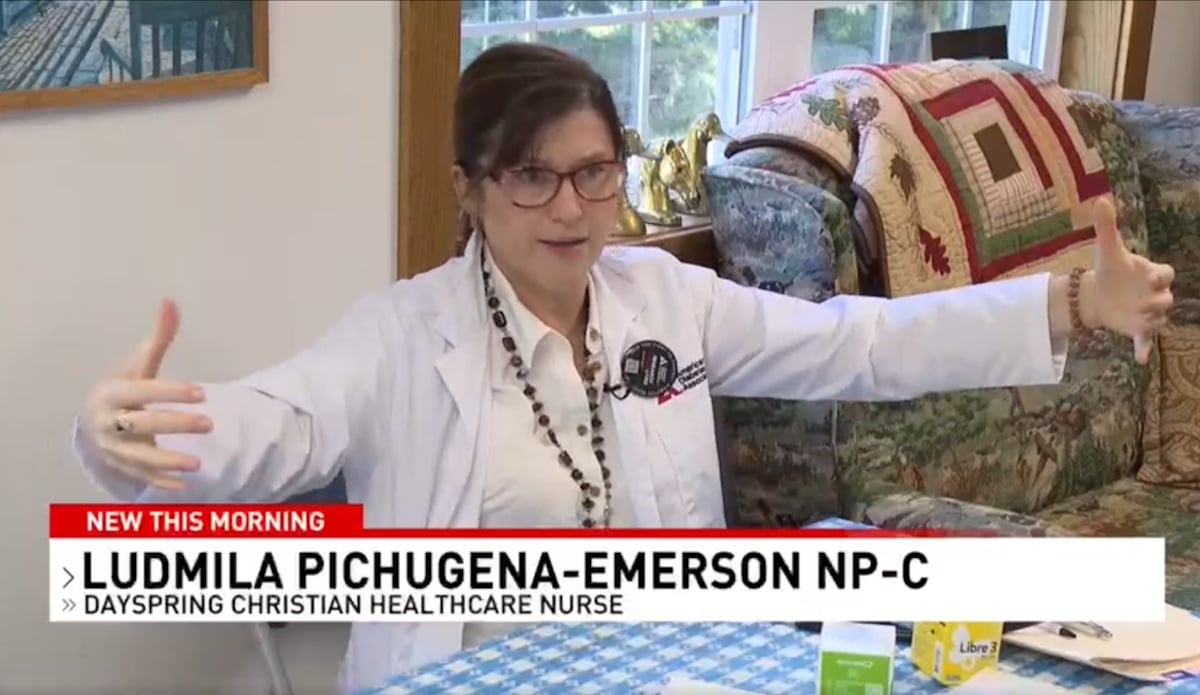
And an endocrinologist named Ludmila Pichugena-Emerson, and others, are trying to do just that in the case of the Amish, proactively:
In the past two years, Emerson and Dr. Dan Kragt at Dayspring Christian Healthcare have worked with Amish patients to fund insulin machines, support groups and treatment at little to no cost.
“But the next step for me is to find the relatives who are absolutely healthy and don’t need insulin yet, before the attack of antibodies happen,” said Ludmila Pichugena-Emerson.
She’s had some success already:
In fact, she has already found several who fit that description.
Most recently, Emerson gave an eight-year-old girl a shot of the only FDA-approved monoclonal antibody, a shot that can delay the onset of Type 1 diabetes.
The young girl is one of the few pediatric patients in the state to receive the shot at home.
“We screened her and, lo and behold, she had antibodies for type 1, but she don’t need insulin yet. She was in stage 2 of type 1 diabetes. 100% chance she would go to stage, 100%,” said Emerson.
Great news that they can use this knowledge to try to help people before they get to insulin stage.
Also on a positive note, the report suggests that the Amish population in question could end up being “key” to helping cure the disease.
There is at least one simple reason for that: there are “more at-risk people to study”. And of course the special genetic characteristics of Amish populations would also come into play here.


Interesting
But, it sounds like the studies could be confusing. Also, have any studies on the high rate of diabetes among native Americans come to any helpful conclusions?
Too little a Sample?
I don’t know anything about the communities where this study has been conducted. Or the general cause of Type 1 diabetes , but I’m wondering if lifestyle is taken into consideration. Does the type work , farm v “english”, jobs factor into diabetes? What do they do in the communities where these studies had taken place and does it matter.
Amish and Diabetes
Do you reckon it has anything to do with their diet??
The Amish are human too
As a taxi driver to the Amish, I’ve gotten to know them intimately. I’ve stayed in their homes and eaten with them hundreds of times. In most cases, their diets are full of rich, starchy, sugary foods – so it’s no surprise to me they struggle with diabetes.