Old Colony Mennonites
Stephen Scott on the Old Colony Mennonites:
People known as Old Colony Mennonites occupy large tracts in the state of Chihuahua near Cuatemoc and Casas Grandes and in Durango.
These German-speaking people emigrated from Manitoba and Saskatchewan in western Canada in the 1920s. They came to North America in the 1870s from Russia. The name, “Old Colony,” derives from their origin at Chortitza, the oldest Mennonite settlement in Russia. The Russian settlers were originally from Prussia and the Prussian Mennonites can be traced to Holland.

So, the Old Colony group represents the Old Order element of Dutch Mennonitism, a separate branch from the Swiss Mennonites from which the Amish and Old Order Mennonites descend. The Old Colony Mennonites emerged as a distinct group in the 1880s in Manitoba.
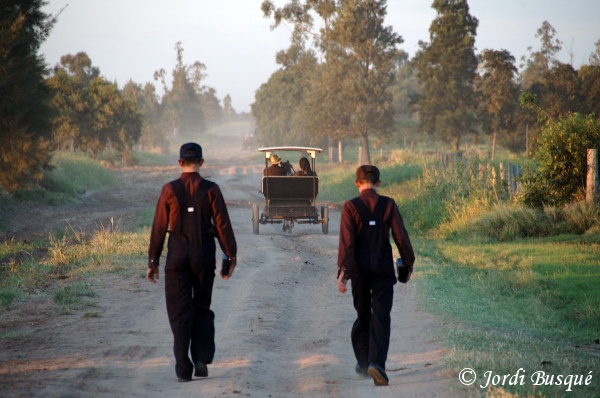
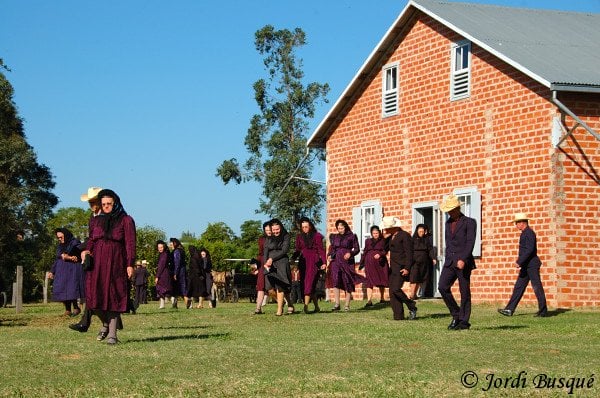
All photos were taken by Jordi Busque. The first three are from the Riva Palacios Colony in Bolivia. Starting in the 1950’s, large groups of Mennonites left the Mexican settlements and established communities in Bolivia, Belize, and Paraguay. Scott says that “this last emigration represents the ultra-conservative element among the Old Colonies”.
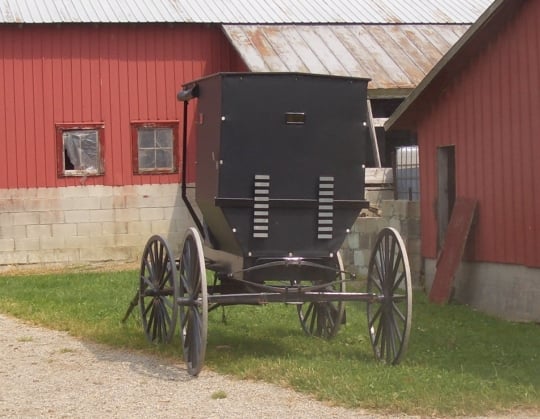
Scott explains that Old Colony Mennonites took advantage of discarded automobiles, stripping them down until only the chassis remained, and then converting them to two horse wagons known as “Karrenwagen” (auto-wagons).

I found these photos interesting because you can see the type of transportation used in this settlement. The vehicles seen in the first three shots look smaller than the ones Scott presents in his book, with more of a converted-golf cart appearance.
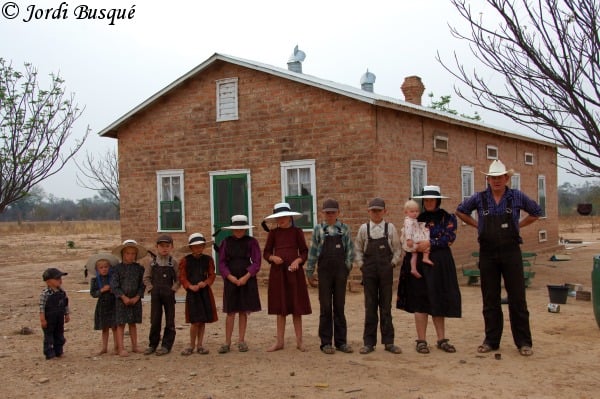
This family, parents and ten children, resides in Durango in Mexico.

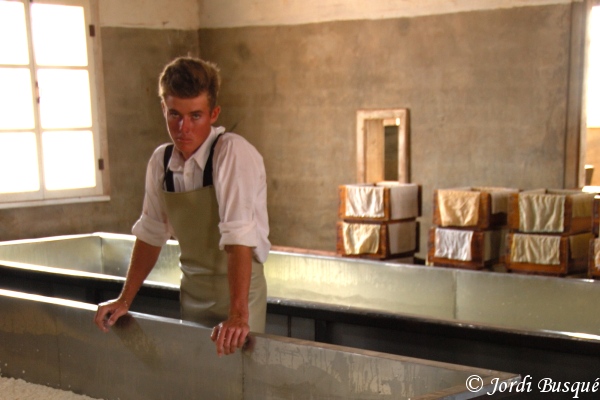
Cheesemaking is an important occupation in some communities. Pinondi Colony.
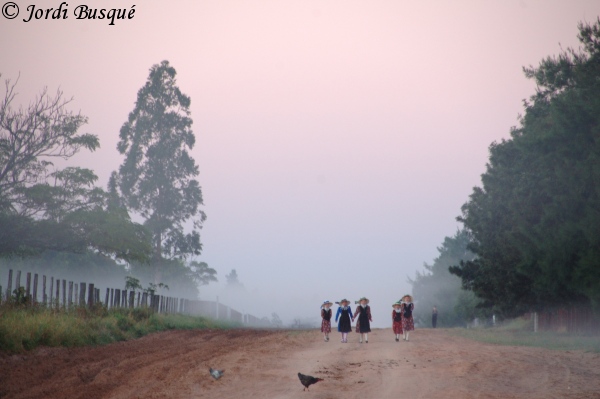
Children on their way to school, Swift Current Colony in Chihuahua.
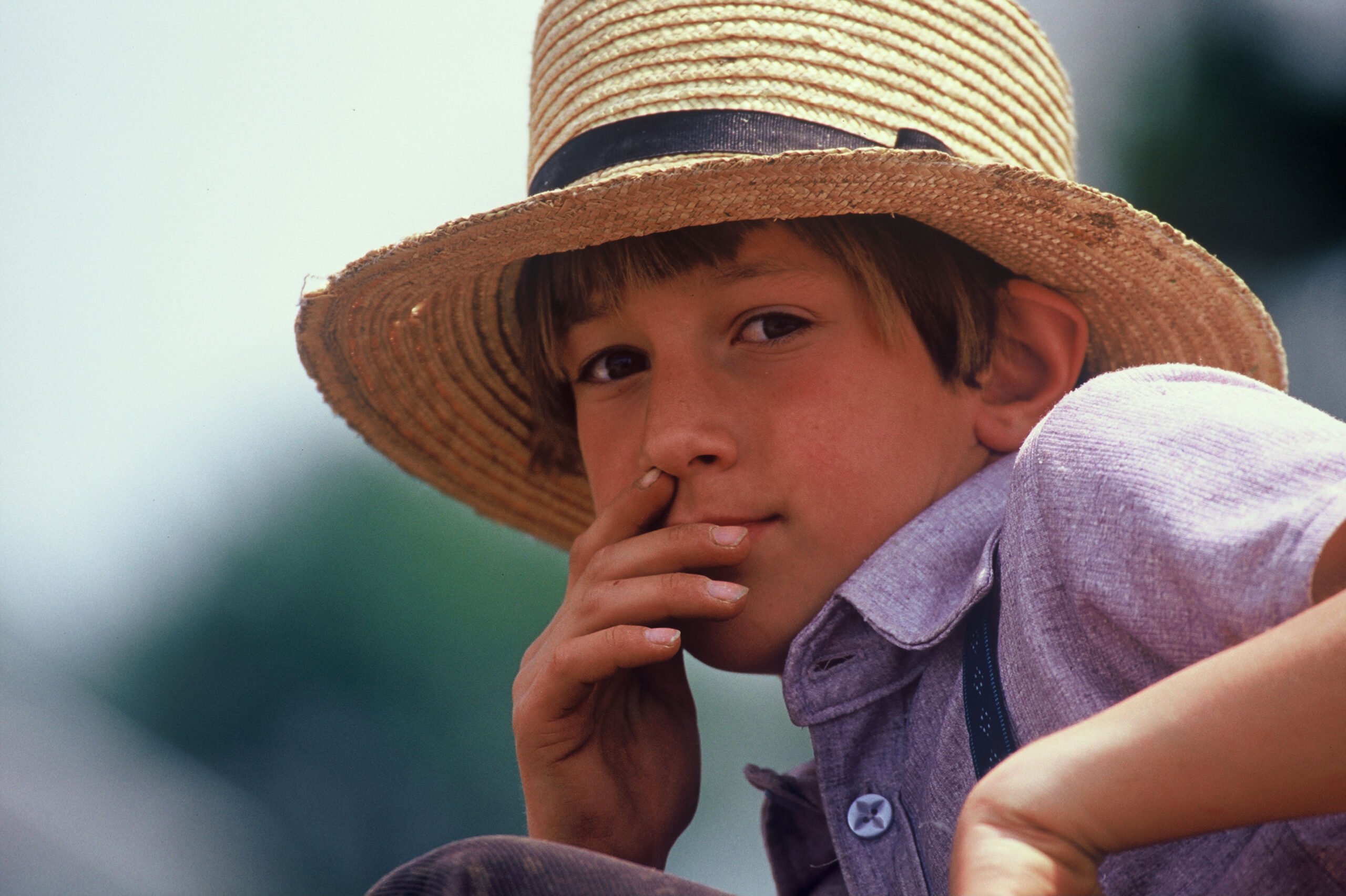
More of Jordi Busque’s Old Colony Mennonite photography.
Text source: Plain Buggies: Amish, Mennonite, and Brethren Horse-Drawn Transportation by Stephen Scott.
Fantastic pictures, interesting communities.
That was very interesting! Thank you for sharing this.
We have a lot of “Mexican Mennonites” in SW Ontario now. They still maintain close ties with their families in Mexico.
Some of family, including my daughter live in Coahuila MX. The Old Colony Mennonites sell their home made cheese on the streets and roadsides in that area too. I find the local Old Colony people in Ontario to be in great transition and there seem to be a number of social issues in the group.
Mennonite Windmills near Monclova?
Hi, my father used to live in Mexico and knew of some Mennonites just north of Monclova that manufactured windmills. He has lost the card that he had with their contact info and we were interested in purchasing a windmill from them. If Ruth or anyone else has contact info that might help us, we would really appreciate it. Thanks!
I’ve never heard of the Old Colony Mennonites till now! How neat!
Thank you for allowing me to learn something new about Anabaptism today!
Hope you have a good Memorial Day weekend!
Dawn
What I want to know is, do they speak German with a Spanish accent?
It was fun learning how others see my heritage
I would love to get in contact with Mennonites – can anyone help? Please write to me: glueckskindline#aol.com (please exchange the # with @ to minimize spam)Thanks!
i would like to get in contact with Mennonites my in Texas and Mexico my email is mchljanuary@yahoo.com
My grandmother is a mennonite from Durango. My father has told me that his father was a tarahumara Indian. My father left home when he was young and never returned home. I was trying to see if anyone can shed light as to how I could get a hold of my grandmother. My father’s name is Ramon Muela Enriquez. If anyone has any ideas please contact Gustavo at gusen93@yahoo.com. thanks.
I am a old colony mexican mennonite. I live in ontario canada. We are peacefull people who are raised with rules and tradition.
Old Colony Traditions
I was born into the Old Colony Traditions. I found out later that we can not be saved and go to heaven by keeping traditions. I came to the point that I realized I was a sinner and lost without Christ. Ephesians 2:8 and 9 says “For by grace are ye saved through faith; and that not of yourselves: it is the gift of God, not of works (or tradition) lest any man should boast”. I have placed my faith in the Lord Jesus Christ for salvation FULL AND FREE. I thank God for what Jesus Christ has done for me at calvary.
Did Russian Mennonites settle in the Monclova, Abasolo region of Coahuila in the 1800’s? Where can I read up on it? Although I always thought I was 100% Mexican, since my parents were born in Abasolo and San Buenaventura Coahuila, my autosmal DNA is showing substantial Russian DNA??
Great informative report and thanks for it. I’m from San Buenaventura, Coahuila and even though, I’m from 100% Basque descent, I like to read stories of other European ethnic groups in the Americas. Eskerrik asko.
Glad you found it worthwhile Albert!
Jaime, I am not an expert on the OCM, but as I know the first Old Colony Mennonites came to Mexico from Canada in the 1920s, and settled in Chihuahua and Durango. They would have come to Canada from Russia previous to that.
Fellow genealogy buffs,
I am trying to find it on the web right now, but I found a short blurb, that the first Russians into Monclova/Abasolo Couhuila was in the early 1800’s when Czar Alexander 111 began persecution of a particular Russian population. Maybe somebody out there can help???
I found Czar Alexander 111 in wiki pedia. He had an immense dislike for Russian Jews and in 1880 many Russian Jews began to flee. Maybe some fled to Coahuila? I have read that Monclova was a Haven of the forbidden people in the late 1500’s!!
The “Russian” Mennonites as pointed out above are not Russian at all but were part of a huge number of German people who were invited to settle in Russia by Catherine the Great. When she came to hold the lands in South Russia of Ukraine and Crimea, she invited Germans to come and farm it. Many who were persecuted for their religious faith went there, some Mennonites and Amish headed east into Russian lands at the time others were making the trip to Pennsylvania. All of the world’s Hutterites went to Russia and a large number of Reformed and Lutherans as well. Even a few German Catholics. Catherine offered them freedom from taxes for an extended period, 180 acres of land, and the freedom to run their own “dorfs” or villages where they could practice their own religion and teach German in their schools. They were also exempted from the military. This was an attractive position to many Germans. Our ancestors stayed in Russia until the law changed in the late 1800’s and the military exemption law was revoked as well as the German school law. They were going to “Russianize” the Germans.
Thousands of Germans left to come to North America. Many of them the Low German Mennonites. The Old Colony people are part of the Low German people and they speak Low German as their language in their homes. There are many Low German Mennonites though not of the Old Colony faith, in Kansas, Nebraska, the Dakotas and the Prairie provinces of Canada. Many are members of the liberal General Conference, or some smaller groups like the Mennonite Brethren, the Evangelical Mennonite Brethren or the more conservative Church of God in Christ (Mennonite) a.k.a. Holderman Mennonites. There are also many who are members of the conservative Kleine Gemeinde.
Low german
I’m so excited to learn more about my heritage.
My mothers family were originally Mennonites. I remember her telling me they started in Prussia and went to Russia after being persecuted in Germany. They left to settle in Minnesota, USA. From there they went to Saskatchewan, Ca to homestead. When my grandmother died at 41 the family kind of broke up and are now located throughout Canada. My aunt Dorothy met a soldier from NY, married him and relocated to NY. My grandfather couldn’t handle my mother so he packed her off at 13, to my aunt who reared her.
I remember them talking in “low german” when they didn’t want us to know wjat they were saying. I also remember my brother taking german in HS thinking our mother could help him. She said she couldn’t because the book german was different from her dialect.
This is all so new & exciting to me.
Thank you for your in put.
Sincerely, Candace Crupi
Matz
Would anyone know what the reason is why Old Colony Mennonits woman wear the “matz” (the things that the woman are wearing on the picture were they are coming out of church)
Clarification on previous post
Per the book, Jews in Mexico, Part 1, by Shep Lenchek, he states,”In late 1882 after the assassination of Russian Tsar, Alexander 11(Second), that significant numbers of practicing Jews entered the country (Mexico). The Jews who escaped from Russia to Mexico are the ancestors of possibly half of the present Jewish population.” I am thinking that many of these Russian/German Jews may have settled in Monclova Coahuila. Speculation on my part, but if anybody could refer me to a source, it would be appreciated!
I am an Old Colony Mennonite
I spent my childhood in Durango Mexico. I now live in Ontario Canada.
Yes the Old Colony Mennonites have evolved allot here in Canada. But part of me does miss how easy and simple life was in Mexico.
it may seem to some a sheltered life but to us its like a dream. the world seem so big and open. your imaginations run wild with excitement. we had few toys to play with but the world was our playground. School was always fun and so spiritual full of song and laughter.
When there were moment of sorrow or fear they were always replaced with reassurance of faith and love.
We had to work hard for a living but it was all our own. our farms, our animals, our fields and our Harvest. that in itself was all the reward we needed. we didn’t have allot of money. But we did well with what we had.
i have often though of writing a book or memoir of how life as an Old Colony Mennonite is. for all those who want to know more or are curious. but must say my grammar need work before that happens.
i am glad there are people who want to know more about us and not judge us based on what society considers “normal”.
Glad you took time to share Helen. I bet you’ve seen some changes. I think your group is very little-known, in the States at least. It’s my understanding that Canadian Old Colony Mennonites use motor vehicles and typically higher technology than generally in South America (ie Bolivia)? As you probably know the Amish and Old Colony Mennonites have had some exchanges in recent years.
old colony mennonites
Love hearing about the Amish and Mennonite communities and there background glad to see this and also to hear from people from that heritage comment to see the real side would love to read more things from Helen my grammar is bad also dont let that stop you. A joy to read and very interesting. Thanks
book
i first of all enjoyed reading this site. very interesting. about 4 years ago, i got interested in the giesbrecht side of our family and started researching. this led to me writing a historical novel that i self published and sold about 100 and have now rewrote it and am looking for a publisher. it was a wonderful journey, speaking with others , reading their backgrounds and checking history. i did find out that my family was from the old colony mennonites. anyhow i just wanted to encourage you to write your story, just start writing as you see it, later when you have written it ask someone to help, but just get started. if you have pictures, all the better. that is something that i wish i had a lot more of, but our family did not take a lot of pictures.
Helen, find a good editor.
Hello, Helen!
Don’t let weakness in language usage keep you from writing. Writing is a good way to develop your linguistic proficiencies. A good “word program” and a competent but patient editor can clean up grammatical problems, and help you to improve your writing skills in the process.
I recommend keeping a notebook which records your thoughts and observations on the Old Colony. Over a period of time, this would provide grist for your writing “mill”. Also, read what others are writing.
Be patient with yourself as a researcher and writer! I just had a research paper accepted for publication in a Quaker scholarly journal. I have worked on this paper for 15 years, and have read versions of it at three professional meetings. IMHO, the paper has a lot to offer, but it took many years to get it ready for publication. Give your work time to develop.
Helen, I hope you kept that dream alive to write your book. Reading just this short piece of your writing here, I found it very beautifully. It is descriptive, full bodied, has a nice flow to it, and a wonderful rhythm.
You are a natural born writer. You will make a success of it, so please do write.
Very interesting Erik! I love learning more and more from your website. Keep it up!
Please write something about the Amish in Colorado! Still waiting on this. I do know they have two groups. One in southern CO and one in N. CO. But that is about all I have been able to find out.
Not what they do for business, etc.
I would be interested in reading the book if Helen ever does write one. Just find someone to help you write it Helen, and you won’t need to worry about your grammer. : )
No need to wait
Thanks Lee Ann, here you go:
https://amishamerica.com/colorado-amish/
Also:
https://amishamerica.com/colorado-amish-communities/
https://amishamerica.com/colorado-amish-settlement/
https://amishamerica.com/amish-moving-colorado/
https://amishamerica.com/colorado-amish-history/
interesting
This is nice to see – a bit of ‘social studies’ with a pleasant , positive spin! I have Amish and Conservative Mennonite background. I don’t consider myself Mennonite anymore but I treasure some aspects of that heritage.
Plautdietsch
Mennonite Low German is called “Plautdietsch.” Plautdietsch is spoken by the Russian Mennonites, Kleine Gemeinde, and Old Colony Mennonites, in Bolivia, Paraguay, Belize, Mexico, Canada, and Kansas. Is it spoken anywhere else? It seems there are two language codes for Plautdietsch. The ISO 639-2 language code for Low German (Low Saxon) has been nds (NeDerSaksisch) since May 2000. The other three-letter language code for Plautdietsch is ISO 639-3: pdt. Why would there be two codes, nds and pdt? Does Pennsylvania German have a code, too?
http://www.mennolink.org/doc/lg/. A Mennonite Low German dictionary, “Kjenn Jie Noch Plautdietsch?”, by Rempel, can be used online to find a word in Plautdietsch to English, or from English to Plautdietsch.
http://www.biblegateway.com/ has the Low German Reimer 2001 version of the Bible online in Plautdietsch (NDS), both in print and in audio. This is John 3:16:
Jehaun 3:16, Reimer 2001 (REIMER), “Dan Gott haft dise Welt so Leef jehaut, daut hee sien eentsje Saen jeef, daut aula, dee aun am jleewe, nich feloare gone, oba daut eewje Laewe habe.”
http://www.biblegateway.com/resources/audio/?source=9&aid=33 has the Plautdietsch Bible in audio!
http://en.wikipedia.org/wiki/Plautdietsch_language, says that a film, Stellet Lijcht (Silent Light), was set in a Mennonite community in Chihuahua, Mexico, in 2007. Most of the film’s dialogue is in Plautdietsch. Wikipedia also gives a text sample of The Lord’s Prayer in Plautdietsch.
This information will also be posted at https://amishamerica.com/what-language-do-the-amish-speak/
My dad is from Durango and anytime he visits I always as for this cheese. It is amazing! just had it last week! 🙂
Thank you all for the support! I’m thinking I’ll start a blog! Don’t think it will be mind blowing but it will give others an inside look of what my life has been like growing up old colony! Once I do start it I will post the blog site add. Thank you again. ☺